Saturday, June 04, 2011

Saturday at the Archives: Museum of Modern Marvels
Museum of Modern Marvels
By Jeffrey Pepper
Originally published May 29, 2008

The future frequently envisioned in the 1930s was a bright and shining place, filled with tall skyscrapers and mechanical automatons that took even the most common laborious tasks and functions out of the hands of the common citizens. It was a great big beautiful tomorrow as presented in films such as Metropolis and Things to Come and a popular culture phenomenon that ultimately culminated at decade's end in the World of Tomorrow presented at the 1939-1940 New York World's Fair.

Donald Duck experienced that particular vision of the future for a brief time in 1937 when he visited the Museum of Modern Marvels in the cartoon Modern Inventions. It was released on May 29th of that year.

The Museum, like much of era's pop culture futurism, what not so much a showcase of emerging technologies but a series of robotic appendage-based contraptions designed to perform the mundane rather than the magnificent. Hydraulic potato peelers, pneumatic pencil sharpeners and robot nurse maids were among the exhibits within the halls of the museum's sleek, streamline moderne architecture. No doubt many members of the cartoon's audience, as they were then emerging out of the throes of the Great Depression, could dream of owning a robot butler, despite Donald's own exasperation with the one that haunted his steps as he toured the museum.

A standard archetype of these earlier era future visions and also present in Modern Inventions is the robotic barber chair. Donald comically gets his tail trimmed and head polished by the friendly automation. Disney would in fact revisit that concept and the whole of 1930s futurism some forty years later in a set piece of the Horizons attraction at EPCOT Center.

Fleischer Studios, home of Popeye and Betty Boop, would also explore similar themes in 1938 with the short All's Fair at the Fair, a cartoon that anticipated the upcoming New York World's Fair. It as well featured an automated robot-based shave and a haircut sequence.

Friday, June 03, 2011

What a Character! - The Mountain Lion

The twilight of animation's golden age is littered with potential cartoon stars that sadly faded with their medium.  Numerous new characters were born out of the 1950s-era Disney shorts, but most were simply not granted enough time to establish themselves.  One such case study involves a character who, despite starring in five different cartoon shorts, did not even earn a name for himself--literally.  In historical texts, he is simply the "the Mountain Lion," although he has unofficially been identified by some scholars as Louie.  For practical reasons, we will apply that monicker for the purposes of our discussion here.

Louie was introduced in the 1950 Donald Duck cartoon Lion Around.  He is an undomesticated creature, an inarticulate denizen of the forest, but certainly not in the benign and harmless fashion of Humphrey Bear, who was also a product of the same time period.  In Lion Around, the nephews attempt to fool Donald with a mountain lion disguise, which of course leads inevitably to an encounter with the real McCoy.  In Hook, Lion and Sinker, Louie gains more of a  comical edge and a personality bordering on buffoonery.  He and his young cub attempt to steal fresh fish from Donald, and their antics bring to mind Disney's coyote characters, Bent-Tail and Bent-Tail, Junior.

The Mountain Lion's finest moments would however be achieved with a different co-star.  He shared the screen with Goofy in both with 1950's Lion Down and its 1952 followup, Father's Lion.  Lion Down brings the lion to the city where he has to deal with a blissfully ignorant Goofy.  In Father's Lion, a true Goof classic, Louie again falls victim to Goofy's exaggerated and wholly unintentional bravado, and Goofy Junior's always dead-on aim with his pop gun.

Louie's final appearance was in the Cinemascope cartoon Grand Canyonscope, where he reunites with Donald Duck and encounters J. Audubon Woodlore, who has been displaced from his usual patrols at Brownstone National Park.  It is a widescreen tour de force of sight gags and pratfall comedy, of which Louie is a prominent player.

Disney historian John Grant described the Mountain Lion as, "a rather anonymous character," and noted that, "this indeed was his strength, for it was as a mysterious lurking presence that he had his greatest effect."  And it was through such anonymity that he has at least happily gained some degree of historical notoriety.

Tuesday, May 31, 2011

Freeze Frame! - Haunted Muses


In a very quick bit of theme park to motion picture synergy, an element of the Haunted Mansion is referenced in Disney's 1997 animated feature Hercules.  During the musical number I Won't Say (I'm in Love), the Muses take the forms of various sculptures as they provide background vocals for Meg's performance.  At one point in the song, they are featured as a set of marble busts that bear an uncanny resemblance to a similar and rather famous set piece from the Haunted Mansion's cemetery.

Monday, May 30, 2011

Service With Character: Memorial Day Edition

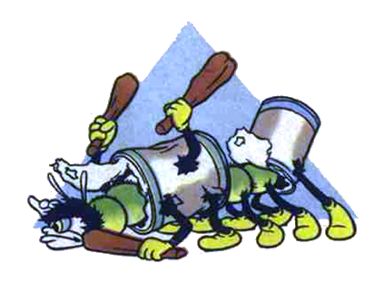
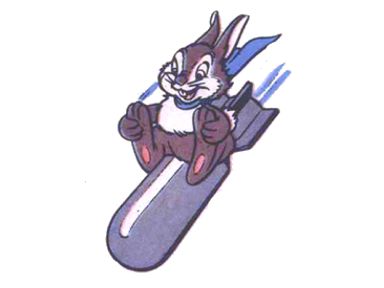
In honor of the Memorial Day holiday, we are presenting a special edition of our very popular 2719 Hyperion Exhibition Hall series Service with Character: Disney World War II Insignia.  Today we feature twelve emblems collected from 1944 issues of Walt Disney's Comics and Stories.

32nd Sqd. Air Training Corps

494th Base Headquarters and Air Base Squadron

Co C 714th Tank Btn. 12th Armored Div.


799th Bombardment Squadron

881st Field Artillery Battalion

Army Nurse Corp

 Bombing Squadron 102


 Hq. Sq. 41 MBDAG-41


 Ships Repair AD-40


 U.S.S. Piedmont


 U.S.S. Sapelo


U.S.S. YMS 329


Explore the 2719 Hyperion Exhibition Hall:
Service With Character: Whimsical Thought and Serious Intent

Saturday, May 28, 2011

 Saturday at the Archives: Disney's Hollywood-The Pan-Pacific Auditorium
Disney's Hollywood: The Pan-Pacific Auditorium
By Jeffrey Pepper
Originally published February 20, 2008

I must admit I have a very strong sentimental attachment to the moniker Disney-MGM Studios. But I'm really warming up quickly to its new Hollywood identification.

Let's face it, there is a lot more Hollywood than MGM in the Disney Studios at Walt Disney World. Much of the theming of the resorts third gate is embodied in idealized architecture that is rooted in the southern California environment from which Disney entertainment emerged. When Walt Disney created a letterhead in 1923 that listed his uncle Robert Disney's Hollywood address at 4406 Kingswell Avenue, it was the genesis of a geographical dynamic that would inspire the elaborate design of a central Florida theme park nearly sixty-five years later.

As part of a new ongoing series here at 2719 Hyperion, we are going to show you the true Hollywood behind Disney's Hollywood Studios. And we are going to begin this parkeological expedition at the recently rechristened front entrance to the park.

The entrance area to Disney's Hollywood Studios and the architecture surrounding the ticket kiosks were inspired by the Pan-Pacific Auditorium, an arena-entertainment venue that served the Los Angeles area for close to forty years. The Studio's entrance facade recreates that building's own front entrance and its distinctive four towers. The towers reflected a sleek, aircraft-inspired look, and each was crowned with a high-reaching flagpole and corresponding flag or pennant. It opened on May 18, 1935 and was the first major commission for architecture partners Walter Wurdeman, Charles F. Plummer and Welton Becket. Three decades later, Becket would partner with United States Steel and Disney in creating the design for the Contemporary Resort at Walt Disney World.

The Pan-Pacific was one of the more famous examples of Steamline Moderne design, an extension of Art Deco that became prominent during the mid-1930s. The style proved especially popular for much of the architecture created for the 1939-1940 New York World's Fair. The style's influence could be seen in the art direction of films such as Lost Horizon and The Wizard of Oz, and also in the designs of consumers products including appliances, automobiles and trailers.

Up until the opening of the Los Angeles Convention Center in 1972, the Pan-Pacific Auditorium was the primary indoor venue for the city and its surrounding population. The interior itself encompassed 100,000 square feet and could seat close to 6,000 individuals. It played host to trade and consumer shows, circuses, concerts, ice shows and political functions, and was also a home for sporting events including basketball, hockey, tennis and wrestling. Dwight D. Eisenhower, Richard Nixon and Elvis Presley were among the many notable figures that appeared there.

Following its closing in 1972, the building sat vacant and neglected. It gained a temporary degree of notoriety in 1980 when it was featured in the film Xanadu, but quickly faded again from public notice shortly thereafter. Its deterioration continued nearly unchecked for almost another decade. Then on May 25, 1989, just three weeks after the debut of Disney-MGM Studios and its Pan-Pacific-inspired entrance, the once famous southern California landmark was destroyed in a spectacular fire. The location has since become the Pan-Pacific Park, administered by the Los Angeles Department of Recreation and Parks. The architecture of the facilities recreation center recreates in part the auditorium's entrance design, albeit on a much smaller scale.

 The Pan-Pacific Auditorium entrance design will be recreated again in the near future at Disney's California Adventure. The look of its front entrance area will soon emulate that of Disney's Hollywood Studios, in a re-imagining that is intended to evoke the setting of southern California in the 1920s and 1930s.

Thursday, May 26, 2011

Vintage Headlines: Disneyland Summer Reading


Here's a fun slice of 1950s pop culture with a Disney spin.

Kids have been nagged about summer reading for decades; in 1956, the librarians of Kern County, California came  up with a clever twist to encourage their young patrons to crack open the books--a Disneyland-themed summer reading program.  The details were provided in this newspaper article from June 14th of that year:
Disneyland has been chosen as the theme for Kern County Free Library summer reading clubs according to Miss Irene Branham, supervisor of work with children.  All elementary school children in the county are eligible to participate in the summer reading program. Registration for the clubs will take place in county branches during June. Children interested in joining a club are urged to sign up now.

By way of books, children joining the Disneyland clubs will visit Disneyland's Adventureland, Tomorrowland, Fantasyland and Frontierland. Each child will have a Disneyland map and booklet in which to record his make-believe visits to each land. Reading certificates will be presented to children reaching the goal of 10 books read during the summer.  Disneyland maps and posters donated to the library by Disneyland Inc. will decorate the 35 county branches sponsoring summer reading clubs. Miss Branham emphasizes that this is a pleasure reading program with the double objective of  encouraging leisure time reading and providing the librarian with an opportunity to give reading guidance to young patrons.  The library's vacation loan, allowing children to borrow eight books for a period of six weeks, will enable children to continue reading for the club during the family vacation.  Children and their parents may get further information about the summer reading program by visiting any branch of the Kern County Free Library.

Wednesday, May 25, 2011

Vintage Snapshot! - Caballeros in Revue


Decades before they appropriated the River of Time at EPCOT, Donald, Jose and Panchito first performed at Walt Disney World in the rather short-lived Fantasyland attraction, The Mickey Mouse Revue.  The audio-animatronic trio performed their namesake song as part of the production.  After a nine-year tenure in Florida, the show was exported to Tokyo Disneyland where it enjoyed a much longer lifespan, closing just recently in 2009.

Tuesday, May 24, 2011

Pixar Freeze Frame! - The Finn McMissile Poster


Finn McMissile, a British spy, plays a major role in the upcoming Pixar feature Cars 2.  But the stealthy character managed to sneak his way into Toy Story 3 last summer.  Finn is featured in a poster on the wall of Andy's room, reflecting Andy's more grownup interests and sensibilities.  Finn's design was inspired in part by James Bond's classic 1964 Aston Martin. 

Monday, May 23, 2011

In Search of River Country Souvenirs

River Country has long faded from the Walt Disney World landscape.  Now close to a decade removed from the resort, the old fashioned swimmin' hole has been largely forgotten in the wake of its newer water park siblings Typhoon Lagoon and Blizzard Beach.  It also sadly suffers in regard to having produced very little in the way of lasting souvenirs or memorabilia.  In the few years that I actively visited the park in the late 1980s, very little was offered in the way of branded merchandise beyond t-shirts, beach towels and postcards.  The park never had a formal merchandise shop; cast-members typically manned a small souvenir cart just past the entrance.

My own personal River Country souvenir collection is rather pitiful to say the least.  Beyond a few postcards, all I possess is a rather mundane and unimaginative panel-style button.  Created to resemble a comic book cover, it features Goofy and poses the question, Who's Making a Big Splash?  If memory serves, the design was also featured on an oversize beach towel.  An eBay search turned up a pin with the same design, but with an Established 1976 caption across the bottom.

It seems apparent that River Country was the neglected child of Disney World branded merchandise.  Are there 2719 Hyperion readers who have any other River Country treasures squirreled away?  Let us know!

Friday, May 20, 2011

Don Rosa's Never Published Disney-MGM Comic


Ah, what might have been . . . 

As part of an upcoming collection of Don Rosa Donald Duck stories, Boom! Comics is releasing a previously unpublished work that would have tied into the opening of the Disney-MGM Studios back in 1989.  The Starstruck Duck, only produced as rough breakdowns, chronicled Donald and his nephews visiting the Disney World theme park and Donald's quest for the autograph of the world's biggest star--Mickey Mouse.  Even in its very rough draft state, the story is still very clever and entertaining.  It is part of Walt Disney Treasury: Donald Duck Volume 1, the first in a series of trade paperbacks reprinting Rosa's Donald Duck stories in chronological order.

The web site Comics Alliance has made available all ten pages for your reading pleasure.  Take a look!

Thursday, May 19, 2011

Lost Imagineering: We The People


Another very regrettable lost dream from the truly amazing concept that was Disney's America.  Press material from 1993 provided this description of what was likely to have been one of the park's premiere attractions:
We The People 1870-1930
Framed by a building resembling Ellis Island, We The People recognizes the courage and triumph of our immigrant heritage - from the earliest of settlers to the latest political refugees.  A powerful multimedia attraction, We The People explores and explains how the conflicts among these varied cultures continues to help shape this nation.

Wednesday, May 18, 2011

Vintage Headlines: More and Better Shows


Spring of 1955 was a busy time for Walt Disney.  The Disneyland television show was nearing the completion of its first season, the opening of Disneyland the park was just a few months away and The Mickey Mouse Club would premiere on ABC the following September.  Newspaper columnist Bob Thomas provided a look at the state of Disney productions in this article from March 15, 1955:
The 51 acres of  the Walt Disney Studios probably contain more ideas than any similar place in the world.  The place bristles with new plans and ambitious projects. Leading the thinkers is a 53-year old dreamer named Walter Elias Disney. One of the major reasons for his fabulous success: he has never outgrown the boyish notion that even the wildest dreams can come true. Vast millions of TV viewers know Walt as the proprietor of Disneyland, an hour show that has brought new dimensions of entertainment and enlightenment to home screens. The public's response has been immense. The ABC network show sprang into the list of the 10 most seen programs.  Some 15,000 letters reach the Disney Studios weekly. The producer has even bigger plans for next  season. The first year's product of 20 shows ended last week. Fifteen programs will be repeated. Ten of these will be played again during the summer.

On Sept. 7, Disneyland will start a new season of 26 shows. Because of the amazing success of the Davey Crockett trilogy, Walt will have two frontierland subjects. One is "Johnny Tremaine," the story of a boy who lived during the American revolution and witnessed Paul Revere's Ride, the Boston Tea Party and the Battle of Lexington. The other is called "Children of the Covered Wagon." Based on fact, it will show a pioneer caravan over the Oregon Trail. "I want to get Fess Parker (who played Crockett) out of buckskin," Walt said. "He'll play  a doctor who goes along with the wagon train. Buddy Ebsen (Crockett's sidekick) will be in it too." Among the other Disneyland subjects: rocket around the world; the Goofy success story; "Robin Hood" (two parts); "Legend of Sleepy Hollow." plus the life of Washington Irving; history of the animated cartoon; American folk lore; a day in the life of Donald Duck.

Disney's latest enthusiasm is an hour-long, five-a-week children's show for ABC, the Mickey Mouse Club.  Starting this fall, it may well revolutionize the kiddie market. It Howdy Doody looks worried these days, you'll know why. "The show will be emceed by Mickey himself," Disney said. "Our people-and-places photographers all over the world will send film showing what children in other lands are doing. As soon as we get accredited, I expect to sec the Mickey Mouse newsreel right with the others filming the President at the White House."  Disney plans to show kids how to draw, how to keep clean, how to drive safely. "It seems to  me that most shows play down to the children," he observed. "I plan to play to the 12-year-olds; the younger ones will want to reach up to that age. I don't think teenagers will have their intelligence insulted, and I believe we'll have a lot of adults watching."

The pre-TV functions of the Disney lot are going in high gear too. In the mill are cartoon features like "Lady and the Tramp," "Sleeping Beauty" and a widescreen release of "Fantasia." His nature photographers are filming elsewhere; the next feature will be "The African Lion." Disney is also planning such live-action films as "King Arthur," "The Great Locomotive Chase" and "Colorado Expedition." Then there is Disneyland, the11-million-dollar, 160-acre wonderland near Santa Ana, Calif.  Opening, this July, it will be the closest thing to a world's fair that America has seen in the postwar era.
Some annotations to the article:

Johnny Tremaine emerged as a feature film (sans the "e") instead of television episodes, as did Children of the Covered Wagon, the title of which changed to Westward Ho! The Wagons.  King Arthur of course became the animated The Sword in the Stone.  Colorado Expedition was eventually released to theaters as Ten Who Dared.

Tuesday, May 17, 2011

Pixar Freeze Frame! - A Heimlich Maneauver


When Pixar produced Toy Story 2, they had very little character canon to draw upon for inside jokes and hidden cameos.  But the filmmakers did manage to sneak in a number of references to A Bug's Life, Pixar's second feature film.  Heimlich the caterpillar makes a brief and rather camouflaged appearance when Buzz Lightyear pushes his way through some shrubbery during the journey to Al's Toy Barn.


A few moments later, shortly after entering the store, Buzz runs past a display of A Bug's Life merchandise.

Monday, May 16, 2011

TaleSpinning with Don Rosa


Little known fact: well known comic book scribe and artist Don Rosa took a brief but entertaining detour into the Disney Afternoon in 1990. Otherwise known for his meticulously crafted and lavishly illustrated and designed Donald Duck and Uncle Scrooge comic book stories, Rosa scripted two episodes of TaleSpin, Disney's high-flying animated adventure series that featured characters transplanted from the Jungle Book into a pseudo-1930s South Pacific setting.

Rosa penned the first two produced episodes of the show, It Came From Beneath the Sea Duck and I Only Have Ice for You. Both episodes were aired as part of a Disney Channel sneak preview during the spring and summer of 1990.  The show debuted the following September as part of the syndicated Disney Afternoon, a two-hour block of programing that aired Monday through Friday in the late afternoon. Of the experience, Rosa once noted, "It was a good job; it paid real well, but there were too many fingers in the pie. And I never intended to be a TV screenwriter anyway. People try for years, and here I fell into it. I didn't enjoy it.''


Rosa's lack of enthusiasm for the project was not in any way reflected in what ultimately made it to the small screen.  Both episodes showcase much of the same cleverness and wit that Rosa infuses in his Duck-based adventures. In It Came from Beneath the Sea Duck, Rosa creates a a comedy of errors when Kit tackles his first babysitting assignment for Rebecca, and the mischievous Molly proves a handful.  Crossing this with bumbling air pirates and an oversize octopus, Rosa fashions an above average story with equal doses of humor and adventure.

In I Only Have Ice for You, Rosa's clever tongue-in-cheek wordplay extends beyond the title when the Hire for Hire gang attempts to retrieve an iceberg for desert Prince Neberhazbinbroke.  The very idea of attaching propellers to an iceberg to get it airborne is not a concept all that far removed from a Donald Duck-Uncle Scrooge adventure story.

TaleSpin was certainly among the best of Disney's character-related television endeavors, and for a brief two episode run it had the added bonus of a Don Rosa pedigree.  Fun times and great memories.

Saturday, May 14, 2011

Saturday at the Archives: Melody Time
Melody Time
By Jeffrey Pepper
Originally published May 27, 2008

Vastly underrated, largely unrecognized, and sadly little discussed by even the most serious and well respected of Disney historians is the 1948 animated feature Melody Time. It is in many ways an unheralded classic and a very notable showcase for many of the studio's most talented writers, artists and animators.

The initial lack of financial success for Fantasia forced Walt Disney to abandon plans for successive reissues of that film with new material, but he did in fact revisit the style and structure of Fantasia, though not its classical music format, in both Make Mine Music which followed in 1946, and then Melody Time. Along with the other late-1940s "package" films Fun and Fancy Free and The Adventures of Ichabod and Mr. Toad, the films quickly lost their identities when Disney chose to subsequently break them apart into individual sequences for later theatrical releases and television airings. It was not until the mid-1990s that Melody Time emerged again in its original form, though albeit in very low profile Disney Channel airings and then a few years later in home video releases that, at least in America, included the unnecessary editing of cigarette smoking references. These factors, combined with the film's very distinct post-World War II popular music have sadly served to diminish its otherwise significant artistic and creative achievements. Even contemporary critics tend to still compartmentalize the film, analyzing and discussing its component parts rather than addressing its overall theme and presentation.

Melody Time is comprised of seven musical vignettes--Once Upon a Wintertime, Bumble Boogie, The Legend of Johnny Appleseed, Little Toot, Trees, Blame It on the Samba and Pecos Bill--presented in the form of an overall musical program, somewhat akin to a concert hall program. Though it jettisoned the classical music trappings of Fantasia, it still retained that film's prominent theme of artistic interpretation. Each sequence begins with a paintbrush and canvas introduction. Though generally well received, most criticisms of the film focused on these connecting narratives, considering them generally weak, and undermining the film's overall presentation. While generally praising Melody Time's individual segments, Leonard Maltin remarked in his book The Disney Films:

"What Melody Time lacks is unity. The paintbrush format and Buddy Clark's introductions are a poor substitute for cohesion, and, though one can enjoy the various segments, there is a feeling, when Pecos Bill brings the film to an abrupt conclusion, that something is missing. Fantasia was episodic, too, but one felt that it was cut from a whole cloth, as it were. There was never a feeling of fragmentation."

It is an opinion with which I must respectfully disagree. The cohesion that Maltin found lacking is in fact present on a much more subtle yet still overriding level. The overall art direction of Melody Time represented a dramatic shift away from the more literal artistic interpretations that had characterized most Disney animation up until that point. Mary Blair, Claude Coats and Dick Kelsey, despite the episodic format, provided the film a unified visual style heavy with impressionistic influence and very atypical uses of color. It is a film that is consistently painted in very bold strokes and in many places truly bears the mark of Mary Blair's artistic genius. This is especially apparent in Once Upon a Wintertime, Trees and Johnny Appleseed. It is indeed ironic that Blair's legacy has been recently so wrapped up in It's a Small World, by individuals who tend to disregard efforts such as Melody Time where her talent and creativity are so better represented.

The Legend of Johnny Appleseed in particular is easily one of the most underrated and unappreciated works of Disney animation. Studio veteran Winston Hibler created a rhythmic narrative and successfully combined it with wonderful songs and Blair's often stunning tableaus. Hibler's eloquent and frequently beautiful poetic narration is complemented so often by Blair's amazing designs. The sequence's final moments that highlight " . . . John's heavenly orchard of apple trees," where apple blossom trees merge into a cloud-filled sky, is simply breathtaking.

And this is not to in anyway discount any of the other six segments. Once Upon a Wintertime is a holiday greeting card come to life and is especially notable for the aforementioned atypical uses of color. Though brief, Bumble Boogie is a high energy tour de force through a surreal piano inspired naturescape. Well realized are both Little Toot and Pecos Bill, which stylistically come closer in storytelling and design to Disney's then more traditional efforts. Blame It on the Samba returns to the visually dynamic settings, music and characters of The Three Caballeros, while Trees presents a dramatic and again clearly Blair-inspired interpretation of the Joyce Kilmer poem. Ward Kimball's broad interpretation of Pecos Bill is especially well realized.

Similar to Make Mine Music, Melody Time is also an entertaining representation of pre-rock and roll American popular music figures. While little remembered today, Dennis Day, Frances Langford, Freddy Martin, Ethel Smith, and most especially the Andrew Sisters and Roy Rogers and the Sons of the Pioneers were well known personalities via both film and radio. For many, it serves as a nostalgic musical time capsule; for others it unfortunately severely dates the movie and diminishes its overall appeal. Regardless, in the history of Disney music, songs such as Johnny Appleseed's "The Lord is Good to Me," "Blame It on the Samba," and Pecos Bill's introductory "Blue Shadows on the Trail" deserve far more recognition than they have heretofore received.

The film's most lasting legacy would certainly be the Pecos Bill segment. Those particular characters successfully transitioned into theme park incarnations over the years, with Walt Disney World's Pecos Bill Tall Tale Inn and Cafe being the most prominent example.

It is unfortunate that Melody Time has suffered somewhat unfair comparisons to Fantasia, and also the often very unfair perceptions of stagnant creativity associated with the post-war package films. It certainly deserves better.

Explore the 2719 Hyperion Archives:

Images © Walt Disney Company

Thursday, May 12, 2011

Vinatage Snapshot! - Rafts on the Rivers


This panorama of the Rivers of America at Walt Disney World's Magic Kingdom highlights potential raft congestion as guests are ferried to and from Tom Sawyer's Island.  The image dates from 1979.  Construction cranes can be seen on the right; work was well under way to bring Big Thunder Mountain Railroad to realization.  The docks for the Davy Crockett Explorer Canoes can be seen in the foreground.

Wednesday, May 11, 2011

The Classic Comic Strips of Mickey Mouse


One of the more interesting (and certainly welcome!) of recent publishing industry trends has been the reprinting of classic newspaper comic strips in deluxe hardcover volumes.  Fantagraphics Books has been one of the true pioneers in this regard, most especially when they began their Complete Peanuts series back in 2004.  It was in turn very exciting indeed when Fantagraphics announced earlier this year that they would be reprinting classic Disney-related comics and comic strip collections in these same high standard formats.

As part of Free Comic Book Day this past Saturday, Fantagraphics gave us a sneak preview of what we can expect from their upcoming Floyd Gottfredson Mickey Mouse comic strip reprint series.  The 36-page giveaway features the story Pluto the Racer, a collection of strips originally published in 1935.  David Gerstein, one of our favorite Disney scholars provides an introduction, while Floyd Norman, one of our favorite Disney Studio veterans, pens an appreciation of Gottfredson that relates to Norman's own tenure in the Disney Comic Strip Department.


Chances are your local comic book shop may still have some copies available, and certainly the price can't be beat.  The first volume of Walt Disney's Mickey Mouse arrives in stores next month and reprints the first two years of the comic strip from 1930 and 1931.  Volume two is set to be released in the fall.

Tuesday, May 10, 2011

Pixar Freeze Frame! - Boundin' with Stanley


The setting of the 2003 Pixar animated short Boundin' was likely not far removed from the small town of Radiator Springs, as demonstrated by this Pixar Freeze Frame.  The vehicle that delivers the rancher to shear the sheep is in fact Stanley, the founder of Radiator Springs, who was immortalized (at least in statue form) in Pixar's 2006 feature Cars.  Stanley's somewhat less than anthropomorphic appearance in Boundin' predated Cars by close to two and a half years.

Monday, May 09, 2011

Forgotten Dreams: The Woodcutter's House


The Woodcutter's House, written by Robert Nathan and first published in 1927, represents a rather enigmatic chapter in the history of unrealized films at the Walt Disney Studios.  References to the project span a period of close to fifteen years, yet it remains almost completely undocumented in Disney history texts.

Robert Nathan was a generally well regarded writer of his era.  His career encompassed five decades, beginning in the 1920s.  He produced material that included novels, poetry, screenplays, non-fiction and children's literature.  His most famous works are likely two novels that were adapted into successful films, The Bishop's Wife and Portrait of Jennie.

The Woodcutter's House is a sequel of sorts to The Fiddler in Barley, both of which are among Nathan's earliest of books.  The Woodcutter's House is not the easiest of novels to categorize and define.  It stands as a bittersweet, yet low key romance, overlaid with an ecological morality tale.  Included in the mix are whimsical, fantasy elements and some not-so-subtle sexual allegory.  Nathan tells the story of Metabel, a plain young girl who, after the death of her father, leaves her home in the small village of Barley and is drawn to a distant mountain known a Hemlock.  There she comes upon a small cottage that is the residence of a simple woodcutter named Joseph and his Uncle Henry, a lettuce farmer.  Needing to fill the void caused by her father's death, Metabel moves in with the two men and assumes the roles of their cook and housekeeper.

Robert Nathan
Joseph, a quiet, sensitive naturalist, is pressured to be more ambitious by his uncle, and also by St. John Deakan and his daughter Prissy, the owners of a sawmill who live in the nearby town of Wayne.  Prissy has designs on Joseph, much to the dismay of Metabel who has fallen in love with the young woodcutter.  Prissy wants Joseph to put a road over Hemlock and exploit the mountain's abundance of ash wood, which Joseph stubbornly refuses to harvest, instead pursuing a less ambitious but more forest-friendly plan of moderation and sustainability.  The whimsy that Nathan weaves into the story involves a number of animals playing out their own melodramas, and the little green man, self-identified as "the god of good humor," an apparent guardian of the forest.

Such whimsy on the part of Nathan is often accompanied by a sharp metaphorical edge.  Early in the book, when Metabel and her dog Musket are walking toward Hemlock, a complaining Musket is engaged by a happier May-bug:
Musket walked along without enthusiasm; his mind was prey to forebodings, and he gazed at the ground with a gloomy expression.  He did not expect any good to come of this excursion; at the very least it was a long walk back. "A hill is never anything when you get to it," he said; "all you see is other hills, which look grander than the one you are on.  What I say is, if you wish to look up at a hill, then stay down in the valley where you can see it."

He addressed these remarks to a young May-bug.  But the May-bug did not agree with him.

"You are old," she said; "that is the trouble.  You sound very wise, but the truth of the matter is you do not feel anything.  Any one can be a philosopher, in that case.  It is quite another matter with me.  An emotion I cannot control fills me with the liveliest joy.  Hope lifts my wings.  Perhaps to-morrow I shall be a mother.  What an exciting life."

And she flew away into a spider's web.  "Even if I am not to be a mother," she murmured, as the spider began to eat her; "I am entirely too young to be a philosopher."
Such themes carried a burden of sophistication uncommon to Disney films of that era.  The animals may have been talking, but the matters they were discussing were distinctly adult and often somewhat risque.  An aging Musket is frequently frustrated by a lack of virility and the suspected unfaithfulness of Susan, a female dog that he is pursuing.  A small mouse asks for advice in regard to his more sexually experienced fiance.  

Later in the novel, the little green man attempts to explain the politics of Heaven to Metabel:
"The gods are always fighting.  I alone have no such desire; and that is what makes me unique.  I do not even urge my rabbits to attack Uncle Henry's lettuces.  What is the good of quarreling?  But the gods do not feel amiably inclined toward those who will not fight with them.  Accustomed to augments and battles to prove that the other gods do not exist, they cannot bear a mind in which there is neither envy nor disapproval.  Like you, I have almost no friends in Heaven, because I do not wish to fight about anything."

"While their mortal admirers slaughter each other upon the earth, Heaven resounds with divine slaps and blows.  The god of the Jews has had his nose pulled many times.  But he is tough; almost as tough as I am.  I respect him for his obstinacy.  I would like to be friends with him, but he will not have it.  'There is no good humor,' he assures me proudly, 'among the Jews.'  And he covers his beard with his hands, to keep an enraged Baptist saint from pulling it out."
Clearly, this was not exactly the type of philosophical content that Disney was willing to present in his films at that time.  

It is difficult at best to determine what attracted Walt Disney to The Woodcutter's House, though certainly the fantasy elements were likely a major component of his interest.  As early as 1946, newspaper accounts mention Disney developing the novel for a feature film.  In his autobiography, screenwriter Maurice Raph said that Walt had purchased The Woodcutter's House specifically for him to adapt.  Raph worked for Disney for two-and-a-half years following World War II, which would align closely with the aforementioned 1946 newspaper report.  Raph claimed that Disney's interest in the Nathan novel reflected a then progressive pro-environment attitude.  "He believed in supporting the balance of nature," Raph observed.

It seems that Walt always envisioned the material as a combination of live-action and animation similar to Song of the South and So Dear to My Heart.  In July of 1950, long after Raph broke ties with the studio, another newspaper article reported that Disney, "has taken Robert Nathan's novel, The Woodcutter's House and will make it even more of a fantasy for the movies."  The article noted that, "There will be but one cartoon character, the god of god humor, who presides over the real animals in the forest."  Later that same year, the New York Times indicated that Disney was in discussions with actor Danny Kaye for The Woodcutter's House.  Reporter A. J. Weiler observed that a screenplay had been completed by Larry Watkin and added that, "It has been on and off the Disney shelf for several years and its sole definite aspect is that Disney sees it as a combined live-action and animated feature."  Watkin had at that time just completed the screenplay for Treasure Island and would go on to script numerous Disney live-action films throughout the 1950s, including The Story of Robin Hood, The Light in the Forest and Darby O'Gill and the Little People.

Danny Kaye and Joe Besser

It was shortly thereafter that The Woodcutter's House faded from Disney Studio history.  The only remaining footnote to the story is found interestingly enough, in a number of resources relating to the Three Stooges.  These sources report that in July of 1959, Stooge Joe Besser filmed fifteen minutes of test footage as the little green man for The Woodcutter's House.  Call sheets are the only evidence of the Besser screen test.  While the footage may still possibly exist, no storage records for it have be found within the Disney archives.

Though we are without the details of the project's ultimate demise, it is clear that The Woodcutter's House proved an insurmountable challenge for Walt Disney and his studio.  Though wrapped in whimsical underpinnings, Nathan's novel is in fact a mature and rather adult story that would have required substantial changes to become a more family-friendly presentation.
Friday, May 06, 2011

Vintage Headlines: But the Commercials!


"But the commercials!  They're enough to drive you nuts."

So said well known newspaper columnist and future Walt Disney biographer Bob Thomas in an article published on December 3, 1955.  Thomas was discussing the tremendous success of the The Mickey Mouse Club television show that had debuted just a few months earlier, but was at the same time lamenting the glut of commercials that accompanied the program.  Here in the 21st century, the average television viewer can expect anywhere from 20-30 commercials during a typical hour's worth of network television.

How much was too much back in 1955?  Let's see:

"Not only are there three in every 15 minutes.  The station sneaks in three more every fifteen minutes at the station break."

Outrageous!

Among the media, Thomas was one of Disney's more passionate cheerleaders and it was unusual for him to be so critical.  Indeed, he quickly qualified the rant by adding, "The Disney people are just as upset as the public.  Walt apparently didn't foresee the excesses of the network; he vows that next year he'll have some control over such matters."

Before launching into his anti-commercials diatribe, Thomas did speak to the phenomenon that The Mickey Mouse Club had become in just a very short time:
"Mickey never had it so good.  His outsize ears are popping up on the heads of kids all over the land:  they're buying the mouse hats (29 to 98 cents) at the rate of 24,000 a day.  (Whatever happened to coonskins?)  Two hundred other pieces of merchandise connected with the club are being sold, and more are added daily."

"The mouse has captured the daytime rating honors, snowing under his major opponents, veterans Howdy Doody and Pinky Lee.  A recent survey gave the club a 76 per cent advantage over the opposition in the East."

Thursday, May 05, 2011

Vintage Snapshot! - Skyway to Tomorrowland


The Skyway was a Magic Kingdom mainstay during the park's first few decades, as demonstrated by this photograph from 1977.  Steve Birnbaum provided this description in the 1988 edition of his famous guidebook:
Entered from near Peter Pan's Flight, this aerial tram transports guests one-way to Tomorrowland.  En route it's possible to see the clear aquamarine pool traversed by Captain Nemo's ship, the striped tent tops of Cinderella's Golden Carrousel, Tomorrowland's Grand Prix and the not-so-wonderful rooftops of the buildings where many Magic Kingdom adventures actually take place.