Showing posts with label The 1970s. Show all posts

Friday, January 06, 2017

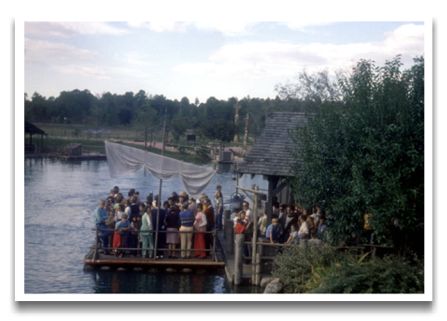
Snapshot '73: The Fort Wilderness Railroad

It remains a little remembered but still treasured piece of 1970s Walt Disney World iconography.  I speak of the Fort Wilderness Railroad.

Author Michael Broggie noted in his book Walt Disney's Railroad Story:
"Built with the best of intentions, the Fort Wilderness Railroad serves as a prime example of a simple concept that turned into an operational nightmare.  Four quaint, five-car steam trains were planned to operate over a 3 1/2 mile route, providing transportation through the Fort Wilderness campground area at Walt Disney World Resort.  Considering the $1 million cost to build its locomotives and rolling stock, however, the line was hardly a cost-efficient operation--running for a relatively short period between 1973 and 1977."
There is no argument that can truly be made on behalf of this failed endeavour (the chapter in Broggie's book is entitled "Fort Wildnerness Folly"), but it can make one nostalgic for a time when cost efficiency wasn't necessarily the highest priority at Disney World and experimentation was encouraged rather than immediately subjected to a cost-benefit analysis.

These impromptu snapshots date from 1973 when the railroad was just getting up and running.  One interesting footnote - two of the coach cars were modified to become Pleasure Island ticket booths in 1989.

Friday, March 04, 2011

Vintage Snapshot! - All Aboard in Frontierland


The original Frontierland train station in Walt Disney World was a somewhat modest and unassuming structure when now compared to its contemporary counterpart.  This Vintage Snapshot dates back to 1975, years before the landscape of Frontierland, and the station itself, was dramatically re-imagineered to accommodate an E-Ticket attraction of epic size and proportions: Splash Mountain.  Also notable are the vintage 1970s-era blue strollers parked in the foreground.  Classic ankle killers of the highest order!

Thursday, February 24, 2011

Vintage Headlines: Disney on Parade

Relating to yesterday's Window to the Past that features a publicity photograph from the 1973 edition of Disney on Parade, we present this Vintage Headline.  During the early summer of that year, the touring company for that elaborate stage production was appearing in venues located in western states.  Critic Robert McDougal, provided this very enthusiastic and rather detailed review of the show that was performed in Provo, Utah on May 30, 1973:
From the moment Mary Poppins came swooping out of the wings flying high above the crowd to he last moment when crowds of eager children rushed out to surround Mickey Mouse, the opening night of "Disney On Parade" Wednesday held a packed house spellbound.

The show is celebrating the 50th anniversary of the founding of the Walt Disney empire which consists of cartoon and feature film production in addition to books, records and entertainment centers.

An apt description of the presentation is flawless, but a description of the spectacle is spectacular. Costume design, lighting, choreography and execution of the spectacle were all without fault.

The show depends on a mixed media approach for its effect and on lavish costume and spectacular sound and props. A large screen is used to project animated settings and backgrounds, then at the appropriate time, the character comes alive on stage and continues the plot.

Early in the show, the story of Pinocchio on Pleasure Island uses the device to good effect. The famous puppet with his conscience (Jiminy Cricket) plunges through a series of adventures until he rescues his father from a whale in a dynamic film presentation of the whale's antics and ferocious attempts to harm the heroes.

Clever costume changes, and a series of remote controlled hoists which flew characters in and out of the production were worthy of note.

An interesting trip to the bottom of the lagoon near the island of Naboombu involved the entire cast dressed as sea creatures for a 1920-ish mini musical revue complete with villains, beautiful girls and a hero. The staging was good and the costuming extremely imaginative and engaging. The story was perhaps a little too deep for the younger members of the audience whose attention seemed to wander, but only an occasional adult moved as a child prevailed on a parent to make a trip out for drinks and other necessaries.

The children were on the edge of their seats literally throughout the rest of the performance.

A hit with the children was a skit where two cars compete for the attention of Goofey. The scene ends in a high wire chase as Bug Herbie tries to force his attentions on the lovable hound in confrontation about 30 feet above the stage.

Most of the sound and music for the production came from a finely tuned Disney sound system, but is interestingly spiced with live music and sound effects which lend realism to the overall effect of the film, the actors and the music.

Act two was a Mary Poppins spectacular with a fleet of dancing chimney sweeps, and London's former social fabric in engaging and dancing. Mary enters and leaves by the aerial hoist system and appears to fly with the aid of her umbrella.

If your child has not seen one of the annual Disney productions, he should. If he has seen one before, the chances are that he has already persuaded you to go again this year.
McDougal was clearly not well versed in Disneyana.  He failed to identify the lagoon scene as being from Bednobs and Broomsticks, which had debuted in theaters just two years earlier.  The "Goofey" misspelling is not a typo on my part, it appeared that way in the article and apparently slipped past McDougal's editor as well.

An uncredited article in the Oxnard Press Courier provided additional details (likely in the form of a re-edited press release):
For the first time in any arena show "Disney On Parade " characters 'fly' suspended from a revolutionary $250,000 computerized monorail track high in the arena. Mary Poppins , fish from the "Bedknobs and Broomsticks" production, and bears from "Bear Band Jamboree" appear to actually fly through the air at speeds up to eight miles per hour.

Production numbers open with a brief film segment on a large screen in the storybook castle which completely fills one end of the world's largest portable stage, and then the cast brings the capsule versions of the stories to life. The famous wooden puppet returns in "The Further Adventures of Pinocchio" for a visit to the carnival setting of Pleasure Island where bad boys turn magically into donkeys right on stage.

For the "Bedknobs and Broomsticks" production the stage is transformed underwater to The Briny Ballroom for a 1920's mini musical revue with the entire cast appearing as sea creatures. In the "Used Car Lot" production, Goofy and Donald Duck can't pick between a vintage Model T and Herbie the Love Bug. Both comedy cars appear to come to life. Herbie makes theatrical history as the first car to drive across the high wire chasing a frightened Goofy.

But wait!  Believe it or not, there was apparently a second production of Disney on Parade, touring simultaneously (at least during June of 1973) with the one described above.  This review from the Tucson Daily Citizen on June 20, 1973 detailed an entirely different show:
The show opens with the traditional welcome by the familiars such as Mickey Mouse, Tigger and Goofy. Then there is an amusing birthday party for Winnie the Pooh, who makes herself sick eating honey"and has the most fascinating nightmare. Donald Duck, in long hair and Liberace-sequined dress-tails plays the piano like it has never been played before.
Goofy has a go-round with the Love Bugs — Hermie and Gloria and Junior, who violate all the traffic laws. The Love Bugs were the favorite of the young people with me. But I liked the Aristocats, a big production number of swinging Paris life seen through the eyes of cats and kittens. This year Snow White gave way to Sleeping Beauty. This is another full scale production piece which features a pas de deux danced by the Sleeping Beauty and her prince. The three good fairies are plump and protective and the wicked witch is quite frighteningly venomous. Another new and quite delightful number has Donald Duck going south of the border to fiesta with his two caballero pals, Panchito and Jose Carioca. The young people with me liked this one next best to the. Love Bug: I liked it next best to the Aristocats.
The program closed with a fresh rendering of "It's a Small World" and the kids all crowded close to" the 'stage to say hello to their favorites.
A very notable component of this production was its costuming.  Most prominent was the gown worn by the actress portraying Princess Aurora from Sleeping Beauty.  Valued at $7500, it contained more than 800 tiny lights and countless sequins.


It appears that the latter production was in fact the 1972 edition of Disney on Parade and the show's third incarnation.  The production featuring Mary Poppins was the fourth version of Disney on Parade and began touring in 1973.  The different productions would actually tour well beyond the calendar years they were initially identified with. 

Wednesday, February 23, 2011

Windows to the Past: Disney on Parade


Character costumes have evolved dramatically over the course of Disney history.  This particular Window to the Past showcases Donald Duck, Goofy and Pluto as they appeared in the touring production of Disney on Parade in 1973.  This publicity photo showcases a distinctly leaner Donald and a Goofy with oddly overemphasized eyelashes.  The late Bill Justice was the primary creative force behind Disney on Parade costuming.  For more information on the very early versions of Disney on Parade, return tomorrow for Vintage Headlines: Disney on Parade, right here at 2719 Hyperion.

Thursday, February 10, 2011

Totem Pole Parkeology

Editors note:  There must have been some totem pole karma floating around recently.  I had been working on this post for the past two weeks, only to discover that Meet the World addressed Walt Disney World totem poles in this excellent article from January 30.  In addition, our very good friend Jim Korkis discusses totem poles in his most recent article at Mouse Planet.  Hopefully I'll be able to add a little bit to the discussion.

In Walt Disney World's very early years, there was a vast expanse of open land at the edge of Frontierland.  It was the intended location of the never-realized Western River Expedition and its Thunder Mesa landscape; instead it became the home of both Splash Mountain and Big Thunder Mountain Railroad.  Prior to those expansions, the area was essentially grassy fields interrupted only by small clusters of totem poles and an adjacent walkway that took guests to the Davy Crockett Explorer Canoes.  The above photo showcases a group of totem poles that were located near the original Frontierland train station.

This second photograph confirms an additional cluster of totem poles further up the walkway and parallel to the shoreline.  Taking into consideration the foreground location of Tom's Landing on Tom Sawyer Island, the placement of these poles would approximately match the area just to the right of the entrance to Big Thunder Mountain Railroad.  There is a sign that is consistent in both photographs.  Here is an aerial view to better relate how it all fits together:

So what happened to the totem poles once Big Thunder moved into the neighborhood?  The following aerial photograph from early 1979 shows where the land has been cleared for the attraction, with barricades extending all the way down to the area of the first cluster.  The photograph also shows that the rear cluster of poles has been removed and relocated closer to the shore just beyond the Explorer Canoe dock.  The front cluster remains in place, but in a decidedly odd manner.  One pole remains outside of the construction barricade while three others remain within the work zone.


A second, ground level photo confirms that observation:


The specifics of when and where all the various poles were relocated will have to be left to sharper eyes than my own.  Jump ahead another year or so and you have two poles now in close proximity to the raft launch to Tom Sawyer Island:


Yet those would ultimately vanish, leaving the remaining ones at the far corner of the shore, where they would over the years slowly vanish into the growing trees and shrubbery. It appears that a few have survived to this day, and remain tucked away in that remote corner of Frontierland, remaining a hidden discovery for the always curious theme parkeologist.


Photo credits: Florida State Archives, Bill Cotter, Bing Maps and flickr user blm07.

Monday, December 20, 2010

Rascals in Plastic: The Classic Pirates of the Caribbean Model Kits


My first encounter with Walt Disney's Pirates of the Caribbean?  It was not on a family vacation to Walt Disney World.  Nor was it on a similar excursion to Disneyland.  I was introduced to those various rascals, scoundrels, villains and knaves in 1973 when I used hard-earned allowance money to purchase plastic model kits based on the now classic theme park attraction.

It all began with a very impressive four-page advertisement that appeared in numerous comic books.


At that point in my life, I'm not sure that I'd even heard of the Disneyland attraction, which at the time was less than a decade old.  What I saw when gazing at these pages were very, very cool models of . . . skeletons.  Yes, for many young kids at that time, monster model kits were a big deal.  Monster model kits involving skeletons?  We were beside ourselves with excitement.

Model maker MPC enhanced the Pirates of the Caribbean kits with the wholly new Zap/Action feature.  According to the ad copy:
Now . . . something never in model kits before.  Zap/Action pirate scenes based on Walt Disney's Pirates of the Caribbean, the most popular attraction in Disneyland.  First you build these exciting and detailed scenes . . . then at the touch of a lever . . . release Zap/Action . . . and the pirates perform a variety of surprise actions!  And the Zap/Action can be reset over and over again!
MPC launched the series with five kits: Dead Men Tell No Tales, Fate of the Mutineers, Dead Man's Raft, Condemned to Chains Forever and Hoist High the Jolly Roger.  Two additional kits were later released: Ghost of the Treasure Guard and Freed in the Nick of Time Ghost of the Treasure Guard however, actually recycled the figures from Dead Men Tell No Tales and Hoist High the Jolly Roger and combined them into a larger scene.  The figure in Hoist High the Jolly Roger was the only one in the series to represent a living human and not a skeletal ghost.

I remember personally owning Dead Men Tell No Tales and Fate of the Mutineers.  Each of the first five kits included a two-page printed insert that provided background on the Disneyland attraction, a history of the Age of Piracy and a suggested layout that would simulate an attraction ride-through.  It is likely that the following paragraph from that insert was the first time I'd ever heard of Pirates of the Caribbean.  Growing up in western Pennsylvania, my friends and I knew little of Disneyland.  Park-centric shows on the Wonderful World of Disney had become almost non-existent by the early 1970s, at least a far as I remembered.


The introductory paragraph from the insert:
The most popular attraction at Disneyland is the Pirates of the Caribbean, an electronic wonder that is years ahead of its time in excitement, imagination and animation.  Here, all the authenticity of the Age of Pirates are combined with the most advanced technology and that special Disney fun touch to provide a sight, sound and action attraction that has thrilled millions.  Now, Pirates of the Caribbean is the basis for an entirely new kind of kit series from MPC . . . a total scene kit series with the added dimension of Zap/Action.  Like Disney, MPC has created the lighter side of the Age of Piracy . . . yet combining it with the authenticity and the proven appeal of action and excitement.
The original five kits:

Dead Men Tell No Tales
Left behind to guard the treasure, this pirate has plenty of life left in him.  He builds up into a great model scene.  But watch out!  One touch of the button and . . . Zap/Action!  His arm swings up and he's got the drop on you.

Fate of the Mutineers
No fate worse than being dumped on a desert island . . . and falling in quicksand!  One maty tries to help the other out, but a touch of the switch and . . . Zap/Action!  The blighter's bones give way!

Dead Man's Raft
Here is a magnificent model scene . . . the remains of a badly battered ship with an old salty seaman behind the wheel.  But one slight peek inside the hatch and Zap/Action!  Up leaps his angry mate, slamming down upon the treasure map.

Condemned to Chains Forever
He tried to skip ship, but skip he will no longer.  A hard hearted scene with alligator and all.  But alligator beware!  A finger's touch and . . . Zap/Action!  Down swings the sword upon the alligator's head!

Hoist High the Jolly Roger
In fantastic detail, Captain Villainy with his peg leg upon the king's ransom, preparing to fight all comers.  And curses!  That's just what happens when . . . Zap/Action!  He swings his arm with sword . .  and woe to the treasure hunters.

The two additional kits:


As noted, Ghost of the Treasure Guard combined two previous kits.

The kits proved very successful and MPC subsequently produced a series of models inspired by another Disneyland attraction, namely the Haunted Mansion.  Those kits also featured Zap/Action!

Re-releases of vintage monster/film/sci-fi kits have been very popular in recent years so it is curious that MPC has never opted to reissue the kits.  Especially considering the incredible popularity of the Pirates of the Caribbean movie franchise.  Maybe the company will reconsider with the impending release next year of On Stranger Tides and rumors of additional sequels.

Very special thanks to Sam McCain of Horror Sanctum Studios who provided the photos of his own Pirates of the Caribbean model kit collection.  Sam is a well known and respected Hollywood makeup effects artist and master mask maker.  You can visit him at www.horrorsanctum.com.

Sunday, September 19, 2010

Buena Vista Obscura: Captain Cook's Followup


Just a brief addendum and followup for those of you whose appetite was whet by my previous post regarding that ubiquitous early Polynesian Village lounge, Captain Cook's Hideaway. This functions as both an extension and a rectification of my previous post.

I can now say with more certainty that I have identified the original location of Captain Cook's Hideaway, and it was not where I thought it was. In my original post I indicated that photographs of the establishment seem to be rare. Although pictures of the entrance and inside certainly are, almost any early promotional photograph of the Polynesian Village is certain to contain some part of Captain Cook's Hideaway... ...assuming the photograph is an exterior view, taken from the air.

Here's just one example, taken from "The Magic of Disneyland and Walt Disney World".


Based on the foliage growth and completeness of the Golf Resort in the background, I think this photograph was taken no later than 1974. If we move in closer the item of interest, typically, is right on the crease of the page, which I have rejoined digitally. Take special note of the circular structure in the lower left.


This outdoor patio is certainly the original location of Captain Cook's. There's a palm tree growing right up through the middle of it. The location of all other original Polynesian eateries has safely been established to be inside the lobby structure, and Captain Cook's Hideaway is the only original eatery which advertises an outdoor area:

"CAPTAIN COOK'S HIDEAWAY Dockside cocktails served inside or outside at the Polynesian Village. Open from 11 am until 2 am. Entertainment." - Walt Disney World News, Vol. 1 No. 1, October 1971

"For guests desirous for a dark rendezvous and the strains of a haunting guitar, Captain Cooks Hideaway provides both, as well as an outside patio romantically bathed in soft candlelight." - Walt Disney World Vacationland, Spring 1973

So here it is, the Captain Cook's Hideaway dockside patio. Though the torches ringing the patio burn bright, and it may not be dark enough yet to get the full effect of a romantic candlelight, it is bright enough to see that palm tree extending through the patio on the left and that circular building out by the pool in the background. This means that Captain Cook's Hideaway occupied a spot *just west* of the current location of the food court it later gave its name to, and where the indoor arcade is now. This image is from the 1977 "Walt Disney World ... a pictorial souvenir".


"Time takes on a leisurely tempo in the romantic South Seas environment of the Polynesian Village. As guests wander along palm-lined paths beside tropical pools, the throb of Tahitian drums announces the nightly torchlit luau held on the white-sand beach i front of the low-silhouetted guest "longhouses"."

As originally constructed almost every room in the Polynesian Village faced the water.

--

Previous Buena Vista Obscura entries:
Captain Cook's Hideaway
The Lake Buena Vista Story: Part One, Part Two, Part Three, Part Four
The Golf Resort

"Snapshot" series at Passport to Dreams Old & New:
Olde World Antiques
The Great Southern Craft Company

Monday, June 07, 2010

Buena Vista Obscura: Captain Cook's Hideaway


One aspect of the Walt Disney World Vacation Kingdom in her earliest days which is least likely to translate appropriately to our modern experience is how the entire resort was constructed as a multitude of experiences of which the Magic Kingdom was only the centerpiece. While it's true that this is still the case and the most remarkable things you can do at Walt Disney World are oftentimes the ones you don't even set foot in a theme park to experience, it takes the repeat visitor oftentimes to finally wrestle herself free of the lure of the parks and really get to exploring the intricate backwaters of Walt Disney World. Now those who have explored the pages of an old issue of Walt Disney World Vacationland may be surprised that, yes, there are indeed articles about the Magic Kingdom, but the bulk of the issue is devoted to all the other things you could do at Walt Disney World, even in those early days.

There's good reason for this. For the first ten years of the resort's existence, the Magic Kingdom ran very short operating hours unless it was a holiday season or the summer rush. Open at 10 am and close at 6 pm. That's an eight hour operating day for the centerpiece of Walt Disney World for most of the year.

To put this in perspective, the absolutely shortest regularly scheduled operating day at the Magic Kingdom today is one of those days when the park closes early for a hard ticket event - 9 am to 7 pm, a ten hour operating day. Closing at 6 pm is pretty extraordinary. None of the sit down restaurants would even make it into the dinner rush! There were two very simple parades daily - various entertainers and characters would pile onto the Main Street Vehicles and proceed in haphazard fashion through the park - and there were no fireworks unless the park was open past midnight.

Given these circumstances even the day tripper would be likely to maximize their effort and retreat to one of the Disney hotels on the monorail to take in dinner or a show such as the Electrical Water Pageant, and this is just how Disney wanted it. Although the Magic Kingdom may have closed at 6 pm, the Lake Buena Vista Shopping Village was open every day until 10 or later, and every resort had at least one bar or night club open until 2 am, complete with live entertainment - the Trophy Room at the Golf Resort, the Village Restaurant at Lake Buena Vista, The Top of the World at the Contemporary. So the oft repeated canard that Walt Disney World was once a place with less emphasis on the Magic Kingdom may be rephrased to emphasize that Walt Disney World was once a place *designed* to make you take advantage of the offerings outside the gates of the Magic Kingdom.

This was the time period in the resort's history when it was most markedly different than what we have today. With the park's closing designed to force most guests out of the theme park and into Walt Disney World's other areas, Disney was coming up with ingenious night time entertainment offerings such as the Eastern Winds and Moonlight Cruises. It was a time when tourists and cast members alike flocked to the new modern hotels being built on property along SR 535 near the Preview Center, which offered the newest night life and dining, such as Howard Johnson's "Place For Rib". It was a time when the campfire sing-along on the beaches of Fort Wilderness was as important a part of your day as riding Space Mountain or Pirates of the Caribbean, and the sounds of a Dixieland quartette echoed across the Seven Seas Lagoon from a dimly lit sidewheeler, pacing the waters on a romantic moonlight "showboat" cruise.

Great Ceremonial House, looking south on the second level, 1972 or 1973

I provide all this set up because by itself, Captain Cook's Hideaway isn't much to talk about. It was, in fact, a single room, dimly lit, located on the ground floor of the Polynesian Village's Great Ceremonial House. Across from the South Seas Dining Room, a simple buffet, these two establishments occupied a small side hallway on the ground level where currently the large open "BouTiki" shop is located. In those early days before the various Gift Shops and Eateries were modified in such a way to open up into the Polynesian's dramatic atrium, the Great Ceremonial House mostly resembled an open box with two levels and fairly featureless bamboo walls.

But Captain Cook's was the very original Cast Member hangout, long before the Adventurer's Club or the Big Bamboo was a glimmer in anyone's eye, and as such maybe deserves more attention than it would otherwise receive. On pages 125 and 126 of Realityland, author David Koenig relates Disney World's efforts to get SR 535 modernized to handle the large amounts of employee traffic currently traveling on it - a problem they had, of course, created, the road itself predating Walt Disney World by many years. Disney was unwilling to contribute the needed funds for adding shoulders, lanes and such, but they were willing to launch a massive PR campaign which included a song by Captain Cook's resident musical duo, the improbably named Salt Water Express - 'Can You Arrive Alive on 535?' The song was submitted to local radio stations and even plastered on billboards. Disney got their road widened on the government's dime, and such is the lot of obscure facets of Walt Disney World that they are often mixed up in stories bigger than their actual profile may suggest. One wonders how many Disney guests those many summer nights ago were confounded by talk of "Arriving alive on 535".

Disney described their creation in more romantic terms in a 1973 Vacationland:

"For guests desirous for a dark rendezvous and the strains of a haunting guitar, Captain Cooks Hideaway provides both, as well as an outside patio romantically bathed in soft candlelight."

There are very few photos of the inside of the place, which probably indicates that it wasn't much to look at. Salt Water Express began their sets at 9 pm and went until 2:30 pm, except on Monday, either seated in a corner romantically lit with a soft purple light or amongst the patrons. The real attraction, of course, was a cozy getaway from the bustle of what was already one of America's busiest fun centers, with the comfort of a potent tropical cocktail.

The namesake of the establishment, Captain James Cook, was killed by Hawaiians after trying to take hostage of the King of Hawaii in 1779. Although probably nobody was killed by the Polynesian Village resort staff in Captain Cook's Hideaway during the watering hole's run, the notion of the white man gradually succumbing to intoxication via one of the bar's potent tropical cocktails while the folk strains of Salt Water Express ring through the room makes for a strangely appropriate connection. In later years, as the resort became more of a family centered enterprise, Captain Cook lent his name to the new food court which, albeit many renovations later, still bears his name.

In a way it's hard to be too excited about these sort of places at Walt Disney World on an individual basis, and indeed it's not Captain Cook's Hideaway but what it represented in its time which fascinates today. There is very little at Walt Disney World today which resembles it, and even the darkest of dark bars is likely to serve lemonade and punch in light-up cups along with their adult-only concoctions. It's simply hard to reconcile the child-centric wonderland of Walt Disney World today with a place that used to promote restaurants serving "Gallic fair in a high timbered room smelling of cedar" (the Lake Buena Vista Club) or "nightly floor shows featuring top name performers" (the Top of the World).

In a way, then, perhaps Captain Cook's Hideaway is of interest. The Polynesian Resort is, of course, today quite notable for her lack of a real tiki bar, a truly dark and adult escape into a world of imagined exotic pleasures. Captain Cook's may have been Disney's concession to the "Trader Vic's" crowd, an establishment which is itself today as endangered and rare as early Walt Disney World. So next time you're in line waiting to buy your massive Dole Whip or pulled pork flatbread, raise a refillable mug to the original Captain Cook's Hideaway and the Salt Water Express - now just a hazy, rum soaked memory flitting elusively across time, dancing off the waters of the Seven Seas Lagoon, the waves from the phantom wave machine, the ghost boat on a moonlight cruise to nowhere.

--

Previous Buena Vista Obscura entries:
The Lake Buena Vista Story: Part One, Part Two, Part Three, Part Four
The Golf Resort

Monday, March 15, 2010

The Lake Buena Vista Story, Part Two: 1975 - 1982


By 1976, The Lake Buena Vista Club was hosting brunch. On Mondays, one could enjoy a Night of Wine & Roses – wine sampling at the Village Spirits, a rose from the Flower Garden, then a romantic, silent flote boate cruise to the Club for dinner. Tuesdays was Dinner for Tue, with a candlelit Club dinner followed by a moonlit cruise. Sundays brought about a Champagne Brunch with stops at Village Spirits, a flote boate cruise to the Club, and a brunch with eggs benedict and roast beef. And Disney was building again in Lake Buena Vista – this time to the West of the Lake Buena Vista Club, East of the Treehouse Villas, nestled comfortably between four golf holes – the 10th and 11th to the east and north, and the 17th and 18th to the west and south. Because of this, these became known as the “Fairway Villas”.


The Fairway Villas were amongst the most dramatic and distinctive of Disney’s developments in Lake Buena Vista, as well as the most architecturally sophisticated. From Walt Disney World: The First Decade:“Designed to showcase energy-efficient housing ideas, the Fairway Villas benefit from thoughtful positioning and energy-conserving construction methods and materials.

Exaggerated roof overhangs and double-glazed windows reduce heat absorption through exterior walls during warm weather. Air-to-air heat pumps serve as energy-minded air conditioners. When an air conditioner is on, heat is recovered from its condenser to provide hot water.

To preserve the major portion of the surrounding acreage for parks and recreation, Disney planners clustered the Lake Buena Vista Villas around heavily wooded courtyards and cul-de-sacs. Planners avoid the ‘grid’ system found in many neighborhoods, where residences are uniformly built on rows of small, square subdivided lots.


Most of the Villas look out onto natural surroundings, rather than onto other dwellings. Thus, clustering not only saves more space for recreation, it retains a sense of privacy while enhancing the spirit of community.”

And an earlier 1977 magazine: “The Villas, expected to yield energy savings of 50 percent with their unique design, each have a 720-square-foot living, dining, and kitchen area and two bedrooms, one of which can be combined with the adjoining Villa. Designed for family vacations, meetings, seminars, and executive conferences, the Villa units will be arranged so that as many as four bedrooms can be rented by one tenant.”


Crazy concept art for the LBV houses

The Treehouses and Fairway Villas, of course, had nearly as many windows as walls, and the Fairway villas had their distinctive skylights, encouraging the use of Florida’s ample sunlight instead of eclectic lamps. Car parking was provided underneath the Villas in dugouts. Today these touches may not be as impressive or obvious as something like the Universe of Energy’s solar panels but in 1976 they were stylish as well as forward thinking, something few residential houses can today claim. Disney even built full-scale residential houses in the style of a ranch house as part of this development, four of them: numbers 301, 302, 303 and 304, clustered around their own little cul-de-sac away from the other Villas. These were intended to be real honest to goodness houses, perhaps in later days as retirement houses for prominent Disney officials. Each had a little car / golf cart port and was built in a different style: southwest for 301, a beach house for 302. Number 303 was a square little ranch house and 304 was a grey little number with some volcanic rock accents.


The LBV houses in later days. Top to bottom, 301 - 304

The experiment was not repeated, and today the houses which are on Walt Disney World property remain hidden off 535 and on the far side of Bay Lake, a carefully selected “population” of less than 50 people.


In 1977, the Sun Bank building went up south of the Village, near Interstate-4 and SR 535. Read some 1978 Disney literature: “The first building of the new Office Plaza, developed by Oxford Properties, US, Ltd, boasts one of the country’s most up-to-date banking systems. The five-story building is the first phase of a planned 13-building office park on a 50-acre site.” Disney was building themselves quite a little town on the outskirts of their property.

1977 brought more changes to the Village. The Shopping Village was originally built on the south-eastern side of an inlet, with Captain Jack’s Oyster Bar, as the northernmost building, facing a sylvan forest. A bit further north along the Village Lagoon (by now re-named the Buena Vista Lagoon), the Vacation Villas had, for five years, faced a little bar of land in the middle of the Lagoon as it narrowed into the canal system near the Lake Buena Vista Club. Disney dammed up an area to the north-west of the Pottery Chalet, sliced off several dozen feet of land off the Villages cozy cove - turning it into more of a bay - removed the island facing the Villas, and began construction of the Empress Lilly Riverboat.


Between it and the pottery Chalet they built the Village Pavilion, a series of interlocked structures housing three new eateries. When the Empress Lilly opened, a new dock was added on the water side of the vessel, facing Captain Jack’s. Now the flote boats would depart exclusively from the Lake Buena Vista Club and silently dock alongside the Lilly, disembarking passengers ascending a gentle ramp and emerging into the Promenade Lounge. Motorboats would ply between “Cruise Dock West”, near Captain Jack’s, and the Lake Buena Vista Club.

The 1977 expansions officially brought a name change to the Village, now the Walt Disney World Village at Lake Buena Vista.


Since the earliest days of the Lake Buena Vista Club, a canal wrapping around its north face had always widened into an elongated dewdrop of a lake, called Club Lake. And in 1978 a series of little buildings began to spring up along the shores of Club Lake, on the shore near the Club and across from it, in what would turn out to be Lake Buena Vista’s final growth spurt in over a decade… The Club Lake Villas.


Probably the most charming of the Lake Buena Vista developments surrounding the Clubhouse, the Club Lake Villas were smaller one-family townhouse type accommodations with a bedroom, a square little living room generously splashed in sunlight thanks to dramatically vertical ceilings and skylights, and a kitchenette. They were clustered in little courtyards with roundabouts between each grouping of four, and each Villa looked out across Club Lake at the far side’s grouping of Villas. A long wooden footbridge was constructed to link the Villas on the north side of Club Lake with the Villas on the south side, which had their own pool and recreation facilities. Or one could follow the golf cart path onto the Lake Buena Vista Club and her pool and marina.


In 1978, the Post Office had moved out of its’ spot in the Village to make way for an expansion of the Village Spirits shop – The Vintage Cellar – and made its way over to the old Preview Center building, where the Lake Buena Vista Post Office became the Lake Buena Vista Welcome Center, offering check in services for those staying in the Villas (a temporary building off Buena Vista Blvd, the major vehicle entryway from Preview Blvd., had served as the Welcome Center until now).


Club Lake in the Institute days

Spring 1980, a high roofed structure surmounted with a signature square tower appeared along the northern coast of Club Lake – the Lake Buena Vista Conference Center. Aimed at the corporate sponsors Disney was still courting in 1980, the “8,000 square foot facility was designed to expressly for small to medium sized meetings and seminars. Movable walls in the cedar-covered, chalet-style building allows the four rooms to be configured in several ways. When the rooms are combined into one 6,500-square-foot space, more than 500 guests may be comfortably seated theater style. The Conference Center also features advanced lighting, sound and audio-visual systems, and can handle television broadcasts, press events and multi-media shows.”

And it was this arrangement – the Lake Buena Vista Golf Course, the Motor Plaza, the Clubhouse, the Marina, the Conference Center, the Treehouses, the Fairway Villas, Vacation Villas and Club Lake Villas – anchored by the Walt Disney World Village – that was pretty much the “finished” form of Lake Buena Vista for over ten years.


What is today hard to emphasize enough about this is how unique, not only for accommodations at Walt Disney World, but unique amongst each different kind of Villa, this community was. The Polynesian and Contemporary Resorts were a pretty standardized size of room, each not especially distinguished from any other high-end resort hotel except for the remarkable Disney design work outside their four walls and the location they were in. Disney themselves certainly never made too many claims that the actual experience of the rooms in their resorts was much to write home about, and priced them competitively in the 1970’s to make staying on property not only convenient but affordable.

The Golf Resort, in comparison, offered somewhat larger rooms, and the Campgrounds at Fort Wilderness larger still, with very large cabins and additional campsites added in 1978. But the Villas were really something else, truly room to spread out in. Not only that, if one wished to ‘go shopping’ amongst each model she could compare things like beddings, staircases, interior finish and kitchen facilities to find a truly comfortable, truly perfectly tailored “best fit”. In these days before Eisner’s aggressive expansion of Disney’s hotel properties, each unit could be uniquely designed and furnished, uniquely situated, uniquely tailored to an individual’s vacation needs. Although it’s hard to fault the hotel addiction on Eisner’s part too much if he gave us great architectural works like the Wilderness Lodge and Boardwalk, but each of those rooms are identical to the others in layout and basic amenities, a far cry from those funky, unique Villas dotting the landscape across from the Village. It may seem out of place here in 1978 to bring up Eisner, but in a very real way Eisner was to alter the future of the Villas… directly and indirectly.

Of course, as of the early eighties with the excitement of the Walt Disney World ‘Tencennial’ and the opening of EPCOT Center, none of that was even foreseeable. From a May 1982 interview with Dick Nunis:

“But what [Walt Disney] really wanted to do [in Florida] was develop an area where all types of corporations, governments, and academia could come together to really try and solve some of the problems that exist in the world today. We started with the recreation area, and then began the community, which is Walt Disney World Village, and now we’re building the center … Epcot Center, and we’re going to connect it all with the monorail system. […] In addition, we have some dreams for the Walt Disney World Village. From the Empress Lilly, we’re going into a New Orleans street, and you’ll walk right into a beautiful New Orleans hotel.”


To this end, in 1981, Disney began to purchase extra monorail beams and pillars from Morrison-Knudsen, a concrete manufacturer, who had also supplied the beams for EPCOT Center at a very reasonable price. Since 1977 Disney had been publishing and promoting a little model showing an expanded Walt Disney World Village, complete with a fully realized office complex, an expanded shopping village, and a monorail and peoplemover running through it – yes, a Peoplemover. As of 1976 the Lake Buena Vista Land Company had begun to plan for a Peoplemover to bring guests from the Motor Plaza hotels into the Village, stopping at the Pottery Chalet, and then moving on. On to where? Well..

“Future plans in the commercial area include a two million square foot office park to be developed in the next ten years. The project is contemplated as the headquarters offices for major financial institutions as well as for local professional business. The shopping village will be expanded in the next ten years to approximately 300,000 square feet. A multi-modal station will become the focal point for both the city [Lake Buena Vista] circulation system and the regional transportation network. There will be medium to high density living units constructed near the village lake front to create the balance of day and night activities in the commercial center.”

This multi-modal station would comprise bus, taxi, monorail and peoplemover transportation. According to “Lake Buena Vista Peoplemover”, a project proposal published in 1976 and from which the above is quoted, the station would link in with city and regional transportation with the aim of developing a city center “completely void of the private automobile”. This is a manifestation of Disney’s then-commitment to working with the state of Florida, which even in the early 1970’s was rapidly becoming one of the most quickly growing urban areas in the country and much of the local government’s interests at the time were geared towards reducing vehicular congestion. Interstate 4 was online as early as 1957, and in 1971 Disney had quickly constructed a “STOLport”, a small landing strip meant for intra-state commuter planes, another ambitious attempt by then Florida governor Reuben Askew to alleviate traffic congestion. The Florida state flight industry dried up before it even got started, and today the Walt Disney World STOLport sits abandoned. But a transit hub is undeniably a cornerstone of a growing community, which is what Lake Buena Vista was going to be. According to Disney’s plan, the Lake Buena Vista Villas was phase one of an elaborate four-community vacation community, comprising recreation themed communities – golf, tennis, boating and horses – and a transient population of 30,000!

A transient population of 30,000? A peoplemover through a downtown area of shopping and dining? Commercial highrises? Monorails? Modern homes situated in grassy, pastoral suburbs along cul-de-sacs instead of grids? Haven’t we heard this before? That’s right, it’s nearly every component of Walt Disney’s Progress City – only spread out across a huge area instead of the compact circle Walt Disney was envisioning in 1966. Disney was building a community – a real community – or at least trying to.


Come back next week when the Villas become an Institute, an Institute becomes a rubble pile and a hurricane destroys everything!