Thursday, April 26, 2007

The Return of the Original Goof


Animated Views has a great interview with Disney animators Andreas Deja and Mark Henn on the making of the upcoming new animated short How to Hook Up Your Home Theater. Based on their statements, I have to say I'm more excited about this new six-minute Goofy cartoon than any other project in the current Disney-Pixar pipelines. It represents a return to the classic Goofy shorts of the 1940s and 1950s. Gone are all the modern Goof Troop-Goofy Movie references; our hero is clearly returning to his traditional "everyman" roots.

What really blew me away was the promotional poster Animated Views revealed as part of the article. It is a wonderful juxtaposition of 1950s Disney poster design with the modern home theater subject matter of the short. The mix of retro-style television components with audio-video cables and remote controls is nothing short of brilliant.

Wednesday, April 25, 2007

Four Color Fairy Godmothers

In the 1950s world of Disney comic books, even supporting characters could become stars in their own right. Case in point--Flora, Fauna and Merryweather take center stage in this Dell Four Color Comic from 1959.

Crossovers with other Disney personalities were common to these types of character showcases and Sleeping Beauty’s Fairy Godmothers had some very distinct guest stars appear between its pages. In the issue’s first story, “Good Deed Day,” Merry attempts to cheer up a lonely and depressed Reluctant Dragon, the star of the 1941 feature film of the same name.

In “To the Rescue,” the girls do their best, with the assistance of Timothy Mouse, to help Dumbo weather an extreme crisis of confidence that has the little elephant grounded. In the end we learn that “Sometimes a good heart does more than all the magic in the world.”

In the issue’s final tale, the trio find themselves in the middle of some messy court politics centering on the Queen of Hearts from Alice in Wonderland. They come to the aid of the Knave of Hearts who has been falsely accused of stealing tarts.

Rounding out the book is the back cover recipe for Flora’s Fudge, a magical dessert for any occasion.

Monday, April 23, 2007

Blue Sky Department: Dragonshire

The Beastly Kingdom is yet another of the many legendary lost Imagineering concepts from the 1990s. Originally intended for the space currently occupied by Camp Minnie-Mickey in Disney’s Animal Kingdom, it unfortunately fell victim to budget cuts and the whims of Michael Eisner.

While I’m certainly disappointed that Beastly Kingdom went unrealized, I was never completely impressed with the blue sky designs that were being considered for DAK’s proposed land centered on fantasy and mythological creatures. Taken individually, the ideas for Dragon’s Tower, The Quest for the Unicorn and the Fantasia Gardens boat ride seemed imaginative and intriguing, but collectively I’ve wondered just how they would have ”meshed” and under what central concept they would have been unified to ultimately form the Beastly Kingdom. Each of DAK’s various lands are very distinct in their physical settings. Even the much maligned and controversial DinoLand stays true to a specific geographical context.

In revisiting these lost concepts, I was inspired to create a blue sky concept of my own for DAK’s long abandoned fantasyland. One that has a very distinct setting and also shares the themes of conservation and animal preservation that are strongly associated with just about every other aspect of Walt Disney World’s fourth gate.

My blue sky remains true to the Beastly Kingdom’s original theme, and even reinforces the notion of a signature thrill ride centered on dragons, but adds a strong element of story and background history to bring about a truly immersive environment. Thus the land of Dragonshire is born.

Dragonshire exists in a time when magical creatures are fast disappearing from the world. The small village of Wyrmvale sits at the edge of the land’s Old Forest, where these endangered animals have found refuge from a world that threatens to extinguish them. Protecting them is a mysterious group of Forest Wardens who live in a small, yet still imposing castle. Working closely with the Forest Wardens are the Rangers who search the world for threatened creatures and relocate them to the safe haven of the Old Forest.

Dragonshire is essentially medieval in atmosphere and architecture, yet certainly state-of-the-art high tech in almost all other regards. Rising high above the village of Wyrmvale is DragonSpire Mountain. Deep within the mountain’s labyrinth of catacombs is DragonSpire Quest, the centerpiece attraction of Dragonshire. Guests descend deep below the surface of the mountain in search of adventure, only to come face to face with the last surviving red dragon. The only means of escape are mine cars from a long abandoned mining colony which take riders on a high speed journey through caverns and tunnels that reveal secrets long hidden beneath the mountain.

Disney’s current Living Character Initiative would play a crucial part in the land of Dragonshire. Expanding on the technology that brought Lucky the dinosaur to life, Dragonshire would feature numerous mythological creatures realized in the same manner, as the Rangers constantly transport captured creatures through Wyrmvale on their way to relocating them to the Old Forest. Guests would see and interact with griffins, unicorns, wyverns, and numerous other fantastic creatures as the creatures are escorted by the Rangers to their new home.

The village of Wyrmvale would also include a number of shops themed to its fantasy setting, and a large full service restaurant.

Finally, Dragonshire would be instrumental in turning DAK into an evening park by introducing a spectacular nighttime entertainment extravaganza-- Fire Mountain. Employing fireworks, pyrotechnics, and next generation animatronics, Dragonspire Mountain would become the nightly setting of an elaborate battle between good and evil dragons.

Sunday, April 22, 2007

Souvenirs: Pushing Buttons at EPCOT


Buttons have always been favorite souvenirs for me. I'm sure my collection numbers well into the hundreds. They're inexpensive, colorful and years later become small time capsules of memories past.

Here are a few from EPCOT Center's first decade. Most were likely purchased at the Centorium, the very EPCOT-themed shop that the larger and more all-encompassing Mouse Gear replaced a number of years ago. The one featuring Mickey with all the flags likely came from one of the two International Gateway stores.

Saturday, April 21, 2007

Lost Imagineering: Switzerland


The next stop on our tour of the World Showcase that never was is Switzerland. The 1991 EPCOT Outreach fact sheet provided the following description of a proposed Swiss pavilion:

Matterhorn Mountain and Bobsled Ride; Inspired by Europe's tenth most famous mountain, this imposing landmark will be built on the shores of the World Showcase Lagoon beside a charming Swiss village. Bobsleds will race up, down, around, and through a chilling ice-covered adventure. It will be the centerpiece of a picturesque Switzerland showcase.

Thursday, April 19, 2007

Snapshot! - DO NOT WURRY . . .


The various signs in whitewash lettering scattered around Tom Sawyer Island in Walt Disney World's Magic Kingdom are a lot of fun. Here Tom sounds a gentle warning for all those entering Injun Joe's cave.

Wednesday, April 18, 2007

Putting the Archeology in Theme Parkeology

An incredible example of the Imagineers' attention to detail from the Mexico pavilion at Epcot. I have long been fascinated by the Aztec civilization and for that reason Mexico has always been one of my favorite destinations in World Showcase.

Often times, visiting the countries of World Showcase would inspire my choices in reading material. The mesoamerican designs here led me to Gary Jennings' novel Aztec, which in turn became one of my favorite works of historical fiction.

The Simple Things - April 18, 1953

The 1953 Mickey Mouse cartoon The Simple Things is an average and in almost all ways unremarkable production. But what it has come to represent, at least to me personally, resonates on an emotional and sentimental level that goes beyond anything the actual short itself conveys.

The Simple Things certainly lives up to its title. Mickey and Pluto take a fishing trip to the beach where their primary antagonists are a persistent clam and overly annoying seagull. It follows the typical pattern of multi-character shorts, where each character has a separate vignette (Pluto with the clam; Mickey with the gull) and then reunite for an overall climax.

But what distinguishes The Simple Things, was that for all intents and purposes, it was essentially the last Mickey Mouse cartoon.

Granted, Mickey’s Christmas Carol would be produced in 1983, and would be followed seven years later by the Prince and the Pauper. But they were both special productions-- adaptations of literary works with more extended running times, and were not really akin to the typical 7-8 minute shorts produced during the studio’s first three decades. And while Runaway Brain certainly matched the just described criteria for classification as a cartoon short, the 1995 film stands more as a happy and refreshing anomaly rather that a return to a schedule of studio produced fare.

No, despite these films and even the television-produced Mickey’s MouseWorks and House of Mouse, The Simple Things represented Mickey’s retirement from the very art form that he as a character ultimately defined and revolutionized. It would also foreshadow Walt Disney’s own shuttering of the studio’s shorts department two years later in 1955.

Mickey’s retirement from film did not relegate him to the life of leisure embodied in the carefree fishing trip of The Simple Things. He quickly transitioned into a television personality via the Mickey Mouse Club and appearances on the Disney anthology program, and later into the roles of theme park ambassador and corporate icon. But he would with his costars--Donald, Pluto, and Goofy among others--leave behind the very form of entertainment that in fact had given birth to the Walt Disney Company.

I can’t imagine that director Charles Nichols and his crew ever intended for the title of The Simple Things to imply anything beyond the cartoon’s theme and content. But in my studies and research of the short, it has always been identified as Mickey’s last cartoon and in that context the title has always taken on an additional meaning for me. The song "The Simple Things" that opens and closes the film, provides more than a moment of bittersweet sentimentality when considered in the context of the then declining animated short subject, not just at Disney but across the rest of Hollywood as well.

The theatrical cartoons of 1930s, 1940s and 1950s are in many ways the simple things referenced by that song’s lyrics. As Mickey and Pluto no doubt journeyed to a rocky beach to escape their worries and troubles in The Simple Things, I and countless others still escape in a similar fashion to that simpler, yet always endearing animated entertainment of those bygone days.

Tuesday, April 17, 2007

Lost Imagineering: Russia


We are going to continue this week's imaginary stroll around the World Showcase that never was and drop in on the fabled Russian pavilion.

An EPCOT Outreach fact sheet from January of 1991 mentioned briefly a USSR-themed pavilion:

Soviet Union Showcase; A USSR showcase is the addition most requested by EPCOT Center visitors. Its towering onion-domed spires and bold architecture will add a breathtaking new silhouette to the World Showcase skyline by the end of 1999.

An internal Disney Team publication from 1992 reflected the dramatic world events of the prior year--the showcase was now referred to as the Russia pavilion, and a much more detailed description of its attractions was provided:

Imagineering has recenty completed "blue sky" concept work on a Russia Pavilion for World Showcase. Marqueed by the spectacular onion domes of St. Basil's Cathedral, it will feature the spellbinding attraction, Russia - The Bells of Change. This innovative theatrical experience will combine Audio-Animatronics® characters, animated sets, film, and a live actor to surround guests with the personalities, achievements and volatile history of this vast land. Also planned for this new pavilion is a ride-through attraction inspired by one of Russia's best loved folk tales, Ivan and the Magic Pike.

Monday, April 16, 2007

The Wonderful Posters That Never Were

Simply beautiful designs from Walt Disney World's first decade.

Well, let me rephrase that. Simply beautiful designs inspired by Walt Disney World's first decade.

The fact that many folks, upon viewing these wonderful attraction posters for the first time and assume they are authentic objects of bygone days, is testament to the talent and skills of artist and graphic designer Greg Maletic. Greg created the posters as a means of teaching himself how to use Adobe Illustrator, skills he needed for another project he was working on. In a true "dreams come true" bit of synergy, Greg was contacted by a Disney executive who had discovered the posters online, and was commissioned to do actual design work for the House of Mouse!

Greg has generously allowed me to reprint the posters here, and has graciously made them available to anyone who wishes to make printed copies of their own. Check out Greg's blog for all the details. And while there, check out Greg's archive of material he has written for LaughingPlace.com. These well written, insightful articles are well worth your time and interest.

Sunday, April 15, 2007

Lost Imagineering: Meet the World


It was very disappointing when Meet the World never materialized as part of the Japan pavilion in 1982 as originally planned. Developed simultaneously for both EPCOT and Tokyo Disneyland, it was an extensive multimedia presentation that combined live action and animated films with audio animatronics figures. The 1982 Abrams book Walt Disney's EPCOT provided the following detailed description of Meet the World:

Inside the castle, the audience is seated in a rotating carousel theater, which will revolve in front of four stages, each presenting a chapter of the story of Japan.

The first chapter traces the volcanic origin of the islands. Then, in the company of two Japanese children and an animated magical crane (symbol of good health and long life), we explore the early history of the inhabitants of the islands.

Stage II deals with Japan's first emissaries to a foreign country—a splendid scene in Imperial China. Much of China's culture was absorbed and subsequently adapted to distinctive Japanese forms. A new foreign influence arrives with the epochal visit from Portuguese traders, who introduce the Japanese to firearms. This chapter ends with the closing of the country to almost all foreign visitors.

In Stage III, Japan, in self-imposed isolation,develops artistically and intellectually. Here we are introduced to Yaji and Kita, guards in the family of a powerful Shogun in the Edo period, whose story is a Japanese classic. But in the Disney version they are a couple of amusing characters. Enter Commodore Perry and his great Black Ships. His visit gives rise to heated debate between Japan's isolationists and expansionists.

The scene ends with the cataclysmic expansionism of the 1940s, but Stage IV demonstrates,
amply and ably, the rehabilitation, stabilization, and outreach of a modern, caring people, at once sophisticated and traditional, whose influence now extends far beyond the shores of their islands.

The show ends with the children and the crane waving farewell from the gondola of a balloon. But we can return to Japan, at least for a moment, after we leave the theater: it is there all around us, and our appreciation will be heightened after what we have just seen.

Meet the World was ultimately realized as an attraction at Tokyo Disneyland, but its EPCOT Center counterpart sadly never found a home at World Showcase.

Thursday, April 12, 2007

Pixar at the RiverRun International Film Festival

Just a heads up to my fellow North Carolina residents out there. Pixar will be making a presentation at this year's RiverRun International Film Festival next week, right here in my own backyard of Winston-Salem.

From RiverRun's official website:

Don’t miss a very special behind-the-scenes look at Pixar Animation Studios, the company responsible for some of the most popular animated films of the last 20 years, including Toy Story, Monsters, Inc. and Finding Nemo. During this panel discussion and screening, visiting Pixar artists will examine the magic behind the Oscar-nominated Cars, share film clips from the Pixar vaults and discuss the studio’s upcoming feature, Ratatouille.

The Pixar presentation is slated for Saturday, April 21 at 7:30 PM at the Stevens Center in downtown Winston-Salem. There will also be an Animation panel discussion earlier that day at 12:30 PM at the NC School of the Arts. It will feature industry professionals and veteran animators from the top studios Blue Sky, Pixar, Rhythm & Hue, Walt Disney Feature Animation and the Winston-Salem-based Out of Our Minds Animation Studios.

Check the festival's official web site for more details and ticket information.

Epcot: New and Improved!

The big buzz today is about the announced changes to Spaceship Earth at Epcot that will be occurring over the next year or so that relates to Siemens recent sponsorship of the attraction. Both the Disney Blog and All Ears Net have very good articles on the details of the refurbishment.

Despite the misgivings of a very vocal but still relatively small minority of Disney Park enthusiasts (who seem to read negative into every proposed change for Epcot-- i.e. Caballeros in Mexico, Alfredo’s closing in Italy), there is clearly the very positive perception recently that post-Eisner Disney is really making an effort to extend some much needed TLC to the 25 year-old park.

Put it all together--
  • The very much needed overlay/enhancements to the Mexico pavilion, resulting in the Gran Fiesta Tour featuring the Three Caballeros.
  • The forthcoming new CircleVision 360 film currently in production that will hopefully debut at the Canada pavilion later this year.
  • The updating of the American Adventure attraction via additional elements added to finale montage.
  • Ongoing refurbishments to World Showcase restaurants, notably the already mentioned Italy and also China and Canada as well.
  • Another extensive wave of refurbishments to Innoventions.
  • And the totally unconfirmed but somewhat reliable gossip that the Wand will be coming done by year’s end.
I wouldn’t be surprised that when much of these smaller scale enhancements are completed, we’ll see more announcements relating to the park’s larger venues. There has been blue sky gossip circulating about Imagination in the last year that certainly isn’t completely fan-contrived, and Honey I Shrunk the Audience is long overdue for retirement.

And one way or another, the company has to at some point address the embarrassment that Wonders of Life has become. It appears it’s time to throw in the towel in the quest for corporate sponsorship. The attractions under the golden dome have become so worn out and dated that there is little incentive for a corporate partner to come on board with the pavilion in its current state.

A couple of personal wishes on my part--
  • Relocate the Leave a Legacy monoliths and restore the entrance plaza to the more open and welcoming environment it once was.
  • Revisit some of the early attraction ideas proposed for existing World Showcase countries. There has been no new World Showcase attraction since Maelstrom in 1988. Extreme wait times at Soarin’, Test Track, and even Mission Space and Nemo during off seasons demonstrate the need for some crowd-eaters outside of Future World.
While I am still disappointed that the will be no public 25th Anniversary celebration for Epcot, I have to say I’m happily encouraged by all the recent efforts being made on the park’s behalf.

Festival de los Mariachis


While the Three Caballeros are currently being welcomed into Epcot via the new Gran Fiesta Tour attraction at Mexico's World Showcase pavilion, we are reminded of another recent theme park appearance by Donald, Jose and Panchito.

One of the lobby posters at Mickey's PhilharMagic in the Magic Kingdom promotes the Festival de los Mariachis--Una Fiesta Festival. Our three happy chappies are clearly the stars of that particular concert that never was.

Tuesday, April 10, 2007

EPCOT 1982: Fortune Magazine

It was almost 25 years ago when EPCOT Center graced the cover of the October 4, 1982 edition of Fortune magazine. The issue hit the stands mere days before the theme park's October 1st opening. In an article entitled Disney Gambles on Tomorrow, it profiled a Walt Disney Company very, very different from the one that exists today.

Just how important was EPCOT Center to the future of the Disney Company in 1982? This excerpt from the article provides some perspective:

The success of Epcot is critical to Disney's future prosperity, for the fabled entertainment company has recently suffered unaccustomed reverses. It sustained a 10% decline in earnings to $121.5 million, on revenues of $1 billion, in its 1981 fiscal year, which ended last September30—a performance considerably worse than that of most of the FORTUNE 500. This was followed by an earnings drop of 14% in the nine months that followed. Disney is still profitable, of course; it provided stockholders with a 10.4% return on equity last year. But for a company that enjoyed an enormous growth rate for three decades, the recent slide is unsettling.

Disney's problems are those of a child prodigy now grown to maturity but still following the script written by its parents. Walt Disney, a genius in the entertainment arts, died of cancer in 1966 at the age of 65. Sixteen years later, the master's presence still pervades the Disney studio in Burbank, California, the corporate headquarters. His picture is everywhere—in the entrances to buildings, in the hallways, in executives' offices. His name and obiter dicta are invoked on all occasions; he is always referred to as Walt, for the company custom is to call everybody by first names. At Disney World, top executives walk around with little Mickey Mouse name tags labeled Dick or Marty or Jack.

Stay tuned for more excerpts from Disney Gambles on Tomorrow in future posts.

Snapshot: Surf's Up!


Goofy gets ready to hang ten at the Pop Century (AKA Scopa Towers). I know there is a distinct pop culture significance to the automobile, but I'm pretty inept when it comes to cars. I want to say '67 Corvette, but that's a wild guess at best. Someone please educate me . . .

Sunday, April 08, 2007

Deciphering the Train Bulletin


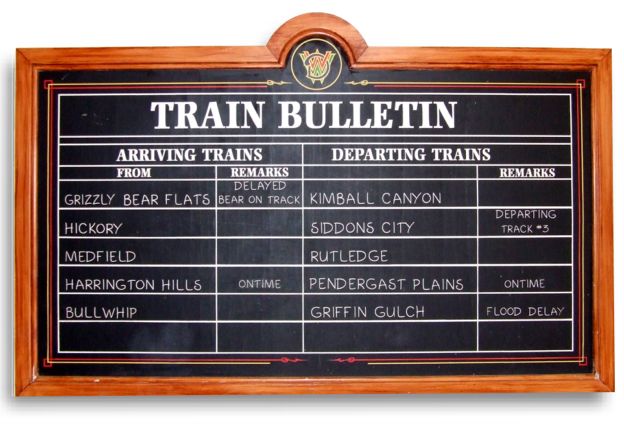
The Train Bulletin hangs on a wall below the Main Street Train Station in Walt Disney World's Magic Kingdom, and is essentially a puzzle of Disney trivia. Each row represents a specific Disney reference. In order, here is what they all mean:

  • Grizzly Bear Flats and Kimball Canyon - This row is a homage to legendary animator Ward Kimball. Kimball was a railroad enthusiast, and in 1938 he acquired a locomotive from the Nevada Central Railroad, and a Southern Pacific passenger coach. Thus, the Grizzly Flats Railroad was born in Kimball’s own backyard.
  • Hickory and Siddons City - The 1966 film Follow Me Boys features the character of Lemuel Siddons played by Fred MacMurray. The setting is the quaint little town of Hickory in the 1930s.
  • Medfield and Rutledge - These are the two rival colleges from The Absent-Minded Professor and its sequel Son of Flubber.
  • Harrington Hills and Pendegast Plains - Harrington is the small town setting for the film Pollyanna. Pendegast is the name of the story’s primary villain, Mr. Pendegast, portrayed by Adolphe Menjou.
  • Bullwhip and Griffin Gulch - The final row on the bulletin makes reference to the 1967 film The Adventures of Bullwhip Griffin, starring Roddy McDowall.

Saturday, April 07, 2007

More Bunny Fun


Tying in to yesterday's Funny Little Bunnies post, David Lesjak was kind enough to forward on this great image from a piece of classic late-1930s Disneyana. The PAAS TRANSFER-O-S packaging featured one of the cartoon's stock players assisting Mickey with some egg decorating.

And be sure to check out David's Toons at War blog for an item that makes the unusual connection between Funny Little Bunnies and the 88th Signal Corps during World War II.

Friday, April 06, 2007

Those Complicated Funny Little Bunnies

With Easter fast approaching, Disney’s Funny Little Bunnies was clearly an obvious choice for the subject of a post here at 2719 Hyperion.

When I watched the 1934 cartoon short recently, I saw a quaint, entertaining, but largely unspectacular endeavor from Disney’s prolific and groundbreaking Hyperion era. The film was the only Easter-themed short produced by Disney and stands as a shining example of the studio’s early marriage with three-color Technicolor. Like numerous other Silly Symphonies, it is a generally plot-less affair, a series of gags and vignettes that served to explain the more secular traditions associated with the Easter holiday. Similar in theme, style and structure to the earlier Santa’s Workshop, the short features a happy contingent of well-dressed rabbits and their assembly line antics, producing holiday treats such as decorated eggs and chocolate bunnies.

So, how could I take a fresh look at this 70+ year old cartoon?

There was the possibility of merchandise tie-ins. But alas, I’m not much of a vintage Disneyana collector and references to products relating to the more obscure Silly Symphonies are a bit difficult to track down. But there was one interesting item that bore mentioning--a 1951 Little Golden Book entitled Grandpa Bunny, that nearly two decades after the cartoon’s release, explained the origins of Bunnyville and its founder Great Grandpa Bunny Bunny.

Then there was the angle of Wolfgang Reitherman, one of Disney’s famous “Nine Old Men.” It had been noted that Funny Little Bunnies was likely Reitherman’s first assignment at the Disney Studio. I immediately went scrambling for Didier Ghez’s Walt’s People books and dug back into the series’ one Reitherman interview. But there was only a brief mention of the short where the studio veteran noted some difficulty in animating the decorated eggs in a couple of scenes.

My Disney history muse was clearly letting me down.

But sometimes an academic approach is not always the correct one. And it was my own mother who indirectly reminded me of this fact.

She was with me when I popped the DVD in the player a second time and navigated through the menu screens to Funny Little Bunnies, desperately seeking some measure of inspiration.

Within a few moments after the short started, my mom observed, “This is old, like one of the cartoons I would have watched when I was a little girl.” I confirmed that she would have been a child of five years when Funny Little Bunnies was released. She continued to watch for a few moments, then added, “Cartoons were good back then. Not like now. I don’t understand the cartoons that come out now.” As a grandmother of toddlers and tweens, she was likely referring to antics of Sponge Bob, Kim Possible and the countless other animated denizens that travel the current cable and satellite signals.

Talk about a humbling moment. Mom’s very basic observation was the perspective I needed. I was over complicating a bunch of cute rabbits.

Because Funny Little Bunnies, like so many of its Silly Symphony contemporaries, is engaging in its very simplicity. In a funny, colorful and happy manner, it explained to a generation of Depression-era children, just where Easter baskets came from.

Disney enthusiasts such as myself frequently expound on the child-like wonder that Disney entertainment often restores to our jaded and cynical adult frames of reference. Yet very often we can’t see the enchanted forest for the trees. Sometimes a work of animation needs to be perceived as it had been by its original audience, without any baggage of historical perspective. To its audience of some seven decades ago, Funny Little Bunnies was a simple and entertaining eight minutes of cartoon fun.
Thursday, April 05, 2007

See Diana Sore, Museum director

There's a terrific job opening over at Disney's Animal Kingdom.

Beyond Chester and Hester, there are a lot of great details scattered around DinoLand that relate specifically to the Dino Institute. Keep a keen eye out the next time you visit, and pay careful attention to the glass enclosed bulletin board where this particular notice is located.

Wednesday, April 04, 2007

Signs of Asia

The Asia area of Disney's Animal Kingdom is literally littered with signs that provide both a degree of age and also history to the Imagineer-created village of Anandapur.

The above sign provides the background to the setting of the Maharajah Jungle Trek, and reveals the ruins you wander through to be those of a 16th century royal hunting lodge, erected by King Bhima Disampati in the mid-16th century.


Closer to Expedition Everest are these signs that provide caution and advice to would-be adventurers.


Tuesday, April 03, 2007

Keep Moving Forward

“Around here, however, we don’t look backwards for very long. We keep moving forward, opening up new doors and doing new things - because we're curious. And curiosity keeps leading us down new paths. We're always exploring and experimenting.”

I've had numerous requests over the past few days to print the Walt Disney quote from the concluding moments of Meet the Robinsons. It was a very significant part of the film, as it ultimately focuses on Cornelius Robinson's mantra of "keep moving forward" and puts in perspective the crazy eccentricities of the extended Robinson clan and how fun and spontaneity are important components of any creative process.

While other Disney pundits are deep in Monday morning quarterbacking, analyzing box office receipts and comparing grosses, the relative financial success (or perceived failure) of Meet the Robinsons is really quite secondary to the message that is being communicated in those final frames of the film.

Walt Disney Feature Animation, and hopefully and more importantly the entire Walt Disney Company, are returning to their creative roots.

". . . moving forward . . . opening new doors . . . doing new things . . ."

For those words to emerge from a company that has been largely deemed creatively stagnant and bottom-line driven for the last ten years, it represents more than a quaint epilogue to an animated feature. I believe Ed Catmull, John Lasseter and Bob Iger are clearly telling us something. That the fundamental principles of the Disney company are still alive and well and have not been forgotten. That not all creative decisions are guided by fiscal projections and held hostage by corporate bureaucracy.

I loved Meet the Robinsons. It was happy, positive, and in my personal and very subjective opinion, very entertaining. And while the story of Lewis and his quest for family and acceptance tugged at my heartstrings, it was the extremely relevant words of Walt Disney that ultimately brought tears to my eyes.

Images © Walt Disney Pictures

Sunday, April 01, 2007

Freeze Frame! - Dinosaur Bob Meets the Robinsons


Here’s a Freeze Frame that will be likely go unnoticed by the numerous moviegoers seeing Meet the Robinsons this weekend.

The prehistoric hedge sculpture of the brachiosaurus-style dinosaur that features prominently in the Robinsons’ exterior landscaping? That’s Dinosaur Bob.

Dinosaur who?

Dinosaur Bob. The title character of a wonderful and beautifully illustrated storybook by William Joyce. It was another of Joyce’s whimsical and acclaimed works, A Day With Wilbur Robinson, that served as the inspiration for Meet the Robinsons.

The name William Joyce seems to hover just beyond the recognition it so rightly deserves. When you consider Joyce’s resume--distinguished writer and illustrator of children’s books, production and design credits on the television shows Rolie Polie Olie and George Shrinks and the 2005 animated feature Robots, humanitarian whose Katrinarita Gras Foundation was founded to aid artists and arts organizations impacted by the 2005 hurricanes-- you would think he would have gained a bit more notoriety among animation fans and Disney enthusiasts alike.

So the next time you head off to the library or your local Barnes & Noble, take a gander at Dinosaur Bob and Bentley and the Egg. Spend some time with The Leaf Men, George Shrinks, and Santa Calls. These happy and immensely entertaining tomes are well worth your attention.

Saturday, March 31, 2007

Pleased to Meet the Robinsons

I just met the Robinsons. And it was a happy encounter indeed.

While the reviews for Disney’s newest animated feature film have been generally positive, there have been a few (most notably the New York Times), that have taken a decidedly harsher view of Meet the Robinsons.

It really represents a damned-if-you-do, damned-if-you-don’t situation.

Meet the Robinsons is quirky, frantic at times, and clearly unconventional. It is also fresh and original. It has so many of the qualities that countless critics found missing in the numerous animated features that seemed to be constantly falling out of the sky over the last year. So when the film is described as “. . . surely one of the worst theatrically released animated features issued under the Disney label in quite some time,” such comments bear a note of exaggeration with fair degree of malicious intent.

The film chronicles Lewis, an orphan and scientific genius, and his time traveling adventures with Wilbur Robinson and Wilbur’s eccentric family of the future. The story does not by any means take the form of a smooth and linear narrative. Much of the movie is a disjointed bumpy ride, where the storytelling can sometimes be as off kilter as its cast of characters.

But ultimately that it what Meet the Robinsons is all about--happy, energetic spontaneity, with a very direct emphasis on fun. Director Stephen Anderson took to heart the story’s oft-repeated mantra of “Keep Moving Forward.” At the same time, the film refreshingly does not pander to the current entertainment climate that requires flatulence-based humor and PG-13 innuendos to effectively reach all the target demographics. It is unapologetic in its old fashioned, yet never over the top sentimentality.

And it is a healthy dose of that sentimentality that sneaks up and emotionally wallops you by the film’s conclusion. Personally, I didn’t see it coming. And that is why I ended up truly loving the movie. It surprised me on a level that was wholly and totally unexpected, with a heartfelt finish that reminded me of what Pixar accomplishes so well in just about all of their films. Yet it is not difficult to understand, in our popular culture which has become increasingly cynical and fueled constantly by internet negativity, why many critics and like-minded viewers would reject the Robinsons’ positive and idealistic message.

Enhancing the experience of Meet the Robinsons tremendously was its Disney Digital 3D format. The process was nothing short of amazing. It was my first exposure to the new digital-based process that utilizes circular rather than linear polarization, and in turn results in stronger more vibrant colors and an almost total elimination of “ghost images.”

An added bonus for most, but a near-religious experience for myself, was the presentation of the 1953 Donald Duck short Working for Peanuts. Made originally in 3D at the height of the format’s post-war wave of popularity, it was a joy to see it restored to a big-screen theatrical presentation. While the cartoon had enjoyed a brief run in the late 1980s as the pre-show for the Magic Journeys movie at Disney World’s Magic Kingdom, that small scale presentation did not do it justice. Here's hoping that Adventures In Music: Melody, the company's only other theatrical 3D film, will accompany a future Disney Digital 3D release.

Thursday, March 29, 2007

Of Mice and Mailboxes

Here's an interesting theme parkeology discovery from Mickey's Toontown Fair at Walt Disney World's Magic Kingdom.

When Mickey's Birthdayland opened in 1988, among the embellishments to Mickey's house was a traditional mailbox painted and adorned in a distinct Mickey style. When the area evolved in Toontown Fair a number of years later, the designs and architecture became much more toonier, and the original mailbox made way for a more stylized replacement.

So what did Mickey do with his old mailbox? The next time you walk through the mouse's garage, take a careful look around and you'll soon discover the answer.

Wednesday, March 28, 2007

FoxxFur on Audio Animatronics

I was thinking about Audio Animatronics recently and began attempting to collect my thoughts for a potential article and/or commentary here on 2719 Hyperion. I was primarily considering how in recent years there has been a distinct shift by Disney away from large scale audio animatronics-heavy attractions, much in the mold of The Great Movie Ride and early Future World endeavors like Horizons and World of Motion. Focus seems to have shifted to weenie-based, centerpiece AAs like Stitch, the Yeti and the much ballyhooed Jack Sparrow. I have wondered if this represented a dramatic shift away from AA-based attractions and reflected a growing disenchantment of the technology among both theme park guests and Walt Disney Imagineers.

Seeking an additional perspective on the matter, I solicited the input of friend and fellow Disney enthusiast FoxxFur, whose blog Passport to Dreams Old and New, represents in my opinion, some of the best writing on the subject of Disney, formally published or otherwise. She responded with an intelligent, articulate essay on the current state of audio animatronics that made me quickly and humbly set aside any intentions I had of writing a similar piece. Even better, she generously and graciously granted me permission to reprint her statements here.

From FoxxFur:

I'm not sure the public reaction to AAs is negative so much as unpredictable. Disney resisted being postmodern longer than probably anybody, and as a result there were/are an abundance of very earnest, interested, conceptually advanced AA attractions which are, sadly, being told with AAs. The public can't suspend disbelief anymore (I think this is, incidentally, disgusting), so the illusion can never be total anymore - only, in the case of recent figures like Stitch and Captain Jack, slightly mysterious.

Yet attractions that use AAs don't necessarily fail because of this. Although it's often mocked, sit in for a showing of The Hall of Presidents or The American Adventure and then stand right at the theater exit doors and listen to what people have to say. It's invariably positive, and usually mixed with some wonder about the figures. Although these are outliers as powerful presentations which have outlived many of their contemporaries, it's clear that people don't have conceptual limitations as to what an illusion of life can and can't be.

Furthermore, I believe WDI knows that for a certain type of effect, AAs still can't be beaten - their dimensionality requires a certain kind of attention and their scope requires that the sets they inhabit to be of a certain scale and complexity. For creating the right "dream state" / "Disney Magic" for many projects there is still no good substitute. For fantastic creatures - singing bears or whatever - there's still no better way to create the illusion of life. It's for humans that they prove problematic.

In addition, attractions with many figures in complex sets are costly to create and maintain. It's no wonder that WDI is falling back again and again on variations of projections and things to project them on - why build it and require it to work on cue for 18 hours a day, 365 days a year when you can make it work once and then replay that on non-degrading digital in a seamless endless loop?

What they're doing is picking their battles - where will an AA be the only appropriate solution? Guests and WDI are getting tired of the very thing that made AAs so amazing to begin with - that they do the same thing on cue every time. With increased demand for characters and Disney going overdrive to market them dry, WDI has very naturally gone on to try to provide us with "Living Characters" - first as projections, then as figures. Ironically, the actors these robots were meant to replace are now required to operate them.

As far as culturally, AAs are strange creatures. I think the best description of them I've ever heard is in Robin Allan, who describes them as grotesque. There's something creepy about them, especially when they travel into, as Jack Sparrow does, the uncanny valley. Richard Schickel, his his book The Disney Version, launches into an insane attack on Disneyland at the very end of the book where he makes the place out to be a freakish remote controlled biosphere built by a man unable to change the world around him, so he built his own, and especially singles out Mr. Lincoln as an essential affront to God. Although probably not in so sure terms, we react to these devices as being vaguely profane as part of our natural tendency to distrust anything which is so fake it's convincing.

And here's a quote from Network, delivered in that film by a television network executive to a psychotic news anchor, which not only sums up the public's perception of the "Disney Control Phantom", but is creepily close to the 'utopia' of Walt's EPCOT:

"Our children will live, [...] to see that perfect world in which there's no war or famine, oppression or brutality - one vast and ecumenical holding company, for whom all men will work to serve a common profit, in which all men will hold a share of stock - all necessities provided, all anxieties tranquilized, all boredom amused."


Enormous thanks to FoxxFur for making this contribution to 2719 Hyperion. If you are not familiar with Passport to Dreams Old and New, waste no more time and head over there now. Your only disappointment will be when you have exhausted her archive and then find yourself anxiously awaiting the blog’s next post.

Memories of Chester and Hester


If you do a little digging in DinoLand USA at Disney's Animal Kingdom, you can sometimes find more than just dusty old dinosaur bones.

It is amazing the sheer volume of material that adorns the walls (and even ceiling) of Chester and Hester's Dinosaur Treasures, Dinoland's signature souvenir shop. Hidden among these many remnants of paleontology pop culture, the keen eye can spot a couple of tributes to the proprietors of both the store and the nearby Dino-Rama amusement area.

Friday, March 23, 2007

Postcards: Now and Then


A few years ago, Disney World produced a line of merchandise themed to vintage travel and postcard designs. One item in particular that I really enjoyed was a Walt Disney World postcard done in the large-letter style that used to be very popular, especially during the 1940s.

An interesting contrast is this actual postcard from 1941. The card's back caption reads:

Almost in the exact geographical center of the State, Orlando is a fast-growing resort and distributing community. It is here that most of Florida's citrus fruit banking is conducted. In fifteen years the city has tripled in population until it is now a city of 35,000 year-round inhabitants. During the winter months it is host to an additional 35,000 persons from other states. Orlando is known as the "City Beautiful" for its 33 lakes and parks.

According to recent census estimates, the city of Orlando has a population of 213,233. The Greater Orlando area, which includes Lake, Osceola, Orange and Seminole Counties tops out at an estimated 1,933,215 individuals.