Wednesday, October 18, 2006

License to Collect: EPCOT 10

Disney World fans are buzzing about what the resort's plans are for EPCOT's 25th Anniversary. The only other EPCOT anniversary that the company acknowledged in any major way was the 10th in 1992-1993. Even then, their efforts seemed focused on merchandise and little else.

Here are two different EPCOT 10th Anniversary license plates. The first features a very distinct Future World theme; the second is a pastel-flavored homage to World Showcase. The Dawn of a New Disney Era-The Continuation of a Dream, with its circular logo, was featured on a wide variety of cast member-exclusive merchandise sold at the Company D store. The World Showcase Around the World in a Day design was used for 10th anniversary merchandise available to guests at the park. I personally really disliked this design. I was further disappointed when they recycled it the following year by just dropping the 10th anniversary references.

Whatever Became of the Placid Palms Resort?

Do you remember the Placid Palms Resort? Chances are you’ve been to its original location, and just didn’t realize it. Here’s a little story I was told back in 1989 when I was visiting what I thought was Disney’s then brand new, state-of-the-art water park:

“For as long as anyone could remember, the quaint thatch-roofed village had nestled along the shores of the sparkling lagoon, in the shadows of a great volcanic mountain. Then came the 20th century with its cruise ships, and tourists and the Placid Palms Resort . . . a special little place for lucky vacationers each year. The great storm, however, changed everything. . . a furious, unrelenting typhoon catching a small fleet of ships by surprise, and tossing them about like toy boats for one terrifying hour. But, in the storm's wake was left a remarkable scene. A surfboard had penetrated completely through a huge tree. A small boat had blown through the roof of one building. A great buoy had crashed through the roof of still another. The Placid Palms Resort was now the Leaning Palms, almost ready to topple over at any moment. A small harbor had been cut off from the sea, trapping an overturned boat and thousands of colorful fish, uh . . . plus a few sharks along the way. Nothing, however, topped the sight of the shrimp boat, "Miss Tilly," impaled precariously on the peak of the great volcanic mountain. To this day, the mountain tries vainly to dislodge its unwelcome burden with an enormous geyser of water every half hour. Well, what nature has really done is a little redecorating. The inhabitants were left with the most extraordinary assortment of waterfalls, rapids, pools, surf and all around wetness the world has ever seen. The once sleepy little resort had been turned into Typhoon Lagoon.”

Few would disagree that Typhoon Lagoon represents Walt Disney Imagineering at its very best. Its 56 acres are filled with countless details that all tie back to this central storyline. I was especially impressed with the explanation behind Shark Reef. In fact, you are immediately drawn into this cataclysmic legend when you turn into the park’s entrance. Burma-Shave style roadside signs proclaim the following:
Birnbaum’s 1990 guide also pointed out the following interesting element concerning the Humunga Cowabunga speed slides:

“Disney Imagineers, when doing research for the park, discovered that large crowds tend to gather where speed slides exist at other parks, to watch women wearing bikinis lose their bathing suit tops on the way down. Ever considerate, the Imagineers built a grandstand so that the voyeurs in the crowd have a place to sit. Modest maidens beware!”

Okay, so maybe there is one design detail that you can’t quite trace back to the Placid Palms Resort . . . (Although some clever Imagineer will no doubt claim the grandstand was from the resort's tennis courts and just coincidentally landed on that very spot!)

Snapshot! - Maharajah Jungle Trek

Pay careful attention as you walk along the paths of the Maharajah Jungle Trek in Disney's Animal Kingdom. Interesting visual elements often lurk just out of plain sight. Most folks only notice the real tigers.

Tuesday, October 17, 2006

Cranky Mouseketeers Part 2

And when I say cranky, I mean really cranky! Found on a popular forum today:

"I am so tired of people refering to any cartoon movie as a "Disney Movie"

Shrek is NOT DISNEY

Over the Hedge is NOT DISNEY

Sharks is NOT DISNEY

Ants is NOT DISNEY

Some times I want to take the movie box and have them look close at the name on it and then beat them int he face with it."

When a few replies noted that there were really bigger issues in the world to be concerned about, the original poster said this:

"But what you don't understand, is thease people are the ones that go to WDW or DL and complain because they dont see Shrek.

Thoes people are also the ones that dont pay attention to the world around them to notice the ligh tis green for 5 mins whil ethey are on their cell phone or looking in the back seat."

Wow . . .

Treasure Map o' the Caribbean

Yet another map for your desktop viewing pleasure. This one is located at the entrance to Pirates of the Caribbean: Battle for Bucaneer Gold at DisneyQuest at Walt Disney World.

Monday, October 16, 2006

Theme Parkeology 101: Disney World 1979

Good morning class.

I was doing some excavating recently and happened upon a very interesting discovery; a large envelope of promotional items relating to a 1979 Walt Disney World vacation that my father had squirreled away in a far corner of a bedroom closet. Consisting of a promotional magazine, a Vacation Guide, and a Magic Kingdom Club Membership Guide, the collection of materials provides an enlightening snapshot of what the World was like near the end of its first decade of operation.Some interesting facts and figures:
  • The ticket system was still in place: A-10¢, B-25¢, C-50¢, D-75¢, and E-90¢. A 3-day unlimited Magic Kingdom Passport cost $29.75 for an adult, $26.75 for junior, $14.75 for child.
  • The Polynesian Revue and the Hoop-Dee-Doo Musical Revue each cost $15 per adult, $12 per junior and $8 per child.
  • A buffet breakfast at the Top of the World restaurant at the Contemporary Resort cost $3.75.
  • The Walt Disney World Village (now Downtown Disney Marketplace) featured 27 specialty shops and the Empress Lily restaurant.
  • Eastern Airlines was the official airline. National Car Rental was the official car rental company.
  • Both Coke and Pepsi were available. Coke sponsored the Main Street Refreshment Corner and the Tomorrowland Terrace; Pepsi sponsored the Country Bear Jamboree, the Mile-Long Bar and the Pecos Bill CafĂ©.
  • The Monorail Club Car was a lounge on the Contemporary Resort’s Grand Canyon Concourse. Cocktails ranged in price from $.75 -$2.75.
  • Guests could borrow Polaroid cameras and Polavision movies cameras for free at the Camera Center on Main Street. You only had to pay for the film.
The WORLD Magazine was not so much a magazine as a travel brochure. It described the Magic Kindom as ". . . six themed lands, over 45 attractions and more than 70 restaurants and shops that can fill at least two days with unending adventures and limitless food." The final page promoted up and coming Disney films including The North Avenue Irregulars, The Apple Dumpling Gang Rides Again, and The Black Hole, and rereleases of 101 Dalmations, Lady and the Tramp and Bedknobs and Broomsticks.

Finally, here's the cover to the Walt Disney World Vacation Guide.

There is certainly no mistaking the 1970s from that photo!

Well, that's it for today. Don't forget your assignments for next class--Birnbaum pages 53-77 and Sehlinger 336-370. See you then.

Sunday, October 15, 2006

More on Merriweather Adam Pleasure


To expand on my previous post, here is an excerpt from an article that appeared in the fall 1989 issue of Disney News:

"Legend has it (Disney "Imagineering" legend, that is) that sometime in 1911 industrialist, inventor, and bon vivant Merriweather Adam Pleasure debarked his Mississippi Riverboat at Lake Buena Vista, Florida, and claimed a small island as his own. Here he created a bustling enterprise — Pleasure Canvas and Sailmaking, Ltd. Buildings quickly sprouted.

Dominating the skyline were the Canvas Fabrication Plant, Sailmaking Factory, and Administration building. Smaller shops made up Chandler Row — a brass foundry, upholstery shop, tool crib, and graphics shop, all for lavish, unique yacht ornamentation.
Later, a library was built and became the headquarters for globetrotter Pleasure's Adventurers Club. In 1924, Pleasure sent to China for the latest in pyrotechnics and built his fireworks factory. Finally, to contain his collection of desert flora, he built an elaborate greenhouse.

Merriweather Pleasure was lost at sea in 1941 and his island of industry soon fell into neglect.
More than forty years later the Disney Imagineers discovered the wreckage, worked a little magic, and, voila, from the ashes arose Pleasure Island, a night-time hot spot with nightclubs, eateries, A 10-screen movie house, and non-stop entertainment. Each of the buildings has been refurbished to house the ultimate in after-dark excitement."

Clock Cleaners - October 15, 1937


On this day in 1937, the Mickey Mouse cartoon Clock Cleaners was released to theaters across the U.S.A. It is one of the many ‘trio” shorts featuring Mickey, Donald, and Goofy, that were popular during the late 1930s.

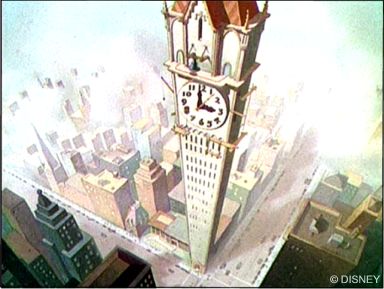
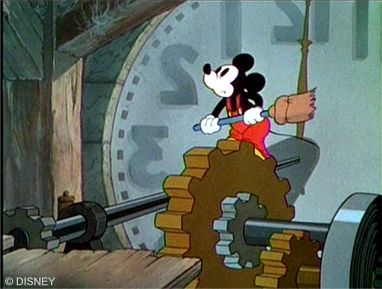
The film places the three protagonists high above the city skyline as they wash and clean both the interior and exterior of an elaborate and precariously high clock tower. It opens with an amazing scene of Mickey riding the clock’s second hand around its face, as a means of cleaning its huge numbers. It then follows each character’s individual adventures: Mickey attempting to evict a stubborn stork; Donald fighting with a sassy mainspring; and Goofy inadvertently being “gonged” by the tower’s mechanical bell-ringers. It climaxes with an intricately choreographed ballet of aerial acrobatics and pratfalls, as Mickey tries to prevent a dumbstruck Goofy from falling to his doom.

Wonderful details abound:The carefully crafted clock face . . .

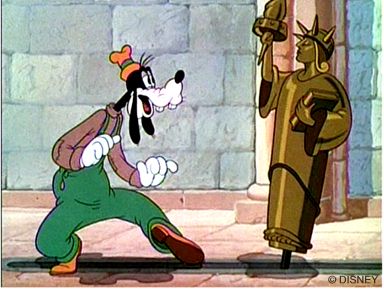
The mechanical bell-ringers that take the forms of Father Time and Miss Liberty . . .

The clock’s intricate gear system that is mechanically accurate and constantly in motion . . .

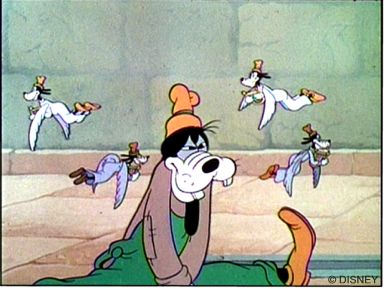
And the little angels that circle Goofy’s head after he is brained by Miss Liberty.

Clock Cleaners
is available on the Walt Disney Treasures Mickey Mouse in Living Color Volume One.

Saturday, October 14, 2006

Snapshot! - We're Looking for a Few Good Brains


Who knows if and when we'll be able to see this again. The last time we were inside Wonders of Life a few years ago, it was like a ghost town. Time will tell.

Friday, October 13, 2006

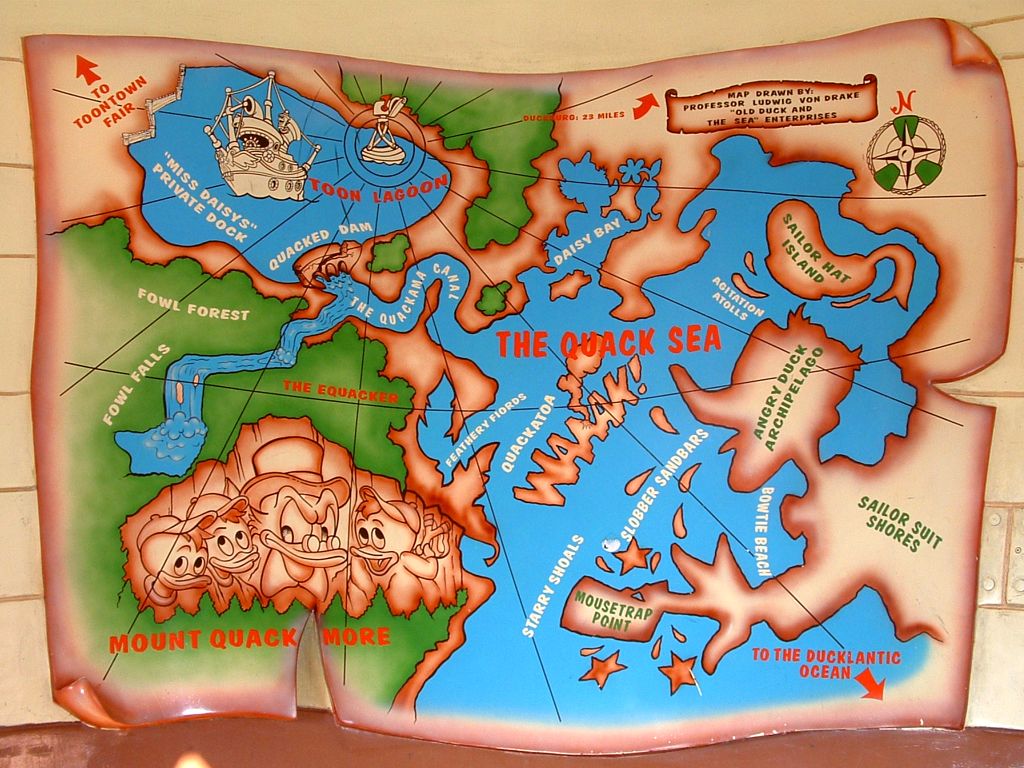
Inside the Miss Daisy

If you can dodge all the various water spouts and make it inside Donald's Boat at Mickey's Toontown Fair, you'll be treated to to seeing this colorful map adorning one of the walls. Link to the larger version if you would like it to reside on your desktop.

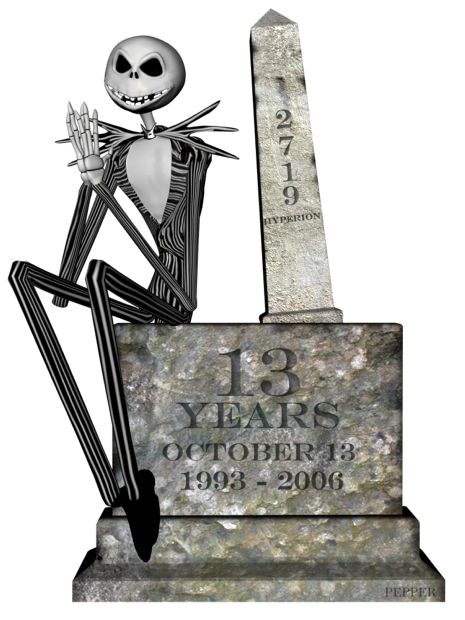
The Pumpkin King is Now 13

In the case of The Nightmare Before Christmas, thirteen is a very appropriate number to celebrate. On October 13, 1993, the film opened in New York City. I dusted off my DAZ Studio software to create this design to commemorate the occasion.

Thursday, October 12, 2006

Lotus Tours

Another dock element from Walt Disney World's Jungle Cruise. Link to the larger version if you want to use it as Windows desktop wallpaper.

Cranky Mouseketeers Part 1

Online forums are interesting places, often microcosms of our larger society. The negativity at times can be overwhelming. Anonymity equals empowerment for many people, and sadly, many use these bulletin boards to channel frustrations that likely have little to do with the subjects being discussed. Here are two comments from a recent thread about Walt Disney World's Year of a Million Dreams promotion:

"I'm sorry my son wanted a Fastpass! You don't have to worry about it because I won't be going any more during the celebration! More for you guys to win! I'll give it up! We just felt upset ,because I spent thousands and won nothing!
Sorry! "

"Duh! When you get to the bare bones, a WDW celebration is nothing more than a marketing campaign. Nothing more. Just a reason to make more money. Again, remember 100 Years of Magic? Nothing more than an excuse to make money. No new E-tickets, 4 "new" parades, 2 of which were made on the cheap using former junkyard cars and trucks as parade floats, another which was a recycled version of its predecessor, and a new theme park icon which was nothing more than a pin store. WDW is all about making money, not making art, not making magic. Magical Moments at WDW serve nothing more to reinforce the fact that us, as consumers, and the front-line entry level cast have fallen for this ruse. Even with all of the freebies given away with this celebration, I can assure you that Disney is not losing a penny."

Lots of anger there. The latter post is especially disturbing. Personally, I just don’t feel my enjoyment of Walt Disney World is undermined by the fact that it’s a business with a profit motive. Over the years, my family has experienced numerous magical moments, both orchestrated and spontaneous. It is one of the reasons we keep returning year after year. I’m not “falling for a ruse,” I’m just remaining loyal to a company that consistently treats me well as a consumer.

Wednesday, October 11, 2006

Don Rosa and the Disney Ducks

If you are a Disney fan and also a reader of comic books and graphic novels, then you likely are already aware of a gentleman named Don Rosa. If not, well, let me just tell you what you’ve been missing.

Don Rosa has been writing and illustrating Disney “duck” stories for nearly twenty years. Inspired by Carl Bark’s extensive library of Disney stories from the 1940s and 1950s, Don has created his own rich legacy of tales that continue the adventures of Scrooge McDuck, Donald Duck, Huey, Dewey and Louie, and the many other denizens of the “duck universe.” Don is a master storyteller and an amazingly talented artist. I’ve followed his duck career from the beginning, with the publication of his first story, “The Son of the Sun” in 1987. While remaining relatively unknown in the United States, Don is a household name in many countries across Europe, where Disney comics are still wildly popular. In fact, his new stories are typically published first overseas, and then later reprinted in the U.S. by Gemstone Publishing.

Tracking down the comics that feature his work can be a bit challenging. Gemstone’s website offers most of their back issues for sale, but older issues published by Gemstone’s predecessor Gladstone are more difficult to find. Most comic shops shy away from this type of non-superhero fare, and the Gladstone issues did not have substantial print runs.

The good news is that Gemstone is reprinting many of these earlier stories in their current publications. They have also over the past year, released two trade paperback compilations that feature some of Don’s most outstanding efforts.

The Life and Times of Scrooge McDuck is Don’s 12-part masterpiece and definitive biography of the “world’s richest duck.” It chronicles Scrooges life, from humble beginnings as a youngster in 1877 Scotland, to his days as a miserly recluse in 1947, when his thirst for wealth and adventure is suddenly rekindled upon meeting Donald and his nephews. Each chapter is crammed full of historical events, exotic locations, and even Teddy Roosevelt shows up in a couple places.

The Life and Times of Scrooge McDuck Companion features a collection of stories that supplement and expand on the material in the first volume. Especially fun are a number of stories that detail Scrooge’s adventures in the Yukon, where he made his first fortune, and also encountered Glittering Goldie, his one true, but ultimately unfulfilled love.

I’ve met Don a few times, most recently at last year’s Heroes Convention in Charlotte, North Carolina. He’s a truly genuine person, who is always happy to do a quick sketch for a sincere fan.

One last interesting bit of trivia: Don scripted two of the early episodes of the Disney Afternoon program Talespin back in 1990.

Who Was That Bear?

When people hear the words “Disney animation,” what immediately comes to mind? Snow White and the Seven Dwarfs? Beauty and the Beast? The Lion King? Peter Pan? Most folks will usually speak the names of their favorite Disney animated feature films.

When you mention Mickey Mouse, Donald Duck, Goofy or Pluto, people think mainly of cultural icons and theme park characters, and not much more. Yet the very films that gave birth to these characters, who are arguably more well known than any celebrities living or dead, go largely unnoticed and unappreciated by the general public, and by even many people who consider themselves die-hard Disney fans.

Animated short subjects are truly the foundation of Disney. They were both the creative and financial backbones of the company during its first thirty years. They made possible everything that came after. But sadly, they have existed in the shadows of the feature films for the past fifty years.

It’s funny. There are so many Disney enthusiasts out there. They proudly proclaim themselves as hardcore Disney fans. They build websites devoted to the theme parks and the movies. They host podcasts that supposedly discuss all things Disney. Yet many would not be able to tell you who Jack Hannah or Jack Kinney was. They’ve never heard of The Lonesome Ghosts nor The Band Concert. Or that a Disney-made Chicken Little predated the current CG feature by some fifty-plus years. Ironically, many of them buy high-priced collectibles inspired by films they have never ever seen. At the Wilderness Lodge at Walt Disney World, people still constantly ask, “Who’s the bear at the bottom of the totem pole?” Duffers the world over have framed animation art of Mickey Mouse playing golf, but could not name the film the scene originated in.

I love the feature films; most are hallmarks, not only in animation, but in the history of film as well. But my real passion is for the shorts. They are amazing in so many ways, and important on so many levels. They were the birthplace of numerous Disney icons. They were the testing grounds for innovations such as sound and color. They were schools of learning for the company’s legendary “Nine Old Men,” and many other talented professionals. And very often, they were windows into the popular culture of 1930s, 1940s and 1950s.

The good news is, that for the first time in the history of the company, nearly all these films are accessible, or on their way to becoming available. The Disney Treasures DVDs now include all the Mickey Mouse and Goofy shorts. Volumes arriving this December will complete the Pluto and Silly Symphony collections. The Rarities set includes numerous stand-alone films and the two Humphrey Bear shorts (he was the guy at the bottom of the totem pole). The On the Front Lines set includes the company’s World War II themed cartoons, public service shorts and propaganda pieces. Upcoming releases should add more rarities, and complete the Donald Duck series, which has had two sets already released.

Needless to say, I plan on discussing and celebrating these films here frequently, and in some fun and different ways.

Stay tuned.
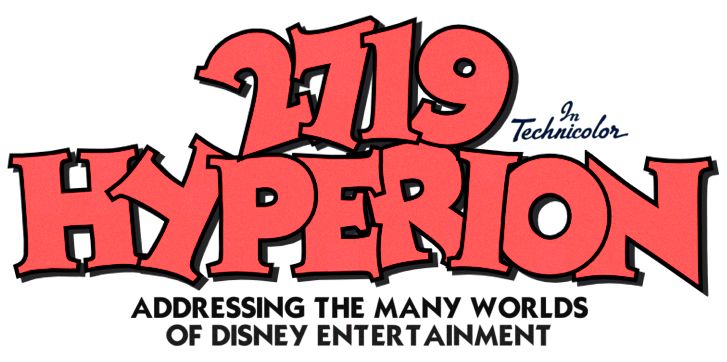
Passport to the Rivers of the Pharaohs

This dynamic design is featured on a wall at the Jungle Cruise's loading dock at Walt Disney World. I've enhanced the original photograph so to use it as a Windows desktop. Click to link to the full 1024 x 768 version.

Tuesday, October 10, 2006

The Legacy of Merriweather Adam Pleasure

With construction walls currently surrounding large areas of Pleasure Island, I thought it would be interesting to revisit this Walt Disney World entertainment district as it was in its very earliest of days.

Pleasure Island opened during the late spring of 1989. The 1990 Birnbaum Guide provided this description of the area’s backstory:

“Although Walt Disney World is not otherwise noted for its historic antecedents, a recent ‘discovery’ may change all that. Imagineers tell us that right beside the Empress Lilly at the Disney Village Marketplace, an island was recently unearthed where an enterprising, larger-than-life 19th century ship merchant, one Merriweather Adam Pleasure, held court.
Though the merchant sailing trade was in a decline at the time of his residence, the upsurge of leisure yachting assured the success of Pleasure's Canvas & Sailmaking, Inc. The booming business spawned Pleasure Island, a community dev
eloped to abet Mr. Pleasure's pursuit of adventure and excitement. So the story goes. . . and continues.
According to local legend Pleasure turned his entire operation over to his sons while he circumnavigated the globe, but he was lost at sea in 1939. Pleasure Island soon fell into disrepair due to the neglect of his lazy offspring. Enter Disney Imagineers, who have transformed the abandoned lofts, warehouses, and factories into an entertainment complex of nightclubs, restaurants, shops, and movie theaters.”

Here is a list from a Pleasure Island brochure that details the complex’s original nightclubs, restaurants and shops. (Click on the image to bring up a larger, more reader-friendly version.)


Like Disney -MGM Sudios that opened at roughly the same time, Pleasure Island evolved and changed quickly during its first few years of operation.

It was an extremely fun and slightly more innocent place back then. One of its debut nightclubs was Videopolis East, an under-18 only club that was inspired by a similar Disneyland venue.

The XZFR Rockin’ Rollerdrome was a skate rink by day and a dance club by night. The house band was the Time Pilots; they hailed from the planet XZFR. The building was originally Pleasure’s laboratory with a wind tunnel to test a secret flying machine he was building. It was ultimately this vehicle, dubbed the Mother Ship (and suspended from the club’s ceiling), that brought the Time Pilots to our planet.

More “histories” were provided for the other locations on the island. The Neon Amardillo was located in Pleasure’s former greenhouse. The Comedy Warehouse building was the island’s original power plant. Mannequins was formerly a warehouse used to store canvas and sewing equipment. The Fireworks Factory restaurant was well, the site of Pleasure's own fireworks factory, that was accidently blown up by a stray spark from Pleasure's own cigar. This at the time was one of my favorite restaurants in all of Disney World. I was heartbroken when they removed it in the mid-1990s in favor of the Wildhorse Saloon, just to satisy the then popular fad of honky-tonk clubs that catered to the country line-dancing crowds.

The shops at that time were equally interesting and full of atmosphere. My two favorites were Avigator’s Supply, a companion store to the Adventurers Club, and YesterEars, which sold reproductions of vintage Disney toys and merchandise.

It will be interesting to see what Imagineers will have “unearthed” when the construction walls come down sometime in the near future.

Monday, October 09, 2006

When I Was Your Age . . .

I listen to podcasts. I lurk on forums. And let me tell you-- I’m tired. I’m tired of the whining. I’m tired of all the moaning and complaining.

The Disney Channel stinks! We hate the “cheap-quels”! We want Vault Disney back! We’re sick of Stitch! There’s not enough E-ticket attractions! There’s too much Pooh stuff! Michael Eisner ruined the company! The parks are turning into Pixar-lands! John Lasseter is going to screw up everything!

You know, young Disney fans just don’t know how good they have it.

Let me tell you how it was when I was your age . . .

. . . we only had one theme park at Walt Disney World. One park, three resorts (if you count the golf one), a campground and a wildlife preserve you had to ride a boat to. That was it.

. . . we had tickets. Yes tickets. None of this unlimited access to all shows, rides and attractions. You rode Haunted Mansion once. That was it. Pirates of the Caribbean. Once. Jungle Cruise. Once. And your mother always made you waste one of those precious E Tickets on Small World.

. . . we had to typically wait three to four years for a new Disney animated feature film. And then what did we get? Robin Hood. The Rescuers. The Black Cauldron. The Fox and the Hound. Oh, they’re nice little movies, but not exactly up there with the likes of Little Mermaid, Beauty and the Beast, Aladdin, Lion King, and Toy Story, all the ones you were all raised on.

. . . if you wanted to watch a Disney classic, guess what. You could see it once every seven years in a theater, if you were lucky. God, when Pinocchio was released on home video in the early 80s, we thought we had died and gone to heaven. Films like Melody Time, Make Mine Music, and Fun and Fancy Free? Get real. I didn’t even know they existed until Leonard Maltin told me about them when I was older.

. . . seeing an intact, unedited Mickey Mouse cartoon was next to impossible. You guys can pretty much pop Steamboat Willie into the DVD player any time you want. Let’s not even talk about how you can now watch some of them on your iPod.

. . . we had nothing even close to the Disney Afternoon, let alone the Disney Channel, Toon Disney and entire Walt Disney Home Video library. We had the Wonderful World of Disney for an hour every Sunday night. And most of the time we got stuck with stuff like Charlie the Lonesome Cougar and Sammy the Way Out Seal.

You youngsters are soft, spoiled. Don’t know what true Disney hardship is.

Saturday, October 07, 2006

Snapshot! - Stage One Company Store

The Stage One Company Store sits slightly off the beaten path at Disney-MGM Studios. You clearly cannot fully appreciate its zany Muppet-themed exterior when the area is thick with guests. I managed to photograph it at a perfect time.

Really Special DVD Features

Two delightful surprises appear on Disney's Platinum Edition DVD of The Little Mermaid that was just released earlier this week.

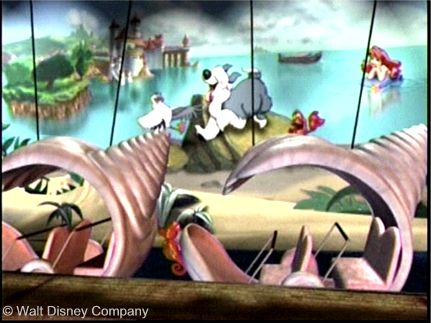
Highly unique and original as a DVD supplemental feature is the Under The Sea Adventure. Very oddly listed under the Games & Activities section on disc 2, this feature is literally a virtual theme park attraction, based on Walt Disney Imagineering concepts for a Little Mermaid dark ride. Imagineers returned to their early 1990s designs to create this CG experience. Tony Baxter provides the background on the project, and viewers are treated to original concept art and models. A really great detail: when you board your ride vehicle at the beginning, you hear safety instructions in both English and Spanish.

The Little Match Girl is a truly beautiful seven minute piece of--what's this?--traditional 2D animation! Developed originally for a proposed Fantasia 2006 feature, this short is a poignant adaptation of the Hans Christian Anderson story. Directed by Roger Allers and produced by Don Hahn, the film retains the story’s original tragic ending. Aside from the snowflakes at the film’s beginning, all the animation was hand drawn. I love a lot of CG animation, especially of the Pixar-level quality, but seeing this film really made me feel even sadder about traditional animation’s recent near-demise. It’s ironic that CG pioneer John Lasseter, now creative head of WDFA, will more than anyone, likely bring it back from the brink of extinction.

Oh, and there’s a really great animated feature film on the DVD that you might want to check out as well. Something about a mermaid and a prince . . .