Saturday, March 05, 2011

Saturday at the Archives: "Grab Your Shootin' Iron Son, We're Goin' Huntin'!"
"Grab Your Shootin' Iron Son, We're Goin' Huntin'!"
By Jeffrey Pepper
Originally published January 6, 2009

Editor's Note: The release of Bambi on Blu-Ray this week reminded me of one of the best gags ever presented in a Disney cartoon.  The phrase "man is in the forest" takes on an entirely new meaning in the 1955 cartoon No Hunting.
 One of the great joys of the Disney Treasures DVD The Chronological Donald Volume Four was to see the 1955 cartoon No Hunting restored to its original unedited, widescreen Cinemascope presentation.

No Hunting clearly stands out as one of director Jack Hannah’s best efforts over the course of his tenure with Donald Duck. It is more akin to Tex Avery’s numerous MGM parodies or Goofy’s own “How To” series, than it is to traditional Donald Duck cartoons. Donald and his typical antics are kept to a minimum, in favor of a broader, satirical take on the outdoor sporting life that was especially romanticized during the post-war years.

Hannah's approach to lampooning that era's sportsmen was certainly an interesting creative choice. The director and his crew set their very over-the-top satire in a tableau of World War I and II-inspired battlefields and elements. Hunters hunker in trenches and hunter-paratroopers descend down from the sky. Beachhead landings and devastated landscapes feature prominently. The comedy is broad and often hilarious, despite the use of very harsh wartime imagery as its primary satirical device.

The broad, but still somewhat sharp social satire is combined with well-crafted slapstick in the form of the spirit of Donald's Grandpappy. He is certainly at the heart of the short's humor and foreshadowed future eccentric Donald Duck relatives such as Ludwig Von Drake and Moby Duck.

Hannah discussed No Hunting with Jim Korkis, in an interview reprinted in Volume One of Didier Ghez’s series of books Walt’s People. Here’s an excerpt where Jack relates the inspiration for the short:

I used to go hunting with my dad when I was a kid and this short was a great takeoff on these hunters and fishermen. They really are this way. They are as dangerous to themselves as to the game they’re hunting. I’ve heard there are more hunters shot on opening day than deer. It shows how timeless these shorts are because it still spoofs hunters and fishermen. They’re still that way.

My students especially enjoyed the joke where all the trash cans are coming down the river and I stuck in Bambi’s mother who says, “Man is in the forest. Let’s dig out.” There was sort of a subtle feeling in the short that Donald wasn’t himself which is why he doesn’t talk. Hunting didn’t mean a thing to him but it was the spirit of his grandfather that came out of the painting off the wall that got into him and now made a monster of him. He was possessed. That’s why he didn’t speak. Donald just wasn’t himself. I never thought of that later as being one of my better shorts but after seeing it recently, I’ve changed my opinion.

Beyond his directing chores, Jack made another interesting contribution to No Hunting:

Talking about this particular short, I stuck my voice in several times. Remember where the spirit of the Duck had antlers on and a moose was down in a hole with him and the moose says, “Hmmm, you’re a cute one”? That’s my voice! The animator I was working with on that sequence, John Sibley, got a big kick out of the way I said it so I finally said, “Hell, I’ll record it.” And I did.

Friday, March 04, 2011

Vintage Snapshot! - All Aboard in Frontierland


The original Frontierland train station in Walt Disney World was a somewhat modest and unassuming structure when now compared to its contemporary counterpart.  This Vintage Snapshot dates back to 1975, years before the landscape of Frontierland, and the station itself, was dramatically re-imagineered to accommodate an E-Ticket attraction of epic size and proportions: Splash Mountain.  Also notable are the vintage 1970s-era blue strollers parked in the foreground.  Classic ankle killers of the highest order!

Thursday, March 03, 2011

Windows to the Past: Donald Duck and the Seasweep


The Kingdom Hearts video game was not the first time Donald Duck was transformed into a mer-creature.  Witness this long-classified photograph taken during World War II at an undisclosed location somewhere in north Africa.  Emblazoned on the aircraft is a fish-tailed Donald, replete with a trident and a stern expression.  The photo's caption reads:
AN ADVANCED NORTH AFRICAN AIR BASE--The crew of "Seasweep" North American B-25 Mitchell bomber of, Major General James H. Doolittle's Bomber Command, have completed their 50th mission. Left to right are: Lt. Wm. J. Hartman, Catskill, N.Y., navigator; Lt. James T. Holey, Tuskaloosa, Alabama, pilot; Lt. Wm. M. Butterfield, Moscow, Idaho, co-pilot; S/Sgt. Alvin L. Langford, Waco, Texas, gunner; T/Sgt. John D. Glass, Biquiu, New Mexico, radio-gunner, and Lt. Marion S. Vestal, Grand Rapids, Michigan, bombardier.
The photograph was dated November 29, 1943.

Wednesday, March 02, 2011

Disney's Hollywood: Gower Gulch and the Drugstore Cowboy


It's always fun to find trace evidence of bygone popular culture lingering in the background of a classic Disney cartoon.  Such evidence is on display in the 1943 Goofy short Victory Vehicles, and it serves to remind us of a long-faded but still quite memorable Hollywood archetype: the drugstore cowboy.

In Victory Vehicles, Goofy briefly played the part of a drugstore cowboy, aptly demonstrating lasso-powered mobility as a form of alternate transportation.  The narrator even refers to him as a "Hollywood drugstore cowboy."  So, just what exactly is a "drugstore cowboy," at least in context to the Hollywood of Walt Disney's time?  The answer can be found in that very same scene, if one looks beyond the mugging Goofy to the background behind him.  The Gower Gulch Pharmacy is the clue that unravels the story of this particular piece of silver screen folklore.


Gower Gulch is the nickname for a very specific piece of Hollywood geography: the intersection of Sunset Boulevard and Gower Street.  This was a location central to a number of well known movie studios, including Columbia, RKO, Paramount and Republic Pictures.  Located at the southeast corner of Gower and Sunset was the Columbia Drug Co., famous for both its soda fountain and newsstand.  Both Columbia and Republic specialized in westerns during this time period, and aspiring actors, many of whom were actual working cowboys, would congregate in and around the drugstore, hoping to be selected by the studio casting agents who would frequent the area.  Many of these hopefuls would come to Gower Gulch fully outfitted in their cowboy clothing and gear, and thus the moniker "drugstore cowboy" was born.

For more information about Gower Gulch, check out today's post on our companion site Boom-Pop!--The History and Mythology of Gower Gulch.

Tuesday, March 01, 2011

Bambi's Second Screen: Amazing, Engaging and Fun

As each new Blu-Ray upgrade of a Disney animated classic is released, it seems there is less and less to say beyond a cursory evaluation of any new supplemental material not included on previous DVD editions.  Such was the expectation with Bambi, the latest in the Diamond Edition series.  But with this particular release, Disney has thrown a curve ball game-changer, a WOW! inspiring next step in home entertainment that is especially compatible with a film such as Bambi, and classic Disney animation in general.  Disney Second Screen is nothing short of amazing and it is indeed the "groundbreaking experience" that Disney's own publicity material proclaims.

Second Screen is exactly that, an additional interactive platform that provides supplemental content that is synchronized to the actual presentation of the film.  Two such platforms are currently available, either an Apple iPad or a laptop computer.  Second Screen comes to the iPad by way of a free application downloaded via the App Store.  For the Mac or PC, it is a Flash-based interface streamed through Disney's web site.  While the PC version works well, one has to feel that Second Screen was designed very specifically with the iPad in mind; it takes full advantage of the portability of that device and its exceptionally responsive capacitive touch interface.  Navigating it with a mouse or touchpad feels distinctly clunky in comparison.  Another advantage to the iPad version is that, once downloaded, the Second Screen content does not require an Internet connection to operate.

 
For Bambi, the Second Screen content is primarily a wealth of production artwork, interspersed with archival photos, anecdotal snippets of text and trivia and a few vintage film clips that take you inside the Disney Studio during those early years of production.  The presentation is a near perfect fit for animation.  The interface is easy and intuitive.  Original storyboards can be experienced effortlessly through the iPad's touch/swipe interface and the Flipbook feature is a particular delight.  Dragging the flipbook button back and forth  literally recreates the original test animation, much like a moviola.  A simple toggle lets you compare the original animation to the finished film sequence.  And although the experience is very much tailored to the animation enthusiast, Second Screen does include a number of kid-friendly features and activities that are well integrated, yet easily avoided if so desired.

 
Second Screen is indeed a major leap forward for supplemental features.  As much as I always value the gallery content Disney includes in the majority of their animated film DVDs, those galleries have always been largely user-unfriendly and typically slow and clumsy when navigating via a remote control.  As noted, the iPad interface is especially fast and seamless.  An added bonus is that the content can be accessed with or without synchronization to the film.

As to the Bambi disc itself, the high definition presentation serves the film well; picture and sound are top drawer and a pleasure to behold.  Beyond the Second Screen feature, there is little new in the way of special features that have not already been included on the previous Platinum Edition.  There is an "enhanced edition" of the Inside Walt's Story Meetings from the prior set, two additional deleted scenes, a rendition of the deleted song "Twitterpated" and the family-friendly Disney's Big Book of Knowledge: Bambi Edition.  Not migrated from the Platinum Edition were Disney Time Capsule: 1942 and a feature on the first DVD restoration process.

As always, a high definition version of a Disney animated classic is a welcome addition to a home entertainment library.  The Disney Second Screen proves to be very enticing and delicious icing on the cake.  If you are an iPad owner, it is an especially fortuitous and engaging experience.

Monday, February 28, 2011

Studio Geo: The House That Snow White Built


Walt Disney began his career as a filmmaker in January of 1920 when he took a job making animated advertisements for the Kansas City Film Ad Company. It was the beginning of a journey that would take a struggling young artist and entrepreneur and eventually mold him into one of the most celebrated icons of 20th century popular culture. The historical map of that journey is an extraordinary one.

Welcome to Studio Geo. These are the places where Walt Disney created his moving pictures:

The Walt Disney Studios - Burbank, California
The success of Mickey Mouse was certainly the primary financial force behind the growth and expansion of the Hyperion Avenue studios. In much the same way, Disney's sprawling and meticulously designed Burbank complex was a house initially built by Snow White and the Seven Dwarfs. Greatly expanded and dramatically modified over the past seven decades, it remains the home of the Walt Disney Company.

Walt wasted no time putting his Snow White profits to work. In August, 1938 he purchased 51 acres of land adjacent to Buena Vista Street in Burbank. Construction on the new studio began almost immediately thereafter and the new facilities were for the most part complete and being occupied by early 1940.

The Walt Disney Company's official history notes that, "Walt was personally involved with all aspects of designing the studio. From the layout of the buildings to design of the animators' chairs, nothing was left to chance. His main concern was to produce a self-sufficient, state-of-the-art production factory that provided all the essential facilities for the entire production process." The new studio, designed primarily by architect Kem Weber, was a graceful swan to the Hyperion studio's ugly duckling. But despite its attractive, campus-like setting and its sleek, streamline modern designs, many members of Disney staff, from artists to service workers, found the aesthetics of their new workplace cold, somewhat sterile and often overwhelming. Over time though, most adapted, probably due in part to numerous employee-friendly amenities that included recreational facilities, a popular commissary and even a full service gas station.

Although the Burbank facilities were designed specifically for producing animation, large soundstages were systematically added to the lot to accommodate gradual increases in live action productions. Stage One was built in 1940 as part of the original design and was used initially to film the live-action orchestra sequences for Fantasia. Stage Two was added in 1949 in an arrangement with actor/producer Jack Webb who filmed his Dragnet television series there for a number of years. That stage later became home to the original Mickey Mouse Club in 1955. Stage Three, complete with a water tank, was built in 1954 specifically for the filming of 20,000 Leagues Under the Sea. Stage Four was added in 1958 and first used for the film Darby O'Gill and the Little People.

Back-lot streets and sets began to emerge in the mid-1950s, at first to accommodate television productions such as Zorro, Elfego Baca and Texas John Slaughter, and then live action feature films that had become the lion's share of the company's output. The back-lot was comprised of four primary groups of exterior sets and facades: a western town, a traditional town square, a residential street, and the Zorro pueblo that was later converted into a French village. The back-lot was eventually phased out over time and replaced with an office building, a parking structure and two additional soundstages.

Far more so than the Hyperion studios, the Burbank studios became much more recognizable to the general public. Walt first showcased the studio in the 1941 feature The Reluctant Dragon, where comedian Robert Benchley bumbled through much of the lot in what amounted to a lighthearted documentary on the making of Disney cartoons. Later, the studio and its environs were frequent backdrops for the Disneyland, Wonderful World of Color and Wonderful World of Disney television programs.

The Walt Disney Company has dramatically expanded in recent decades into an international entertainment conglomerate, and so has the Burbank complex correspondingly enlarged and grown. Following extensive company restructuring in the mid-1980s, then CEO Michael Eisner commissioned architect Michael Graves to create the Team Disney building, an imposing structure that now dominates the studio lot, with its outsized Seven Dwarfs sculptures paying subtle homage to the film that financed Disney's move to Burbank. At roughly the same time, Walt Disney Feature Animation was ironically exiled to a warehouse in Glendale. The department returned to Burbank in 1995 in a new and larger building, replete with a giant Mickey Sorcerer's Hat, directly across the street from the main studio complex.

A street sign that still marks the corner of Mickey Avenue and Dopey Drive has become a company icon of sorts, although its attached pointers to studio departments such as LAYOUT, MULTIPLANE, INK & PAINT and IN BTWEEN have long lost their relevance as directional cues and now serve more as historical markers.


Explore the 2719 Hyperion Archives:

Sunday, February 27, 2011

Boom Pop! - The Return of the Middletons and More!


Our explorations this week at Boom-Pop! took us from a 1930s-era Pittsburgh neighborhood to the Flushing Meadows location of the 1939 New York World's Fair, and our mode of transportation was a 1952 Kaiser Manhattan automobile.

We climbed down from Tony's Attic and walked two blocks to take in a matinee at the nearby Plaza Theatre.  Then, the Middleton family came calling and shared with us another one of their adventures at the Westinghouse World's Fair pavilion.  Finally, we headed to the auto show to take a look at Henry Kaiser's newest model vehicle with the "world's safest front seat."

As we always say, living in the past can be a whole lot of fun.  Visit Boom-Pop! today!


Saturday, February 26, 2011

Saturday at the Archives: Roadside Disney: Looking for a Good Night's Sleep
Roadside Disney: Looking for a Good Night's Sleep
By Jeffrey Pepper
Originally published February 10, 2008

One of the themes I revisit often here at 2719 Hyperion is the traces of popular culture that can be found in Disney entertainment, especially in productions from the Studio's first three decades. The emerging dominance of automobile transportation during those decades gave birth to a roadside culture that permeated the American landscape until diminishing with the advent of Interstate highway system in the 1950s and 1960s. Disney artists and animators would often inject their work with roadside inspirations, and its easy to understand why. Based out of southern California, they existed at a focal point of roadside Americana. The mother road, the legendary Route 66, cut a path directly through Hollywood.

Overnight lodgings became necessities for weary automobile travelers. As author John Margolies notes in his book Home Away From Home: Motels in America, "The roadside hostelries that evolved were not only creative and efficient institutions, but they became part of the ethos of American mobility and popular culture. The setting of a motel room or a tourist cabin has provided moments in movies and literature."
The 1947 Donald Duck short Wide Open Spaces is the first time that a Disney character seeks out a motel for a good night's sleep. The Hold-Up Motel is no more than an old house distinguished by its clever gun motif sign, but it evokes an archetype setting made especially famous by Hollywood in countless crime noir films of that time period. Background artist Howard Dunn did a terrific job of capturing that darker, moodier style, even though the tone of the short was generally light and comical. Seedier roadside venues were clearly the inspiration for the Hold-Up Motel and those places were often distinguished as criminal hideaways or as author Margolies remarks," . . . venues of choice for those with less than honorable intentions." Even FBI Director J. Edgar Hoover attacked the tourist camp industry when he wrote an expose called "Camps of Crime" for The American Magazine in 1940. Fortunately, the only supposed crime Donald encounters at the Hold-Up Hotel is the proprietor charging $16 for "the cot on the porch."

When Goofy took Two Weeks Vacation in 1952, his adventures were the cartoon equivalent of a Route 66 road trip in everything but highway name. At the beginning of the short, a desk bound Goof dreams of golfing, boating, hunting and fishing, but his reality instead becomes roadside escapades involving crooked mechanics, reckless trailer jockeys and the quest for a neon sign proclaiming VACANCY. These vignettes and gags were very much rooted in American roadside culture. Motor courts and tourist cabins were still in their heyday at the time of Two Weeks Vacation, and that is reflected in the backgrounds created by Art Riley.

In his search for lodging, Goofy encounters one of the common marketing mantras of the open road: LAST CHANCE. When countless miles often separated small towns and their roadside establishments, the term LAST CHANCE was frequently used when advertising or identifying restaurants, service stations and motels. To his horror, the Goof discovers he has passed the LAST CHANCE MOTEL and that the NEXT CHANCE MOTEL is still some 500 miles distant. He ultimately arrives at an unnamed motel claiming vacancy. Riley clearly drew inspiration from existing establishments. The motel's adobe architecture can be found in motor courts that dotted the American southwest. The cartoon design is an almost direct copy of vintage motels such as the El Vado Court in Albuquerque and the Adobe Motel in Santa Fe.

Goofy is trumped out of the last room at that particular establishment, but manages to subsequently secure a room at a motel-type that was once a mainstay of automobile travelers: the tourist cabin. In what is perhaps the cartoon's funniest gag, he walks through a quaint and picturesque cottage facade that could have been lifted from a mid-20th century linen postcard. But things are not what they seem, for a ramshackle shack is what lies behind the cottage door.

This is not just a simple cartoon gag; it represents a dynamic that Margolies describes in Home Away From Home:
By 1935, in another article in National Petroleum News, cabin camps were described as being of two types — the $1 cabin and the 50-cent cabin. The dollar cabins weren't all that bad: a bed with good springs, lavatory, toilet, tub or shower, chairs, lamp, and many had interior walls. There was usually a restaurant or a kitchen in a separate building, and some operations even had a swimming pool. The 50-cent cabin was much more spartan, offering little more than a bed with bathroom facilities and electricity, and a lunch-counter-type eating facility. Even so, James Agee, in his 1934 article in Fortune, could wax poetic about "the oddly excellent feel of a weak-springed mattress in a clapboard transient shack."
In the same article, Agee described in detail an even nicer two-dollar cabin: "In this one you find a small, clean room, perhaps ten by twelve. Typically its furniture is a double bed—a sign may have told you it is Simmons, with Beautyrest mattress — a table, two kitchen chairs, a small mirror, a row of hooks. In one corner a washbasin with cold running water; in another the half-opened door to a toilet. There is a bit of chintz curtaining over the screened windows, through which a breeze is blowing. ...Inside you have just what you need for a night's rest, neither more nor less. And you have it with a privacy your hotel could not furnish — for this night this house is your own."

It would appear that Goofy paid for a two-dollar cabin with attractive chintz curtaining, but ended up with the 50-cent transient shack. A closer examination reveals that the bed in the room is in fact an old door propped up with wood posts and bricks. While Art Riley is likely better remembered for his work on such feature films as Snow White and the Seven Dwarfs and Pinocchio, his efforts at bringing forth these then mundane scenes of 1950s America have in effect become artistic time capsules of a now bygone era.

While there are many who would likely consider animated incarnations of motel courts and tourist cabins to be no more than cartoon minutia, they are in fact a testament to artists such as Dunn and Riley whose efforts, especially those associated with short subjects, often go uncelebrated. For through their work, they preserved small pieces of history and popular culture that sadly, continue to fade from both memory and view.

Explore the 2719 Hyperion Archives:

Friday, February 25, 2011

Vintage Snapshot! - EPCOT in Classic Blue and Crystal


Standing in the shadow of Spaceship Earth was quite different in 1982 when this photograph was snapped.  Blue was certainly the dominant color of the main entrance plaza of EPCOT Center in those early years, as especially demonstrated by the fountain and its clear centerpiece with etched EPCOT icons.  The original fountain design was by no means an afterthought for Imagineers; it appeared in numerous pieces of concept art, most notably Herb Ryman's exquisitely beautiful rendering of EPCOT's main entrance.

Thursday, February 24, 2011

Vintage Headlines: Disney on Parade

Relating to yesterday's Window to the Past that features a publicity photograph from the 1973 edition of Disney on Parade, we present this Vintage Headline.  During the early summer of that year, the touring company for that elaborate stage production was appearing in venues located in western states.  Critic Robert McDougal, provided this very enthusiastic and rather detailed review of the show that was performed in Provo, Utah on May 30, 1973:
From the moment Mary Poppins came swooping out of the wings flying high above the crowd to he last moment when crowds of eager children rushed out to surround Mickey Mouse, the opening night of "Disney On Parade" Wednesday held a packed house spellbound.

The show is celebrating the 50th anniversary of the founding of the Walt Disney empire which consists of cartoon and feature film production in addition to books, records and entertainment centers.

An apt description of the presentation is flawless, but a description of the spectacle is spectacular. Costume design, lighting, choreography and execution of the spectacle were all without fault.

The show depends on a mixed media approach for its effect and on lavish costume and spectacular sound and props. A large screen is used to project animated settings and backgrounds, then at the appropriate time, the character comes alive on stage and continues the plot.

Early in the show, the story of Pinocchio on Pleasure Island uses the device to good effect. The famous puppet with his conscience (Jiminy Cricket) plunges through a series of adventures until he rescues his father from a whale in a dynamic film presentation of the whale's antics and ferocious attempts to harm the heroes.

Clever costume changes, and a series of remote controlled hoists which flew characters in and out of the production were worthy of note.

An interesting trip to the bottom of the lagoon near the island of Naboombu involved the entire cast dressed as sea creatures for a 1920-ish mini musical revue complete with villains, beautiful girls and a hero. The staging was good and the costuming extremely imaginative and engaging. The story was perhaps a little too deep for the younger members of the audience whose attention seemed to wander, but only an occasional adult moved as a child prevailed on a parent to make a trip out for drinks and other necessaries.

The children were on the edge of their seats literally throughout the rest of the performance.

A hit with the children was a skit where two cars compete for the attention of Goofey. The scene ends in a high wire chase as Bug Herbie tries to force his attentions on the lovable hound in confrontation about 30 feet above the stage.

Most of the sound and music for the production came from a finely tuned Disney sound system, but is interestingly spiced with live music and sound effects which lend realism to the overall effect of the film, the actors and the music.

Act two was a Mary Poppins spectacular with a fleet of dancing chimney sweeps, and London's former social fabric in engaging and dancing. Mary enters and leaves by the aerial hoist system and appears to fly with the aid of her umbrella.

If your child has not seen one of the annual Disney productions, he should. If he has seen one before, the chances are that he has already persuaded you to go again this year.
McDougal was clearly not well versed in Disneyana.  He failed to identify the lagoon scene as being from Bednobs and Broomsticks, which had debuted in theaters just two years earlier.  The "Goofey" misspelling is not a typo on my part, it appeared that way in the article and apparently slipped past McDougal's editor as well.

An uncredited article in the Oxnard Press Courier provided additional details (likely in the form of a re-edited press release):
For the first time in any arena show "Disney On Parade " characters 'fly' suspended from a revolutionary $250,000 computerized monorail track high in the arena. Mary Poppins , fish from the "Bedknobs and Broomsticks" production, and bears from "Bear Band Jamboree" appear to actually fly through the air at speeds up to eight miles per hour.

Production numbers open with a brief film segment on a large screen in the storybook castle which completely fills one end of the world's largest portable stage, and then the cast brings the capsule versions of the stories to life. The famous wooden puppet returns in "The Further Adventures of Pinocchio" for a visit to the carnival setting of Pleasure Island where bad boys turn magically into donkeys right on stage.

For the "Bedknobs and Broomsticks" production the stage is transformed underwater to The Briny Ballroom for a 1920's mini musical revue with the entire cast appearing as sea creatures. In the "Used Car Lot" production, Goofy and Donald Duck can't pick between a vintage Model T and Herbie the Love Bug. Both comedy cars appear to come to life. Herbie makes theatrical history as the first car to drive across the high wire chasing a frightened Goofy.

But wait!  Believe it or not, there was apparently a second production of Disney on Parade, touring simultaneously (at least during June of 1973) with the one described above.  This review from the Tucson Daily Citizen on June 20, 1973 detailed an entirely different show:
The show opens with the traditional welcome by the familiars such as Mickey Mouse, Tigger and Goofy. Then there is an amusing birthday party for Winnie the Pooh, who makes herself sick eating honey"and has the most fascinating nightmare. Donald Duck, in long hair and Liberace-sequined dress-tails plays the piano like it has never been played before.
Goofy has a go-round with the Love Bugs — Hermie and Gloria and Junior, who violate all the traffic laws. The Love Bugs were the favorite of the young people with me. But I liked the Aristocats, a big production number of swinging Paris life seen through the eyes of cats and kittens. This year Snow White gave way to Sleeping Beauty. This is another full scale production piece which features a pas de deux danced by the Sleeping Beauty and her prince. The three good fairies are plump and protective and the wicked witch is quite frighteningly venomous. Another new and quite delightful number has Donald Duck going south of the border to fiesta with his two caballero pals, Panchito and Jose Carioca. The young people with me liked this one next best to the. Love Bug: I liked it next best to the Aristocats.
The program closed with a fresh rendering of "It's a Small World" and the kids all crowded close to" the 'stage to say hello to their favorites.
A very notable component of this production was its costuming.  Most prominent was the gown worn by the actress portraying Princess Aurora from Sleeping Beauty.  Valued at $7500, it contained more than 800 tiny lights and countless sequins.


It appears that the latter production was in fact the 1972 edition of Disney on Parade and the show's third incarnation.  The production featuring Mary Poppins was the fourth version of Disney on Parade and began touring in 1973.  The different productions would actually tour well beyond the calendar years they were initially identified with. 

Wednesday, February 23, 2011

Windows to the Past: Disney on Parade


Character costumes have evolved dramatically over the course of Disney history.  This particular Window to the Past showcases Donald Duck, Goofy and Pluto as they appeared in the touring production of Disney on Parade in 1973.  This publicity photo showcases a distinctly leaner Donald and a Goofy with oddly overemphasized eyelashes.  The late Bill Justice was the primary creative force behind Disney on Parade costuming.  For more information on the very early versions of Disney on Parade, return tomorrow for Vintage Headlines: Disney on Parade, right here at 2719 Hyperion.

Tuesday, February 22, 2011

Lost Imagineering: Rock Candy Mountain


One of the more famous Lost Imagineering concepts from the early years of Disneyland was Rock Candy Mountain, a structure intended to be part of the Storybook Land miniatures, with interiors accessed by way of the Casey Junior Circus Trains.  Claude Coats drew up the initial design.  Author and Imagnineer Randy Bright provided this background on its development in his 1987 book Disneyland: Inside Story:
Another unusual structure planned for Fantasyland was a giant "Rock Candy Mountain."  John Hench, assigned to the project, gathered his henchmen and went to work, creating a large skeletal structure for the table-top scale model of the mountain.  They planned on a kind of solidified marshmallow cream for the snow and chocolate for the rock outcroppings.  They accumulated a staggering array of real candy bars, gum drops and other sweets, and applied them to the model's surface.  But the more they worked, the more unappealing it began to look.

"It was positively nauseating," said Hench, "and, worst of all, because our building didn't have air conditioning, the whole mountain began to melt.  We had to leave the door open to ventilate the place to get rid of the odor.  It was like a dying candy factory.  Then the smell began to attract dozens of birds, flying in and out of the building, pecking away at our mountain."  As tenacious at Walt usually was about pursuing ideas, he quietly abandoned his "revolting" Rock Candy Mountain.
One interesting disparity among Disney historians concerning Rock Candy Mountain, is the time-frame of its development.  Based on the structure of his book, Bright seems to imply that the concept was developed prior to the opening of Disneyland.  In The Disney Mountains, author Jason Surrell dates the development of Rock Candy Mountain to 1959.  The recent D23 Disney Undiscovered Calendar cited "early 1957" as the time when Imagineers began their work.

Monday, February 21, 2011

Studio Geo: Lightning in a Bottle - 2719 Hyperion


Walt Disney began his career as a filmmaker in January of 1920 when he took a job making animated advertisements for the Kansas City Film Ad Company. It was the beginning of a journey that would take a struggling young artist and entrepreneur and eventually mold him into one of the most celebrated icons of 20th century popular culture. The historical map of that journey is an extraordinary one.

Welcome to Studio Geo.  These are the places where Walt Disney created his moving pictures:

The Walt Disney Studios - 2719 Hyperion Avenue
Flushed with the success of the Alice Comedies, Walt and Roy decided it was time to move beyond their very confined quarters on Kingswell Avenue. In July of 1925, they placed a deposit on a vacant tract of land in the Silver Lake neighborhood of Los Angeles, a mile or so away from 4649 Kingswell Avenue. Construction on a studio building was completed in early 1926, and the Disney Brothers Studio relocated to its new address at 2719 Hyperion Avenue. The operation also had a new name: the Walt Disney Studios. Ironically, it was Roy who suggested the change, noting that since Walt was the creative force in the partnership, it was his name that deserved the studio moniker.

During the studios' earliest of years, the area surrounding 2719 Hyperion Avenue was a generally quiet, empty place. Disney veteran Ben Sharpsteen remembered visiting for the first time in 1929: "I walked through what was mainly a residential development, a section of town which had been laid out with streets and curbs, but which had very few homes at the time. It was late March and the grass and weeds were very tall and they were growing up through the sidewalk in places. It was not a street that was very much used at the time."


In the decade that followed, the studio grew, in what many observers described as an almost organic expansion. Existing buildings were expanded and extended; nearby buildings were absorbed and additional facilities emerged on the opposite side of Hyperion Avenue. The Disney Annex was added to the studio sometime around 1936. Disney desperately needed more artists at this time due to the production demands of Snow White and the Seven Dwarfs and it was in the Annex that aspiring artists were typically given tryout periods to prove their talent and skills, working mainly as in-betweeners under the watchful and often harsh supervision of studio manager George Drake. Part of the training process also involved art classes taught by Don Graham.


By the late 1930s, the studio was literally bursting at the seams. A nearby apartment building was appropriated and became the home of the Story Department. Artists preparing Bambi were located several miles away in rented offices in Hollywood. Plans to further expand the Hyperion Avenue location ultimately proved unrealistic and Walt and Roy began considering ideas for a brand new studio complex.

It is near impossible to overstate the importance and significance of the Hyperion Avenue Studios. In just a little over a dozen years, Disney-produced films moved from the gag-driven antics and primitive rubber-hose drawings of the silent Alice Comedies and Oswald the Rabbit cartoons to the story-centric and visually stunning animation demonstrated in Snow White and the Seven Dwarfs and Pinocchio. It was a spectacular, and in many ways, miraculous evolution. In later years, numerous studio veterans would fondly reminisce of 2719 Hyperion and the creative energy and dynamic atmosphere that was contained within its myriad of jumbled buildings and constrained work spaces.

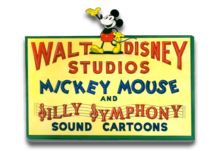
No remnant or relic of the Walt Disney Studios remains at the Hyperion Avenue location. A number of its buildings and components were actually moved to the studio's new Burbank location, most notably the Publicity and Comic Strip bungalow. The fate of its iconic rooftop sign that identified 2719 Hyperion as the home of Mickey Mouse and the Silly Symphonies is sadly unknown. Affixed to a nearby light pole is The City of Los Angeles Cultural Heritage Board Monument No. 163 which reads:
Point of Historical Interest
Site of Walt Disney's original
Animation studio in Los Angeles
2719 Hyperion Avenue
1926 -1940
A supermarket now occupies the area. History and memories supplanted by produce, canned goods, cigarettes and shopping carts.


Explore the 2719 Hyperion Archives:

Sunday, February 20, 2011

Boom Pop! - Floating Airports, Henry Kaiser and Archie at the Fair


We all know that Walt Disney went to the 1965-1965 New York World's Fair, but guess what?  So did Archie, Betty, Veronica, Reggie and Jughead.  Discover the details at Boom Pop!, our companion site devoted to 20th century pop culture.  Among our other Boom Pop! explorations this past week: a look at floating airports-as envisioned in 1952, and a cartoon-inspired investigation of industrialist Henry J. Kaiser.

Living in the past can be a lot of fun!  Join us at Boom Pop!

Saturday, February 19, 2011

Saturday at the Archives: What a Character! - Bootle Beetle
What a Character! - Bootle Beetle
By Jeffrey Pepper
Originally published January 3, 2008


Have you ever heard of . . . a bootle beetle? Well, confidentially, neither have we. But it seems that long ago, these little creatures were plentiful. But because of an in-born love for travel and adventure, the bootle beetle is now a rare little bug.

So begins the off-screen narration to the 1947 Donald Duck cartoon Bootle Beetle. But in a 1978 interview, Disney Studio veteran and cartoon director Jack Hannah revealed the actual origin of one of Donald Duck's lesser known, but still very charming and memorable co-stars:

"There was a series with a beetle named Bootle Beetle. My wife knew a race horse in Pomona named Beetle Bootle and I just switched it around."

Bootle Beetle went on to star in two more Donald Duck cartoons, Sea Salts and The Greener Yard, both released in 1949. Hannah directed all three of these cartoons. 
The three shorts marked a departure from the standard Donald Duck fare of that particular time period, especially when comparing Bootle to the Duck's other mischievous and often times much more malicious but equally pint-sized adversaries. In all three films, Bootle is very much the star and Donald falls back to an almost secondary status. In fact, in Bootle Beetle, three full minutes pass before Donald makes his first appearance. Unlike Chip 'n' Dale or Spike, Bootle is kind, gentle spirited, articulate and well spoken. In many ways he is a reborn Jiminy Cricket and the physical resemblance to that much more famous character is likely not coincidental. His encounters with Donald are told through a series of reminiscences, related by an older, wiser, and whiskered and bespectacled version of the character.

In Bootle Beetle, Bootle cautions the younger Ezra Beetle to not go running off so quickly to a life of adventure. He relates the story of his first encounter with Donald, who is portrayed as an obsessed entomologist attempting to find the Bootle species of beetle, which is revealed to be rare and endangered. The younger Bootle's innocence and naivety stands in stark contrast to the duck's high strung personality and bad temper, and the usual comic antics and pratfalls ensue. In the end, the younger incarnation of Bootle races back to the security of his original toadstool domicile, and Ezra acknowledges to his elder the Dorothy Gale-esque "there's no place like home" moral of the story.

Ezra does not appear in the next Bootle cartoon, Sea Salts, and instead, an elderly Bootle Beetle reminisces directly to the audience of a tale of his younger days with the Duck, specifically aboard the S.S. Quack back in April of '26. Brought together as fellow castaways on a desert island, the always well meaning Bootle again falls victim to Donald's selfish and self-serving ways. Similar to the end of Bootle Beetle, an older version of Donald appears in the opening and closing framing sequences of Sea Salts. Bootle affectionately refers to him throughout the short as "the Captain."

Ezra does return in the final Donald Duck Bootle cartoon, The Greener Yard. Similar in theme and story to Bootle Beetle, the elder beetle again must counsel gentle lessons to his younger counterpart. Via flashback, Bootle demonstrates that Donald's lush and inviting garden landscape is not quite the paradise it appears to be. The short includes a quick homage to director Hannah by way of a "Jack's Real Estate" sign that appears within the trash filled vacant lot that the beetles call home.

As noted, the flashback-narration storytelling used was unique, and provided the Bootle cartoons with a gentler charm and genuineness that was certainly a contrast to the more frantic nature of other Donald Duck cartoons. In The Greener Yard, as the camera settles in on the vacant lot, Bootle invites the viewer to ". . . come on in and sit a spell, and let me tell you a story." Much of that charm was conveyed through the endearing voice work of Dink Trout, who also voiced the King of Hearts in Disney's animated version of Alice in Wonderland. Interestingly enough, the flashback format of the Bootle cartoons was later employed quite directly in 1952's Let's Stick Together, which featured the final appearance of the Duck's other insect foil, Spike the bee.

Another wonderful aspect of the Bootle shorts were the beautiful and often very clever layouts and backgrounds produced by Yale Gracey and Thelma Witmer. They very effectively gave a bug's eye perspective to each cartoon, from the lush forest setting of Bootle Beetle, to the deserted island of Sea Salts, to the bootles' junkyard-furnished dwelling in The Greener Yard. Captain Duck's nautical-themed home in Sea Salts was equally impressive and well realized.

Bootle Beetle would return sans-Donald in Morris the Midget Moose, released in 1953. His resume of storytelling acumen apparently won him the role of narrator for this particular stand-alone short subject, in which he related the story of Morris to not one, but two younger bootles, one of which was presumably Ezra.

Friday, February 18, 2011

Disney Pursues New Comic Book Strategy!


There is some interesting news emerging in regard to Disney comic books.  Last October, I wrote about my overall disappointment with the production and marketing strategies of Boom! in relation to their Disney-licensed comics.  The focus at Boom! has always been the direct market--specialty distributors and retailers, and they very distinctly under serve a more mainstream readership, especially younger kids.

Now we have word that Marvel Comics will be producing an ongoing magazine featuring the Pixar characters.  Pixar-related comics were removed from the Boom! publishing schedule a few months back.  Now we know the reason.  According to the Marvel Comics press release:
Marvel and Disney Publishing will debut DISNEY•PIXAR PRESENTS, a new monthly magazine featuring some of the most popular characters from the acclaimed Disney/Pixar films. Intended for readers of all ages and priced at $5.99, the first issue will hit stores in May 2011.
Each issue of the magazine contains 96 full color pages of content, including a mix of brand new stories, classic adventures, puzzles, games and more. Featuring characters from Disney/Pixar’s hit movies Cars, Cars 2, The Incredibles, Toy Story 3, and more, DISNEY•PIXAR PRESENTS will be available at bookstores, retail chains, comic stores and more. The series debuts with DISNEY•PIXAR PRESENTS: Cars Magazine #1
“We’re excited for the launch of DISNEY•PIXAR PRESENTS, teaming with our friends at Disney/Pixar to bring some exciting new material to fans all over the world and introducing a whole new generation to comics,” said Axel Alonso, Marvel Editor-in-Chief. “We’re committed to providing a great product and ensuring these books are available in locations that parents and kids frequent. The Disney/Pixar library includes some of the most popular characters of all time, making DISNEY•PIXAR PRESENTS exactly the kind of comic magazine that kids and parents have been demanding!”
Rev up those engines and join your favorite characters from CARS in DISNEY•PIXAR PRESENTS: Cars Magazine #1 as Lightning McQueen organizes a charity race for young cars with special needs, but he didn’t invite Piston Cup champion Chick Hicks. The snub gets Hick’s competitive juices flowing, and he’s out to show McQueen a thing or two about racing! Will Hicks ruin the good nature of the Radiator Springs Rally Race? Find out this May everywhere books and comics are sold.
I am indeed, very encouraged.  Marvel appears to be potentially addressing many of the issues I mentioned in my previous article.  The magazine will be content-heavy, comparatively less expensive, have wider distribution and most importantly, be marketed to kids.  It does appear that Marvel will be recycling some of the previously published Boom! material, indicating that they are strongly targeting an audience that Boom! did not pursue and who will perceive such content as brand new.

Despite media spin to the contrary, the Boom! Kids line is floundering.  The Muppets titles have been apparently canceled.  The recruiting of Warren Spector to write DuckTales seems to be just a bone-throw to fanboys.  The recent much-hyped return to more traditional stories and reprints for the classic Disney characters line (Mickey Mouse, Donald Duck, Uncle Scrooge and Comics and Stories) has been disappointing at best, a poor imitation of publishing strategies that both Gladstone and Gemstone utilized, but without the academic underpinnings and evident passion for the material that those previous publishers provided.  Hopefully these remaining Disney comic book licenses will eventually migrate to potentially greener pastures as their Pixar cousins just did.


Explore the 2719 Hyperion Archives:
Disney Comics Go Boom! . . . and Fall Down