Monday, November 27, 2006

EPCOT 1939 - Part Seven: Robots of Future Past

What would any vision of the future be without robots? EPCOT Center featured a couple during its first decade, and likewise, a mechanical man was one of the more popular attractions at the 1939 New York World’s Fair.

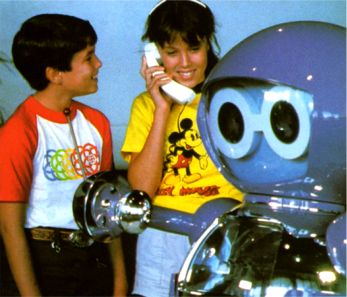
At EPCOT, SMRT-1 entertained guests as part of a number of activity islands at EPCOT Computer Central in Communicore East. Small, round, purple and cute would be the best way to describe the little robot, who interacted with visitors by playing simple guessing games via phone hookups.

Just outside Communicore East, another little robot could be found on occasion. Gyro stood just under 5 feet tall and weighed 150 pounds. Operated by remote control, he would perform twenty minutes shows throughout the day.

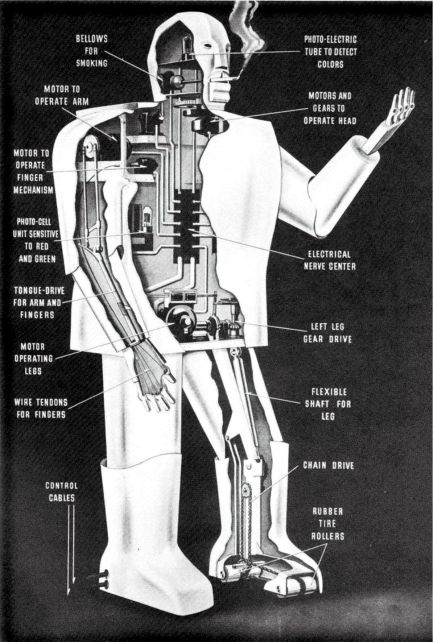
While SMRT-1 and Gyro were pretty state-of-the-art for the 1980s, the concept of an interactive robot was nothing new. An example was present and exceptionally popular at Flushing Meadow’s World of Tomorrow back in 1939. Elektro was a robot’s robot, not at all cute and endearing like his EPCOT counterparts, he held to the more traditional image of robots, as perpetuated by the science fiction pulp magazines of the day--big, slow and lumbering.

Elektro was a resident of the Westinghouse pavilion in the Fair’s Production and Distribution Zone. He was manufactured by Westinghouse in a plant in Mansfield, Ohio. He stood seven feet tall and weighed 300 pounds. As part of his twenty minute presentation, he would walk, move his hands and arms, smoke cigarettes and speak by means of a 78 rpm record player. During the Fair’s 1940 season, he was joined by Sparko, a robot dog who could speak, sit and beg.

Elektro made quite impression on fairgoers and entered into the popular culture of the era. Following World War II, Westinghouse used him to promote appliances, and he was a static display at Palisades Park in Oceanside, California for a number of years in the late 1950s and early 1960s. He appeared in the 1960 film Sex Kittens Go to College.

Veteran comic book writer Roy Thomas made Elektro a supporting character when he reintroduced the Justice Society of America to DC Comics readers in the early 1980s. Thomas created a spin-off team know as the All Star Squadron that headquartered in the Fair’s Trylon and Perisphere buildings. Their robot butler Gernsback was clearly based on the Elektro robots.

Up next for EPCOT 1939: The Universe of Energy as it was back in 1939. We’ll take a look at the Petroleum Industry Exhibition and their mascot Pete Roleum.

Sunday, November 26, 2006

The Wolf Gang Trio

There is a terrific set of posters in the queue area of Mickey's PhilharMagic, featuring many classic Disney characters. My favorite is the Wolf Gang Trio, performing Straws, Sticks and Bricks in B-Flat. Great stuff.

Friday, November 24, 2006

It Came From the Snack Bar

The Sci-Fi Dine-In Theater is one of the coolest concepts at Disney-MGM Studios. From the great set design to the entertaining clips to the exterior billboard that displays this 1950s style poster, it's a really fun experience. The food on the other hand . . .

Wednesday, November 22, 2006

Caballeros in the Age of Misinformation

Official: El Rio del Tiempo will be closed for refurbishment Tuesday, January 2, 2007, through Sunday, April 1, reopening Monday, April 2.

Unofficial: The Three Caballeros, featuring Donald Duck, Jose Carioca and Panchito, will be integrated into a new redesign of the attraction.

It’s a potential development that has many Disney purists again lamenting the influx of “characters” into Epcot attractions. It is an interesting debate. Threads on numerous forums around the web have sprung up, with opinions being voiced both pro and con. But what has proven most disturbing in all this is a real lack of knowledge about the history of these characters and the film itself. One particular thread on WDW Magic was filled with statements from people who really didn’t know what they were talking about.

Some examples:

"You aren't missing much with the short, it was a propaganda film made in the early 40's to promote better relations with South America."

"The movie is nothing but a collection of what North America THINKS South America is like. The film was made under wartime while the US was trying to establish close ties with S. America. The Germans had their eye on S. America, and the US wanted to beat them to it. This film, and the short that preceded it are propaganda, plain and simple. Not any kind of real educational tool. I'm almost positive I read that it was comissioned by the US State Department, just like 'Victory Through Air Power'. The film is somewhat entertaining, and I liked it as a kid. But let's see it for what it really is."

Okay, first of all, The Three Caballeros was released in 1945, not in the early 40s. It was not a short. It was feature length, clocking in at 71 minutes. It followed Saludos Amigos which was released in 1943. Saludos Amigos was only 43 minutes long, but it was still considered a feature.

In 1941, the Coordinator of Inter-American Affairs at the US State Department approached Walt about making a goodwill tour of South America, to counter a growing pro-Axis feeling in that region. Walt was initially uninterested, by when he considered that he could use the excursion to research a potential series of shorts with south-of-the-border themes, he finally agreed. The government sponsored the trip and made certain financial guarantees, but did not commission the making of any of the films that resulted.

Upon returning, Walt decided to integrate the subsequently produced shorts with 16mm footage he took for personal use. Hence, Saludos Amigos was born. It was not a propaganda film. What would be the point of promoting the merits of South American cultures to American wartime audiences? Or to the very countries it showcased? It was a purely commercial endeavor on the studio’s part. The war had completely cut off Europe, but South America was a still a potential market. Beginning with Saludos Amigos, Walt was able to break into that market and pump it for some much needed revenue. And while the 1943 film Victory Through Air Power was clearly a propaganda film promoting the military theories of Alexander de Seversky, it was not in any way commissioned by the US government.

“I think The Three Caballeros is a fine idea (Although wasn't the movie more about South America, anyway?)”

No, that was in fact Saludos Amigos, as discussed above. The Three Caballeros features very prominently the countries of Brazil and Mexico. Disney decided to continue to exploit the Central and South American markets and take advantage of Donald Duck, who was then at the near peak of his popularity. And The Three Caballeros, while being largely ignored today, was a landmark film for the company. Ub Iwerks’ special effects that integrated animation and live action proved a benchmark achievement that paved the way for future productions like Song of the South, So Dear to My Heart, and ultimately Mary Poppins. Well known Latin American personalities such as Aurora Miranda, Carmen Molina and Dora Luz participated. The film spawned hit songs--“You Belong to My Heart” and “Baia”, and a version of the title song was recorded by Bing Crosby and the Andrews Sisters. To dismiss the movie as an inconsequential propaganda piece, does it, and all those great talents who contributed to it, a great injustice.
"The problem with adding the Three Caballeros isn't just about throwing in a Disney character when he doesn't belong there, there is also the issue that Donald Duck is an American character. Why is he appropriate to tell the story of Mexican culture? It isn't like he's part of Mexican folklore!"

Yes, Donald Duck is an American character, but in The Three Caballeros he meets Panchito, a feisty rooster who is clearly 100% Mexican. Panchito takes Donald and Jose Carioca on a whirlwind tour of Mexico, both culturally and geographically. They are shown Mexican Christmas customs, told the fable of the building of Mexico City, and taken on a magic serape tour of the country, culminating in a music-filled finale in Mexico City. It would seem to me that our three happy chappies in snappy serapes are more than qualified to relate the story of Mexican culture to Epcot visitors. It is what they were essentially doing over fifty years ago.

In an earlier post, I observed how so many hardcore Disney fans were by and large unknowledgeable of much of the company’s early history and lesser known productions, and these recent internet discussions tend to bear that observation out. And these folks do not hesitate to weigh in with misinformation, as these examples demonstrate.

Do I want Epcot attractions overrun with Disney characters? Of course not. But often times, based on history and context, good combinations can be made. This proved true with Goofy About Health in Wonders of Life, which drew on the Goof’s earlier “everyman” shorts to create an entertaining multimedia presentation that rang very true to the pavilion’s overall theme. Donald, Jose and Panchito, based on their earlier adventures, could infuse some much needed energy and spirit into a World Showcase attraction long in need of an upgrade.
Snapshot! The Goofy Pose-A-Matic Device

The Goofy Pose-A-Matic Device is an interesting piece of period(?) sculpture located in front of Town Square Exposition Hall in Walt Disney's World's Magic Kingdom. Which begs the obvious question--just what exactly does a pose-a-matic device do?

Here Comes Oswald!

Oswald is on the way! The Lucky Rabbit will be arriving on DVD sometime in 2007.

Disney just launched a new website to promote its Legacy Collection DVDs. The first wave is four sets encompassing the complete collection of True Life Adventure films, with an enormous amount of additional films and extras also included. They will arrive in stores December 5.

Also announced on the site were three upcoming titles for 2007, Destino, Disneyland-Stories, Secrets and Magic and the very much aniticpated The Adventures of Oswald.

Tuesday, November 21, 2006

Lost Imagineering: Port Disney

In the very early 1990s, Disney developed plans for two different theme parks for southern California, with the intention of only one ultimately being completed. Westcot Center was proposed as a second gate at Disneyland, while Port Disney was imagineered for an area at Long Beach. Neither concept saw the light of day. Westcot was abandoned entirely, though fortunately Port Disney survived to some extent in the form of Tokyo DisneySea.

An Employee Forum published in 1991 said:

"Planning continues on the Long Beach park "Port Disney," whose California ocean themes emphasize recreation and fun, mythology, science and ecology. Work is now progressing on an environmental impact report."

Monday, November 20, 2006

Freeze Frame - We Visited Splash Mountain


Much as the Snapshot! feature highlights details from Walt Disney World, Freeze Frame! will bring Disney animation under the microscope. We certainly aren't lacking for source material, as animators seem to just love inside jokes.
Who Framed Roger Rabbit? and its spinoff shorts are notorious for their overabundance of hidden details. Here's one from Trail Mix-Up with a direct connection to Disney theme parks.

Snapshot! - Roger Rabbit: Larger Than Life

The Pop Century Resort (or should I say Scopa Towers) at Walt Disney World has never met a camera it didn't like. Roger Rabbit resides in the 80s area. He and his barrel of dip rise nearly four stories in height. I wonder why they didn't do Jessica as well?

Saturday, November 18, 2006

Happy 78th Birthday, Mickey!

Friday, November 17, 2006

Snapshot! - A Whole New World (Showcase)

The story of Aladdin can be found in a remote corner of World Showcase at Epcot. Explore the twists and turns of Morocco and you'll eventually find a shrine of sorts to our plucky hero.

Thursday, November 16, 2006

Rabbit Tales


An interesting newspaper, complete with loud headlines, greets you upon entering the queue area of Splash Mountain. Even the warning signs in the Magic Kingdom are done with style and flair.

Wednesday, November 15, 2006

Snapshot! - Free Kittens to a Good Home

The Jungle Cruise dock area at Walt Disney World is a lot of fun. It follows the tongue-in-cheek humor that is the attraction's hallmark. Look up and to the right just before you board your boat--you'll see this interesting "notice."

Florida Welcomes Walt Disney

Wade Sampson has a great article on MousePlanet that details the sequence of events that finally forced Walt to disclose his intentions for central Florida. Orlando Sentinel-Star reporter Emily Bavar Kelly was the key player in the tale.

Tuesday, November 14, 2006

Space Home and Garden Show

Here is the third and final poster in our recent Tomorrowland series. The Space Home and Garden Show was a showcase for everything from Interplanetary Timeshare Opportunities to Just Add Water Inc Meal Tablets. Entertainment was provided by the ever popular Nutz & Boltz Boys.

Monday, November 13, 2006

Cranky Mouseketeers: Chill Out and Enjoy the Ride

There are quite a few cranky mouseketeers out there who continue to lament what they consider the sorry output of Walt Disney Imagineering over the past few years. There definitely seems to be a “good old days” mentality being embraced by many folks, and while not totally unjustified, it can often become bitter and mean-spirited.

Much of this I feel can be traced directly back to Disney’s California Adventure. Its creation was clearly a reflection of corporate arrogance and a lack of respect for the audience they so greatly covet. The basic strategy seemed to be the recycling of abandoned concepts from Disney’s America and the duplication of popular attractions from Disney World. The result is a mish-mash of unrelated ideas very loosely themed to the state of California. It was done on the cheap, and it shows.

Unfortunately, and sadly, the frustration over DCA and the legacy of Michael Eisner’s final years have of late been channeled by many into attacks on just about everything that Imagineering produces. It is criticism that is often unfair and increasingly malicious.

A few weeks back, an anonymous comment was made in response to one of my posts that opinioned:

“I think what most people whine about nowadays is the general lack of thought and "magic" put into today's attractions . . .”

It’s an interesting statement. But a very blatant overgeneralization.

First off, all attractions are not created equal. By Disney’s own standards, there is an A-E ratings system that is still informally used by fans and Imagineers alike. But so many have the expectations of an E Ticket for everything that Imagineering produces. Sure, Pooh’s Playful Spot is lacking in thought and imagination when compared to Splash Mountain. But so is Dumbo the Flying Elephant or Mr. Toad’s Wild Ride for that matter. But they all have a place in the A-E hierarchy. Even those attractions much maligned by the Internet minority deserved to be viewed more fairly in this context. Stitch’s Great Escape, Magic Carpets of Aladdin, Chester and Hester’s Dinorama--they all attract and serve their target audiences.

Second, I can provide a number of examples where the assertion of “lack of thought and magic” is just fundamentally wrong:

Mickey’s PhilharMagic - a truly amazing and entertaining experience. In my opinion, it is the best of all the 3-D movies produced for the parks. It pays homage to both the original character driven shorts and the Disney animation renaissance of the early 1990s. It’s clever, fast and funny, with brilliant 3-D effects, and has generated enthusiastic applause at nearly every showing I’ve attended. But alas, the cranky mouseketeers can’t resist taking potshots at the attraction’s lack of a pre-show.

One Man’s Dream - an extensive and often emotional tribute (both exhibits and film) to the man responsible for it all. Not a thrill ride, but still thrilling to those who look beyond the theme parks to the very foundations of what Disney is all about.

Soarin’ - four and half minutes of pure “Wow!” And with the promise of expanding beyond the confines of California, it will be a perennial for years and years to come.

Turtle Talk with Crush - simple in both setting and execution, yet revolutionary in design and technology. It is clearly a precursor of things to come. The expressions on the faces of the kids as Crush interacts with the audience are priceless. A lack of magic? You’ve got to be kidding.

Expedition: Everest - from the minute you approach the entrance, to the moment you stumble off and attempt to regain your balance, an incredible, all encompassing experience. The attention to detail throughout is nearly without equal in all of Disney World.

Finding Nemo-The Musical - an imaginative and innovative interpretation of the Pixar hit film, using puppetry techniques similar to those employed in the Broadway production of Lion King. I was fortunate to have been able to see the first preview on November 5th.

As well-received as all these examples have been, I have seen and heard comments deeply critical of many of them at one time or another. The negativity often precedes the actual opening of the attraction in many cases. Many become so cemented in their feelings that often times their egos will not permit them to ever really enjoy or compliment these new endeavors because it would run counter to their already established preconceived notions.

Me personally? I’m just gonna sit back and enjoy the ride(s).

Magic Kingdom Travel Guide

Time again for some desktop wallpaper. The Magic Kingdom Travel Guide is located on a wall on the lower level of the Main Street Train Station. Click to link to a full size version.

Sunday, November 12, 2006

Located in the Heart of Tomorrowland

The second of two Tomorrowland posters, located in the queue area of Stitch's Great Escape. Did you know that the Astro Orbiter was the symbol of interplanetary friendship and universal harmony? Neither did I.

Snapshot! - To Serve Man

Fans of the original Twilight Zone television show will immediately know what this is all about. The libraries at the Hollywood Tower Hotel are filled with a number of objects from that classic Rod Serling anthology program. They are especially difficult to spot due to the dim lighting, crowded conditions, and lack of opportunities to linger. A very nice cast member helped us locate this particular "cookbook."

EPCOT 1939 - Part Six: The Food Zone

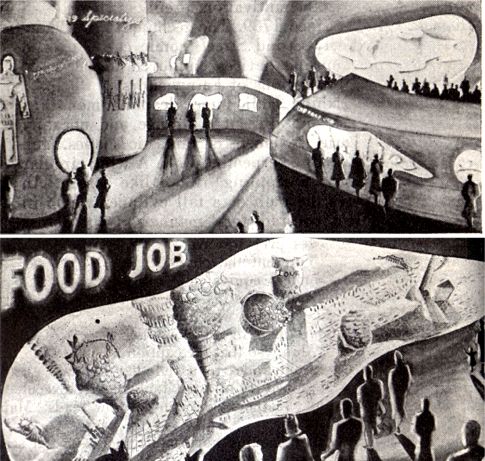
People were certainly “living with the land” in 1939, and the Food Zone was a popular destination for Fairgoers at New York World’s Fair of that same year. The Focal Exhibit of the Food Zone was called “Miracle of Modern Food.” While not in any way similar to any of the future EPCOT Center Land pavilion attractions, it spirit and message ultimately reflected the same themes of “Listen to the Land” and “Symbiosis,” The Land’s 1980s era attractions.

Let’s check our Official Guidebook for a quick description:

Though it deals with humble, commonplace things like "bread and butter," the Food Show is high and amazing entertainment. Comprehensive and dramatic, the Exhibit illustrates the progress made in the cultivation, preparation, , processing and distribution of food since 1789. The techniques of Coney Island, the atmosphere of Forty-second Street, comic cartoons, and "slapstick"' are among the amusing devices employed to stage the "Miracle of Modern Food" for millions of Fair visitors.

In describing the show’s climax, the guidebook conveys a message that would be echoed by its Future World counterpart in 1982:

A startling anticlimax to the show is the exhibit "the challenge to the future," which is housed in a huge chamber under the ovoid itself. Here the walls and ceilings impress you with their grave message of food questions yet unsolved. Springing from the shadows, newspaper headlines and photomontages graphically depict a score of acute food problems darkening man's future. As the show ends, you turn away reflecting on another unfinished job for the "World of Tomorrow." Yet every unfinished task is a challenge—an opportunity for an additional achievement in man's progress.

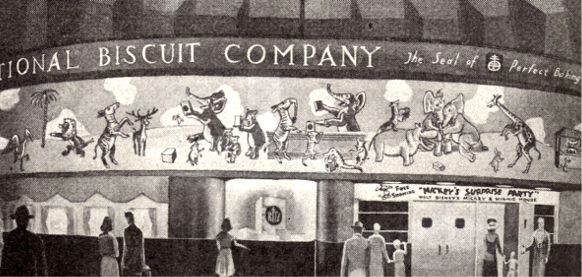
The Food Zone did host Walt Disney’s most direct connection to the Fair. Let’s take a look at the Guidebook’s entry for the National Biscuit Company’s (more familiar to people today as Nabisco) exhibit:

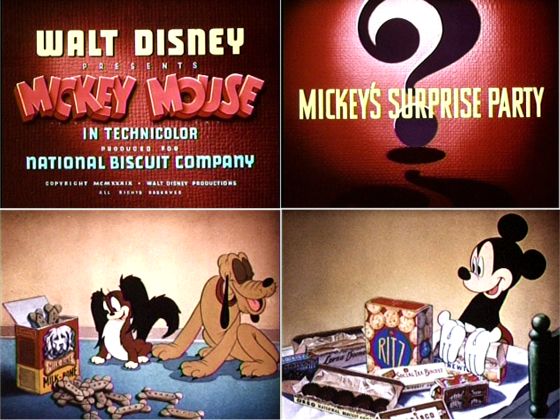
A specially produced Walt Disney motion picture, entitled Mickey's Surprise Party. is the outstanding feature of the Exhibit. Fair visitors are invited to see this amusing film in an air-conditioned theatre. The Disney picture is in technicolor and features many of the well-known "Mickey Mouse ' characters.

The best line of the film: "Oh Mickey--Fig Newtons!"

Mickey's Surprise Party was included as an Easter egg on the Walt Disney Treasures Mickey Mouse in Living Color Volume One DVD set.

Coming next: The Mechanical Marvel of the Fair and its considerably smaller and cuter 1982 counterpart.

Saturday, November 11, 2006

Not Quite a Million, But a Few Cool Dreams Nonetheless

We did not come home from Walt Disney World this week having won a DVC membership or a trip around the world, but our very average family of four did experience the Year of a Million Dreams guest service philosophy numerous times, in fun and different ways.

A few of the highlights:

My eight-year old son was given the exclusive Pixie Dust pin while visiting the One Man’s Dream attraction at Disney-MGM Studios. The cast member awarded him the pin after observing how focused he was on all the exhibits, and demonstrating his interest in Walt Disney’s life.

While looking at merchandise at Big Al’s in Frontierland, my older son was spontaneously given bags of cotton candy for both him and his brother, along with a Magical Moment certificate from the “Frontierland cast.”

My older son got to summon Crush at the beginning of Turtle Talk. He also assisted with some pre-opening duties at Animal Kingdom for which he was rewarded with FastPasses for the entire family at an attraction of our choice.

After riding Rock ‘n Rollercoaster my wife and I were invited to ride a second time and thereby bypass a 30 minute standby wait time.

The kids were awarded Magical Moments certificates for all kinds of different activities--pullback racing at Once Upon a Toy; trivia at Sid Cahuenga’s; handprints at Mickey’s of Hollywood; finding the key at Muppet Labs Security; and playing Star Wars tic-tac-toe at Tatooine Traders.

An interesting side note-- the marketing itself is fairly low key in terms of visible promotional materials. The monorails have some pretty ugly paint jobs, and I noticed some banners scattered throughout the Magic Kingdom, but not much other than that. Maybe they’ll be ramping it up more after the holidays

Antique Rocket Show and Swoop Meet


Back to Tommorowland and a new set of posters. Three adorn the area to the left of the entrance to Tomorrowland in the queue area of Stitch's Great Escape. First up, the 225th Annual Antique Rocket Show and Swoop Meet. The Moonliner is my personal favorite.

Edison Square - Revisited

In my rush to get some content completed prior to leaving for Disney World, I didn’t do my homework very well on the Edison Square card for Lost Imagineering. Jeff Kurtti, author of Since the World Began-Walt Disney World The First 25 Years, provided the correct background information on this early Disneyland area concept. Here’s Jeff’s comment on the post:

“Edison Square was not a "London-themed" street, but rather an American city in transition from the gas lamp to the electric light, a celebration of the inventions and technology of the 20th century, and particularly the wonders of "the Electric Age." The idea evolved over time into Walt Disney's Carousel of Progress.”

Thanks Jeff! I promise I’ll do better next time.

Back From the World!

My family and I just returned from a jam-packed seven days at Walt Disney World. Lots and lots of new Snapshots, and plenty of other cool stuff to talk about--including some Magical Moments from the Year of a Million Dreams.

Big thanks to my best pal Jennifer for keeping the blog updated, and even throwing in a Snapshot of her own!

Friday, November 10, 2006

Snapshot! - Laundry Day?

Gawsh! Over in Toontown it looks like either Goofy has found a unique place to hang out his laundry; or he's missing his pants! Maybe his Barnstormer through Wise Acre Farm really is a thrill ride.

Thursday, November 09, 2006

Buckling up is a sign of good character

I loved this public service message that was created for Walt Disney World in 1989. I first saw it on a billboard when leaving the resort after a visit that year. It also showed up in some magazine advertising supplements featuring Disney-MGM Studios. Kudos to the team that came up with it, wherever you all are now.

Wednesday, November 08, 2006

That 70's Souvenir

Just my opinion, but the Mickey Mouse back scratcher was the Walt Disney World souvenir from the 1970s. In these days of big figs, pin trading, and Bibbidi Bobbidi Boutiques, sometimes it's nice to remember the simpler times.

This and a postcard of 20,000 Leagues Under the Sea were the two items I recall bringing back from my first Walt Disney World visit in 1973.

Tuesday, November 07, 2006

Snapshot! - Who's Da Monkey?

Not exactly the monkey you were expecting to see at Disney's Animal Kingdom? An interesting contrast to the equally fake, yet slightly more realistic Tree of Life.

Monday, November 06, 2006

Fine Art in the Wilderness


Most folks will agree that Disney World is all about the details. I love finding cool designs and graphics tucked away in various corners throughout the resort. Here's a very nifty graphic that donned the cover of a Fort Wilderness Guidebook a few years back. I'm still trying to figure out who that other mouse is being jostled on the back of the cart. Morty? Ferdy maybe?

Sunday, November 05, 2006

Lost Imagineering: Edison Square

One of the really cool features of the early souvenir books from Disneyland and Walt Disney World, were pages near the end that always showcased upcoming projects. The 1959 Walt Disney's Guide to Disney provided a glimpse of an area called Edison Square. It was one of a few different concepts for a "street" that would extend off from Main Street.

Saturday, November 04, 2006

Souvenirs: World of Motion Premiums


Back in 1988, I returned from a Disney World trip and dutifully visited my local Chevrolet dealer, just as I was instructed to do in my World of Motion Guestbook. I did a new vehicle evaluation, filled out the proper form, and a few weeks later received my handy dandy World of Motion Trip Planner and Auto Log.

It's fun to be free . . .

Snapshot! - Sweeping Up Main Street

Yeah, I know. It's not an interesting little detail or a cool spot off the beaten path. It's a bunch of brooms carrying water. But I just love this picture.

Friday, November 03, 2006

Happy Birthday Humphrey! Well Sort of . . .

The cantankerous bear that is Goofy’s foil in the 1950 cartoon Hold That Pose does not bear (sorry) any resemblance to the future Humphrey the Bear in either appearance, personality or setting, yet Disney historians claim they are one in the same. Hence, today, November 3, the original release date of that particular short, also takes on the status of our favorite bear’s birthday.It’s an odd connection that even John Grant notes in his excellent Encyclopedia of Disney Animated Characters. The “real” Humphrey would not appear until three years later in the Donald Duck short Rugged Bear. His frequent co-star, Ranger J. Audubon Woodlore and the setting of Brownstone National Park would not arrive until the 1954 cartoon Grin and Bear It. Humphrey would solo in his own two shorts in 1956--Hooked Bear and In the Bag.

Humphrey was indeed on the verge of becoming the studio’s next big cartoon star, but his career was sadly cut short with the advent of television and the demise of Disney’s cartoon shorts in the late 1950s. Ranger Woodlore would go on to host a few episodes of Wonderful World of Disney, before his equally all-to-early retirement.


But like the proverbial bad penny, Humphrey turned up again, almost forty years after his final screen appearance. When the Wilderness Lodge Resort opened in 1994, there was Humphrey, carved into the lodge’s character totem pole icon, and featured on numerous merchandise and souvenir items. A few years later, he was a frequent player on both the Mickey’s MouseWorks and House of Mouse television programs.

Happy Birthday big guy!

Thursday, November 02, 2006

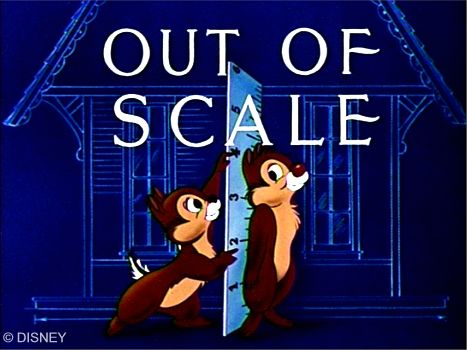
Out of Scale - November 2, 1951


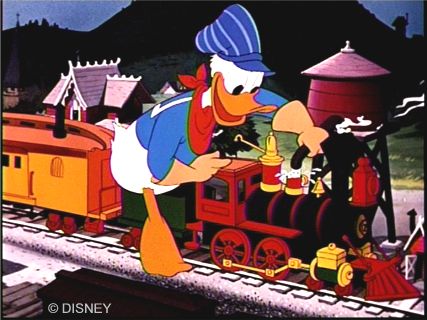
The inspiration for the Donald Duck cartoon Out of Scale, released on this day in 1951, interestingly enough came from Walt Disney himself. Walt had a fascination with trains since he was a young child, so it was not surprising when he took up the hobby of model railroading in the late 1940s. With the help of animators Ward Kimball and Frank Thomas, and the resources of the Disney Studio, Walt built his own backyard railroad, called the Carolwood-Pacific, in the early 1950s. Walt would often don engineer coveralls and cap and take guests on rides on the half mile run around his residential property.


Walt’s exploits quickly became the creative fodder of director Jack Hannah and crew. In the short, Donald is a model train hobbyist, with an extensive garden railway. Insisting that everything in his layout be to the exact scale of his miniature railroad, he unknowingly removes a large tree that is the home of Chip ‘n Dale. The two chipmunks are not very happy about it, and the usual mayhem ensues.


Chip ‘n Dale attempt to rescue their tree, but have to beat a hasty retreat into Don’s miniature town of Canyonville. They quickly become comfortable in a scale model house, that, in a nod to Walt’s concept of the “plausible impossible,” is completely furnished, right down to furniture, food, books, and even reading glasses. It’s possible that the scene might have alluded to Walt’s own penchant for detail--in furnishing the caboose on his 1/8 scale train, he had authentic period newspapers reduced in size and placed in a paper rack.

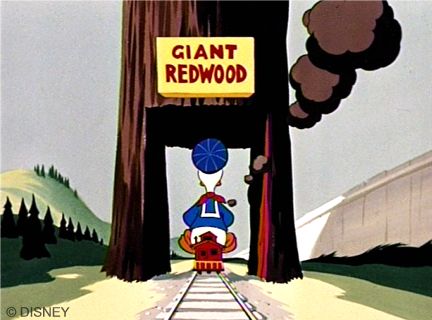
Realizing that the chipmunks are in fact “in scale,” Don calls off the chase and plays along. But the duck can’t resist resorting to some malicious mischief, and the chase resumes anew. In the end, the two convince Donald that their oak tree can convincingly play the part of a giant redwood, and effectively be “in scale.”

Wednesday, November 01, 2006

EPCOT 1939 - Part Five: Highways and Horizons


It was the talk of the 1939 New York World’s Fair. It had the longest lines of any attraction. It was state-of the-art in design and execution. It was the centerpiece of the General Motors Building. It was Futurama.


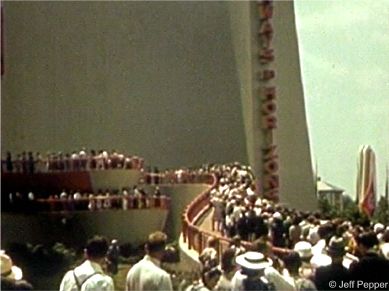
In EPCOT 1939, Futurama was to fairgoers what Horizons was to Future World guests in the mid-1980s. Just as Horizons’ travelers were transported into the 21st century, their 1939 counterparts were taken on a scenic journey twenty years ahead to America in the year 1960. Appropriately, the name General Motors gave to its seven acre exhibit was “Highways and Horizons.”

Once again, our handy official guidebook provides a much better description than I ever could:

"In 600 moving chairs, each equipped with a sound device which serves as a private guide on the Aladdin-like trip, visitors tour a vast miniature cross-section of America as it may conceivably appear twenty years or more from now."

The ride mechanics foreshadowed Epcot attractions like Spaceship Earth and Horizons, especially in regard to the vehicles’ onboard audio.

"Covering an area of 35.738 square feet, the '"futurama" is the largest and most realistic scale-model ever constructed. As visitors in the moving chairs tour this "futurama" they experience the sensation of traveling hundreds of miles and viewing the scenes from a low-flying airplane. As they travel on several levels of the building in their magic chairs, they view a continuous animated panorama of towns and cities, rivers and lakes, country and farm areas, industrial plants in operation, country clubs, forests, valleys and snowcapped mountains. The "futurama" contains approximately 500.000 individually designed houses; more than a million trees of eighteen species; and 50,000 scale-model automobiles, of which 10,000 are in actual operation over super-highways, speed lanes and multi-decked bridges."


The ride culminated in a shining, tower-filled future metropolis. Through a series of transitions, the magic chairs and their occupants were drawn closer and closer into the cityscape, until they finally hovered above a bustling intersection. The ride ends but the amazement did not. Upon exiting their magic chairs, visitors walked onto a full scale reproduction of the street intersection they had just encountered in model form. It was a total “wow” moment.


The guidebook describes how the these imaginary city streets of the future formed the overall architecture of General Motors Building:

"Spacious open-air terraces with several hundred chairs for visitors' comfort encircle two-thirds of the structure. Actually, "Highways and Horizons" is not one building, but consists of four towering structures (four to six stories in height). Located on the four corners of an imaginary and spectacular, full-scale street intersection of 1960, the four buildings are joined into an overall exhibit structure by broad, elevated pedestrian sidewalks, which extend for a full city block in two directions. This open-air spectacle forms the center section of the Exhibit and at night is brilliantly illuminated by a battery of floodlights”


The buildings at the four corners of intersection actually contained additional exhibits and attractions. These included a 650-seat theater that housed the Casino of Science, the World Horizons exhibit that focused on GM’s overseas operations through a series of animated displays, and a full scale “x-ray” car constructed of “plexiglass,” an amazing new transparent plastic.

Yes, in design, theme and even name, the General Motors Building and Futurama, found themselves reborn at EPCOT Center on October 1, 1983.

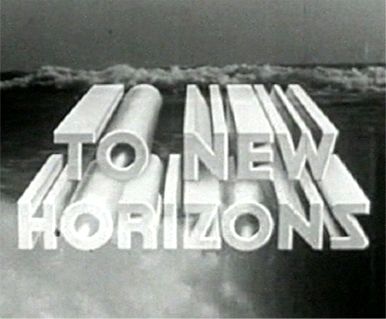
Interestingly, GM produced a short film in 1939 to promote Futurama. Its title:


Up next: As previously promised, a quick look at the other buildings in the Transportation Zone, then over to the Food Zone where we'll experience Living With the Land circa 1939.