Thursday, March 11, 2010

Song of the South: A Slightly Different Perspective

Editor's Note:  At this week's shareholder meeting, Disney CEO Robert Iger made a rather harsh and firm statement about the potential home video release status of Song of the South.  Hollywood Reporter noted that Iger called the film "antiquated' and “fairly offensive," and said there are no plans for releasing Song of the South on DVD.  I addressed previous statements by Iger concerning Song of the South in a commentary from 2007 that I am re-publishing today.  I cannot tell you the last time I watched Song of the South; I know that I have not viewed it in the three years since I wrote this commentary.  I remain as generally indifferent to it now as I did then.  I have retained the original comments to the post left by readers in 2007.

Song of the South: A Slightly Different Perspective
By Jeff Pepper

There are any number of hot button topics out there that ignite the Disney faithful to debates both passionate and contentious. I typically only enter into these discussions if I feel I can provide a unique perspective of the issue at hand. I have lately come to realize that I might have a decidedly different view than most on Song of the South.

Long a subject of blogs, forums and the occasional mainstream media article, the film’s secure-in-the-vaults status has been a disappointment to American Disney enthusiasts for quite a number of years. As far back as the early 1990s, this 1946 mix of live action and animation has been deemed a potential powder keg of political incorrectness and racial insensitivity and considerations for a domestic release have always quickly died on the vine. But while Disney CEO Robert Iger seemed to send a generally discouraging message about a Song of the South release at his first stockholders meeting in 2006, recent comments at this year’s New Orleans conference seemed to indicate a softening on the subject. When again asked about the status of the situation, Iger responded:

"The question of 'Song of the South' comes up periodically, in fact it was raised at last year's annual meeting. And since that time, we've decided to take a look at it again because we've had numerous requests about bringing it out. Our concern was that a film that was made so many decades ago being brought out today perhaps could be either misinterpreted or that it would be somewhat challenging in terms of providing the appropriate context."

For any animation fan and student of Disney history, those are encouraging words indeed. Yet I have to say that I personally feel surprisingly indifferent to a Song of the South release. A decidedly different point of view from an individual who has long decried the suppression of Disney history in the name of political correctness.

In fairness, I have to say that I have for quite some time been able to view Song of the South at my convenience. Japanese and British editions have made this possible for close to a decade and a half. So in that regard I do not have the basic frustrations of inaccessibility that many possess.

Disney last made the movie available to American audiences when they re-released it to theaters in 1986. In the twenty years since, issues of content have escalated into a controversy that has ultimately overshadowed the film itself. In essence, Song of the South has by and large become greater than the sum of its parts. For at its core, and despite having provided the now-iconic strains of "Zip-a-dee Doo-dah" and vivid and colorful animated sequences, it does little to truly distinguish itself from other Disney films of the same time period. And thus comes forth my previously indicated indifference; the film is simply not worthy of all the “legend” it has come to be associated with.

As entertainment, much can be said for the film’s energetic music and well realized animated characters. Yet taken as a whole, it is an uneven, and at times disjointed endeavor. The live-action sequences tend to be slow and without spirit, marked especially by very annoying overacting on the part of its juvenile players, most notably Bobby Driscoll. And while its racial stereotyping is generally benign and without malice, it severely dates the film in a manner that will likely undermine any lasting endearment current and future audiences might have developed for it. In much the same manner that the stature of Gone With the Wind, with its similar racial undertones, has diminished over the past two decades, so likely will Song of the South ultimately become classified more as film history than timeless entertainment.

While I certainly would welcome a DVD that featured a restored Song of the South and included comprehensive supplemental material, I could make the same request for numerous other Disney feature films from the studio’s first three decades. There are other Disney productions much more deserving of either the Treasures or Legacy brand and treatment that Song of the South would likely receive should it be released in the near future.

In the end the question becomes this: Is the desire by many to own Song of the South based on an actual love of the film, or simply the result of being denied access to it? Often times it’s not so much about the cookie as it is about the fact that Mom said “No!”

 Originally published April 14, 2007.

Monday, March 08, 2010

The Lake Buena Vista Story, Part One: 1969 - 1975

(The following represents the newest entry in my Buena Vista Obscura series which I began last year with my coverage of the Golf Resort. I then put the articles on hold pending further research, which I can now proudly say has paid off with this opus. It will be posted in four parts, one each week, and represents nearly a year and a half of information gathering. Enjoy, I know I did! -FoxxFur)


“Situated in a peaceful, pine woods and water-entwined corner of Disney’s 43-square-mile Vacation Kingdom in Florida is Lake Buena Vista, the Host Community to Walt Disney World. Just off Interstate 4 and State Road 535, this nature-inspired city provides the ultimate in vacation lifestyles.”

What follows is the story of one of Walt Disney World’s most ignored and least understood construction projects. Disney themselves seem loathe to admit what they were up to, back in the early 70’s, which is a shame because the armchair Disney historian, so often so quick to condemn the seventies leadership for their shortsightedness and especially their failure to realize Walt Disney’s E.P.C.O.T. project, may be surprised to learn of the ways the company was actually working towards that goal – on a perhaps more realistic scale. Call it the second draft of the EPCOT city. Disney called it “the Resort Community of Lake Buena Vista”.


It’s debatable whether plans for the Progress City, as it was advertised at the finalie of the Carousel of Progress, in the Walt Disney Story and elsewhere, lived much longer than Walt Disney did. What is on record, however, is that the company continued to actively publicize the Progress City model, even taking time to remove a portion of it from the Disneyland Carousel of Progress and ship it over to Florida for installation along the Florida Peoplemover track in 1975. Since their own community building effort was underway by that time, had they wanted to suppress the Progress City concept they presumably would not have gone to such pains to keep the model on public display, as it still is today. So perhaps there is some truth to Disney’s old publicity claim that Lake Buena Vista was “the experimental prototype of the experimental prototype”. Where the connection may be may lie in the fact that much of Disney’s efforts in Lake Buena Vista lay in community planning, ecologicly friendly construction, and the involvement of American industry leaders and Florida state transportation.

But I’m getting ahead of myself… what exactly was Lake Buena Vista?

To answer that we have to start at the beginning, further back than the existence of Walt Disney World itself, actually. Back in January 1970, Disney opened the first little bit of Walt Disney World available to a paying public, an unassuming square building which stands today, but which was then known as the Walt Disney World Preview Center, on Preview Blvd, off state road 535 in Orlando. At this time, a natural body of water behind the preview center, called Black Lake, became Lake Buena Vista.

The name Lake Buena Vista has always struck me as the most inspiring of names for almost-fake towns, a romantic invocation, three of the best words in the Disney lexicon put in the best order possible. Buena Vista, of course, was Disney’s distribution company created out of his break with RKO in 1950. Walt Disney World did then and does now incorporate the municipalities (Disney callas them “towns”) of Lake Buena Vista and Bay Lake, which looks better and less commercial on government maps than “Disney World”. In any case “Lake Buena Vista” is a way better moniker than “Celebration” any day of the week for my money.

A few months after the opening of the Preview Center, construction began along Preview Blvd on the Lake Buena Vista Hotel Plaza, ready to open for guests by Walt Disney World’s second year: Howard Johnson’s still distinctive white tower, a sprawling Dutch Inn, a Royal Plaza which still is memorable for looking like the Contemporary cut in half, and a TravelLodge. By this time, Disney engineers had already begun excavation on Lake Buena Vista, carving out of a canal leading from Black Lake a wider lake which they named Village Lagoon, and kept on digging a complex canal system which eventually wound its way westward and then northward, branching and working its way north all the way past Fort Wilderness and emptying into Bay Lake. These canals still exist today and are known as the Sassagoula River by modern day guests staying at Dixie Landings and Old Key West.

Around this time, the first Vacation Villas began construction on the Village Lagoon and this, my friends, is where our story truly begins. At first, the idea behind these two-level modern little townhouse style homes is that they could be leased or sold to corporate partners to provide a company owned, Disney maintained getaway or to provide incentives or other rewards. In Disney World terms these were truly “out in the sticks”, nearby nothing except the hotel plaza and SR 535 – and this was back in the day when the Lake Buena Vista complex was not internally linked to World Drive, the major tourist artery to the Magic Kingdom – you would have to get back on Interstate 4 via 535 and continue down until you got to the formal 194 / I-4 interchange and could proceed to Walt Disney World.

Entertaining on the Villas' porch

But the Villas faced a peaceful little inlet, and there was a secluded pool, a cove for water launches, and in the earliest years they must have seemed like you had all of Disney World to yourself.

Relaxing at the Villas' pool, late 1970's


The Vacation Villas were perhaps most famous and well-remembered by longtime Disney World visitors as being the strange, low, grey buildings which faced the Walt Disney World Village / Marketplace until 2001. They were perhaps not too astonishing in design – looking more or less like any other apartment complex that could’ve been built in the 1970’s or 1980’s – but for accommodations, they were working overtime. From a 1976 Disney World publication: “For larger families and groups, the spacious one- and two-bedroom Villas provide plenty of room. Each is elegantly furnished and includes all the conveniences – kitchenware, color television, linens and daily housekeeping service. In addition, [Vacation Villa] guests receive complimentary motor coach transportation to the Magic Kingdom and the Walt Disney World Resorts.”
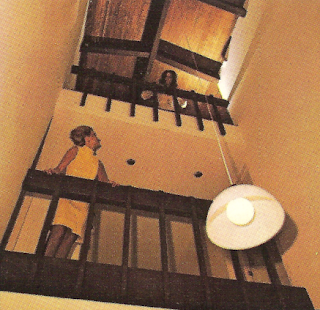

Above, a 1974 promotional image showing the dramatic three-level interior of the Villas. Below, a 1980 view of the outside of a Vacation Villa, and if you look through the window you can see the distinctive wallpaper and signature modern staircase at the back of the living room. A 1987 promotional image better showing the staircase and living room follows.


The Vacation Villas were not long all by themselves along the Village Lagoon. By early 1974, the Lake Buena Vista Golf Course opened alongside the Village Lagoon and extending northwards towards Bay Lake. Designed by Joe Lee, the golf course was “designed with mid-handicap players in mind [but] the Lake Buena Vista course is still challenging enough to be included on the TPA Tour.” Still one of the best and few remaining places to escape back into old Walt Disney World still operating today, the Golf Course was soon followed by its own clubhouse – the Lake Buena Vista Club.

Concept art for the Clubhouse

Opening November 22, 1974, the four million dollar Club was an unassuming little two level structure, the first floor buried to provide a charming entryway from the driveway while allowing the ground to slope away on the water side to provide diners a spectacular elevated view. Built in a Swiss Chalet style, the Clubhouse more or less accommodated just five functions: the Lake Buena Vista Club restaurant, the Lake Buena Vista Club Pro Shop, a pool, lighted tennis courts, and a boat rental and transport marina. In May of the following year, the Marina would host boats leaving every twenty minutes to putter their way across the Village Lagoon over to the Lake Buena Vista Shopping Village.


As inauspicious as it may seem today, the Lake Buena Vista Club was amongst Disney’s earliest efforts towards providing a truly high-end dining experience, along with another early restaurant at the Contemporary which has similarly gone by the wayside, the Gulf Coast Room, and The Trophy Room at the Golf Resort. Here is how the Club is described in a 1976 issue of The World News in their Dining Directory Index: “Continental Cusine served in a country club setting. Sportsman’s breakfast from 7 – 11:30 am $.70 - $2.40. Luncheon served 11:30 am – 3 pm. $2.10 – $4.75. Gourmet dinners from 5:30 – 9:30 pm (until 10pm Friday & Saturday). Atmosphere entertainment. Dinner reservations necessary. $5.75 - $12.95. Full menu selection for breakfast, lunch, and dinner. 6:30 am – 11 pm $1 - $7.95.” (To put this in perspective, $12.75 in 1974 is the equivalent of over $55 today, and only the Gulf Coast Room and the Trophy Room offered this sort of price point in all of Walt Disney World.)


Here’s another testimonial, this time from the Summer 1981 issue of Disney News, perhaps a bit more evocative:


Sparkling Evenings at the Lake Buena Vista Club… Imagine yourself comfortably settled amidst the intimate atmosphere of an elegant, private club. A personable, tuxedoed wine captain glides to and fro, attending to your every need; the serving of a sumptuous gourmet meal, or perhaps, the cork-popping of a bottle of vintage wine.
As you savor your meal, you take in a stunning view of a moonlit lagoon, while a trio of strolling musicians lingers near your table, gently rendering a melodic offering you have specially requested.
After losing yourself in the musician’s stylings, you partake of the ‘house specialty’ – a fiery, devilishy delicious concoction containing rum, liquer, and whipped cream. Cares and worries are light years away.”

(The after-dinner coffee mentioned, by the way, is Café Buena Vista – almond liqueur, brandy, coffee, whipped cream and a candied cherry, according to my Cooking with Mickey Around the World from 1986.)

“Lake Buena Vista Club evenings, in particular, offer seekers of “the good life” – couples, singles, families, the young and the young-at-heart, a truly exceptional experience, enhanced by lush, foliaged surroundings, sparkling waters, personalized attention and expertly prepared gourmet meals, highlighted by such unforgettable entrees as Roasted Duck with orange sauce, Supreme of Red Snapper and Steak Diane Flambe.
Add to this gracious environment the stringed instrumentalizings of the ‘Dixie Deltas’ (except Thursdays), an outstanding selection of fine wines, and the Club’s own Café Buena Vista (that ‘devilish’ potion mentioned earlier) and you might very well be ‘spoiled’ by the time you have capped this captivating evening!”

It’s worth noting that, emphasis on alcohol aside - which was indeed a very big difference between Disneyland and Walt Disney World in 1981 – the atmosphere conjured here is pretty similar to Disneyland’s Blue Bayou. In California, Disney had to build an optical illusion of such a place. In Florida, it could be found in nature, waiting for them there.

One short lived and under documented event around this time was the conversion of the Preview Center into “Buena Vista Interiors”, a “quality contract interior decorating firm […] Personalized decorating assistance is available to corporations and individuals leasing townhomes, as well as to Central Florida residents and businessmen.” (interior view at left) Headed by WED’s in-house interior designer Emile Kuri, it’s another intriguing puzzle piece in the story of Disney and American Industry in Lake Buena Vista. This swings us ‘back round to EPCOT and Progress City, of course. From the very get go Disney (Walt) and Disney (Company) knew that much would rise or fall on the involvement of Industry in EPCOT, and part of its’ eventual conversion into a theme park may be a result of Card Walker’s inability to get as many companies interested in forking over huge sums of money during the economically uncertain seventies as was needed to make the Progress City a reality. Disney tried a number of tactics to entice these companies to sign with Disney, and the “lease or buy” program at Lake Buena Vista was one of these.

The construction of the Vacation Villas in 1972 was more or less unpublicized, indicating that Disney initially hoped to sell all of the units or buildings to various companies. “A limited number of one- and two-bedroom villas, fully furnished and complete with linens and kitchenware, are available to families visiting the Vacation Kingdom for short-term rentals.” reports Disney in 1974, several years later, but this was prefaced by the following:

“More than 100 townhomes, incorporating four distinct design styles, already are completed and are available to corporations for two- or three-year-term leases or outright purchase in full. Ideal for executive family vacations, customer entertaining, or sales-incentive-reward holidays, the townhomes come furnished or unfurnished.”

Ah-ha. If at first these townhomes were meant to be purchased in full by companies, then the establishment of a separate interior design firm to furnish these empty Vacation Villas makes perfect sense. Once Disney began publicizing these Villas outside the ‘Host Community’ and in the ‘Vacation Kingdom’, in fact, this “lease-or-buy” theme is constant. While a Spring 1974 Vacationland boasts of an “Exciting, New Lifestyle for American Industry”, a June 1976 World News edition contains the following from a certain Dan W. Darrow, manager of sales and marketing for Lake Buena Vista: “Clients would be impressed with staying in a Treehouse overlooking a fairway, and employees might work harder if they could win a week’s stay in a luxurious Vacation Villa. […] The spacious Villas are ideal for client receptions, business discussions, or cocktail parties with friends.” Those are dollar signs in Disney’s words, there, one must admit, and this sort of angle doesn’t actually vanish from company literature until around 1979, when plans for EPCOT Center the theme park were more or less primed and underway.

Opening in late 1974 and early 1975, some of the most famous and memorable of all early Walt Disney World lodging structures became part of the Lake Buena Vista complex – 60 “Treehouses”, constructed in, in what was an engineering feat for the time, an undisturbed natural wetland – the Treehouses were elevated to allow for natural drainage, as well as protect the structures from the possibility of flooding. What they actually were were a cluster of three bedrooms and a living room apiece, one bedroom on the ground floor, connected to the living room via a spiral staircase, which shared the “top deck” with two bedrooms and a bath.

The Treehouses must be counted amongst Walt Disney World’s most romantically wacky creations. Complete with an outside deck and all-electric kitchen, with parking for electric carts (one presumably left her car at the Club and the cart was free with your room) and a cart pathway which wound alongside the Walt Disney World canal system, past the Lake Buena Vista Club and eventually to the Village, the original Treehouses are emblematic of Disney’s commitment to not repeat themselves with Walt Disney World and offer something sophisticated and different.


All of this development came to the head in May 1975, with the opening of the Lake Buena Vista Shopping Village. The Village was intended to be the cornerstone of the Lake Buena Vista community, literally its downtown. It included such diverse offerings as restaurants, an oyster bar open until 2am, a lounge with jazz performances nightly, and a grocery store to give those people in Vacation Villas and Treehouses something to cook in their kitchens and kitchenettes. The Gourmet Pantry even delivered direct to those staying in the “host community”. Nearby, the hotels of the Lake Buena Vista Motor Lodge were hosting lively nightlife and dining, popular with Walt Disney World guests as well as locals and Cast Members.

The Village's waterfront in 1975

Things were looking up for Lake Buena Vista.


--

Return next week when we discover Club Lake and the Convention Center!

Bonus Images:


Wednesday, December 23, 2009

Donald Duck's Best Christmas

Disney legend and comic book artist-writer Carl Barks is well known for his deft storytelling and often times sharp wit, and these qualities are certainly evident in the various Christmas-themed tales he put to paper over his long and prolific career. But it is also interesting to note that the Duckman never really succumbed to infusing excessive holiday spirit into these efforts, and more often than not, his tales of Christmas seemed more prone to cynicism than sentimentality. However, Barks' very first four color Christmas story, "Donald Duck's Best Christmas," does touch on themes of kindness and unconditional giving that even the bluster and self serving qualities of its title character can't completely overshadow.

Donald and his nephews anticipate their best Christmas ever; they're heading to Grandma's house via horse and sleigh, bringing presents and the Christmas turkey and singing festive carols along the way. But a curmudgeonly farmer and bad weather soon impede their travels. When Donald is nearly frozen by a plunge into icy waters, they are forced to seek shelter with a destitute family in a remote cabin. Without any thought at all, the mother and her two children quickly offer what little they have--the warmth of the fire and the last of their hot milk--to aid in Donald's recovery. Not surprisingly, Donald can only focus on his own troubles and fails to recognize the hardship that surrounds him, or even acknowledge the sincerity and selflessness of those who have come to his aid.

It falls to Huey, Dewey and Louie to act collectively as the story's moral center and good conscience, roles they typically play in so many of Barks' efforts. For when the ducks give up their trek to Grandma's and sadly turn back for home, the boys reveal to their uncle that they have in fact given away the presents and the holiday bird to the needy family. While Donald is surprisingly non-plussed by the revelation, he still remains relatively true to self by being seemingly unimpressed by his nephews' kind and genuine gesture. His self-centered, final panel proclamation gives credence to the theory that Barks' parting words in holiday tales tended to be jaded and cynical ones.

It was an odd dynamic and one that Barks scholar Geoffrey Blum commented on in a collection of Barks Christmas stories published by Gladstone Comics back in the late 1980s. Blum noted of Donald, " . . . if anything, the story has proven him eminently fallible. By giving Donald the last word, however, Barks managed to soften what would otherwise have been an unbearably preachy ending. It's the first in a long line of ambiguous morals, a device at which the artist became quite proficient. As a purveyor of wholesome entertainment for children, he could seldom finish up with a snarl, yet he was equally determined not to end on a syrupy note. Best to conclude with a question mark."

Whether or not Carl Barks was a Christmas curmudgeon is certainly open for debate. Stories such as "Letter to Santa" and "You Might Guess" were almost totally void of sentiment, but in "Donald Duck's Best Christmas," and his most famous holiday story "A Christmas for Shacktown," even the Duckman allowed a little warmth of heart to emerge from some of the panels contained within those efforts. And that, in and of itself, is a small testament to spirit of the holiday season.

Sunday, December 13, 2009

Disney's Christmas Mice

. . . and we don't mean Mickey and Minnie.

A different breed of mice came into prominence at the Disney Studio during the 1950s, but they were of a different nature than the oversize icons with the big round ears that had come to represent the company. The design style of these creatures seems rooted in rodents of Cinderella, epitomized by Gus, Jacques and their many friends who helped that film's heroine ultimately realize her happily ever after destiny.

Similarly-styled mice appeared in Ben and Me, of which the title character of Amos was the most prominent. This mouse-type also extended into other Disney efforts. In 1957, McCall's magazine featured the illustrated story Walt Disney's Christmas Carol that retold the classic Dickens tale but replaced Bob Cratchtet with the character of Cedric Mouse, who in physical resemblance could easily have been a cousin of Gus, Jacques or Amos. We featured illustrations and excerpts from Walt Disney's Christmas Carol in a previous post here at 2719 Hyperion.

In an interesting twist, the studio extended this mouse-mythology into the audio arena with the release in 1958 of Mickey Mouse Christmas Favorites which was in fact Walt Disney Records first holiday album. The album combined a number of previously released selections, the most notable of which was what would become the company's perennial Christmas tune "From All of Us to All of You." But as these liner notes describe, a number of the recordings came from some freshly discovered talent:

Discovered under a stairway at the Disneyland Studio, the unique all-mouse symphony orchestra under the able baton of Ludwig Mousensky is undoubtably the first and finest rodent ensemble in the world. And, we here at Disneyland Records are proud to present their first recording, "The Christmas Concert." Here are Yuletide hymns, "Hark The Herald Angels Sing," "O Little Town of Bethlehem," "O Come All Ye Faithful," "Jingle Bells," and the popular 'Winter Wonderland." The Mousensky group's rendition of these songs is truly a delightful experience for all. Under the maestro, the orchestra, consisting of Squeeky, Zeke, Horace, Henrietta, Tubby, Tootie, Clarence, Pinky, Stuffy, Zooty, Hans, Fritz, Otto (these three were formerly with the Vienna's famed DeutschMICEster Band), Pee Wee and Frenchy give a new dimension to these Christmas favorites. All proving that Christmas is a time for both mice and men.

While the album jacket did not provide any visual representations of this "rodent ensemble," its high-pitched renditions are certainly reminiscent of those performed by Cinderella's pint-size pals.

Tuesday, November 17, 2009

On Wheels of Progress

On September 29, 2006, a mere nine days into my blogging adventures, I wrote a very brief post about one of my most favorite pieces of Disney entertainment--the generally innocuous and now considerably obscure Donald Duck film Donald and the Wheel. I came to feel that my passion for this particular amalgamation of early xerography, rotoscoping and brief snippets of live action was a very rare emotion indeed. But I have come to discover fellow brothers in the Wheel cause who literally span the globe. So I have decided it is time again to celebrate this largely forgotten production that continues to gather dust in an unvisited corner of the Disney celluloid archives.

Donald and the Wheel was in fact part of one the most dramatic transitions in the history of Disney animation--the move away from hand-inked cels to the faster and more productive xerography process. Xerography was largely the innovation of resident studio technical genius Ub Iwerks. While 101 Dalmatians is most frequently heralded as the first major demonstration of the process, it was actually used experimentally in Sleeping Beauty, and tested more completely in the 1960 short subject Goliath II. But largely absent from the animation history books is the further exploration of xerography in Donald and the Wheel, which made its way into theaters a mere six months following the release of Dalmatians. Its eighteen month production schedule certainly crossed over with those of both Goliath II and Dalmatians.

An exhibitor's kit for Donald and the Wheel, though steeped heavily in PR prose, provided this generally informative background on the film's technical accomplishments:

Walt Disney scores another entertainment first with his Technicolor cartoon featurette, "Donald and the Wheel." Using the revolutionary Xerox and Sodium Screen Processes together for the first time, Disney and his director, Ham Luske, combine real people and objects in the same perspective as animated characters and objects.

Telling the story of man's greatest invention, the wheel, required illustrations of many types of wheels and cogs, sometimes highly technical in nature. Instead of having an animator draw them, Disney had color film taken of wheels and transferred them to the screen with the Xerox Process.

For example, when a scene called for an illustration of the wheels used in a cotton gin, Eli Whitney's original invention was photographed and transferred to the screen.

With the Sodium Screen Process, Disney technicians were able to reduce a beautiful, auburn-haired ballerina to the size of Donald Duck and place her on a phonograph record with him.

The Sodium Process uses two films exposed simultaneously through the same lens, one sensitive to the Sodium screen, the other not. When the two are combined, a perfect silhouette is achieved, which is then superimposed on a master print.

The same kit provided this very detailed synopsis of the film:

In Walt Disney's newest Technicolor cartoon featurette, "Donald and the Wheel," Disney brings to the screen a story he has been working on for the past twenty years, man's greatest invention, the wheel.

The tale is told in rhyme with a pair of ghostly narrators, the Spirits of Progress, Sr., and Progress, Jr. The straight man is none other than Walt's old pal, Donald Duck, aptly arrayed in the garb of a cave man.

The faint figures of Progress, Sr. and Jr. watch a common, ordinary wheel rolling. Barrel-voiced Senior explains to bopster Junior that the wheel is man's greatest invention.

"Without the wheel, mankind would be at a standstill," he observes.


Junior disagrees. "What about the airplane, automobile, typewriter, steam engine, cotton gin, sewing machine and washing machine," says the boy.

Progress Senior strips each invention of all but its basic parts — wheels — and graphically proves his point, that the wheel, son, is man's greatest invention.

Caveman Donald, however, is harder to convince. The spirits take the little character on a meteoric ride from a circular drawing on a rock down through the ages to our present day hot rods. When Donald piles up his heap on the crowded freeways, he gives up.

"Who needs wheels," he says. "I'd rather walk."

The spirits try again by showing the duck that even the world spins like a wheel, that the solar system is really wheels within wheels, that a clock depends upon wheels, gears are adaptations of wheels, and finally, a music box works on wheels.

Music is to Donald's taste, it develops, especially when a beautiful redheaded dancer does a jazz number, a square dance and a ballet with him atop of an oversized, spinning phonograph.

The spirits have chosen the wrong cave man to invent the wheel, however. Donald scurries back to his cave, erases the circle drawn in the rock and pulls his wheel-less sled over the horizon.

"No thanks," says Donald, "I'm not going to be responsible for that thing."

Senior and Junior shrug off their disappointment, but are happy that some cave man, if not Donald, eventually did have the foresight to invent the wheel.

There are likely many who view negatively the film's on the surface mishmash of rough edged styles and and distinctly non-Disney techniques and would no doubt quantify it all as short-cut animation. But in the end, director Hamilton Luske and his crew crafted a charming, entertaining endeavor that successfully mixes humor, music and education. Unlike its much more popular but decidedly stuffier cousin Donald in Mathmagic Land, Donald and the Wheel appropriately moves along at a much more energetic pace, largely due to the the clever rhyming dialog and equally creative song lyrics provided by Mel Leven. The song "The Principle of the Thing," whose lyrics I excerpted in my earlier post, stands as a truly unrecognized gem from the studio's vast library of music. Thurl Ravencroft and his fellow MelloMen did justice to Leven's efforts, with Ravencroft himself performing the voice of the senior Spirit of Progress.

What is especially ironic about Donald and the Wheel is that our favorite duck essentially plays second fiddle to the rotoscoped silhouettes of Progress Jr. and Progress Sr. A generation gap-dynamic is played out by these two characters, highlighted by Junior's beatnik-speak, again cleverly realized in Leven's rhyming dialog.

"Gazooks, Pop! This cat is really nowhere! In some circles we'd call him square"

Through narration and song, these two Spirits of Progress elevate the film beyond the potentially dry history lesson it might have been otherwise. When they are taken out of the forefront in the story's slightly weaker jukebox-phonograph sequence, the pace noticeably slows, but recovers quickly when the duo return for the final fanfare.

The short recycled animation, most notably from the Pecos Bill sequence from Melody Time, then itself later had its own material recycled for the Ward Kimball-directed 1970s' television program Mouse Factory. The gear and cog contraption created during the "Principle of the Thing" song found its way into that show's opening montage. And in an example of typical Disney synergy, the film's subject matter, humorous tone and musical nature would resurface twenty years later in the form of EPCOT Center's World of Motion pavilion.

A comic book tie-in for Donald and the Wheel was released in 1961. It was featured in this prior post here at 2719.

Monday, November 09, 2009

Up With Monsters

Disney Mathematics 101--

Today's Lesson:

Pixar + Blu-Ray = Entertainment Heaven.

My recent home theater upgrade began late last spring. It started very indirectly with the purchase of a Blu-Ray-compatible Playstation 3. It culminated mid-summer with the acquisition of 40" flat panel HD television and a Yamaha surround sound receiver. Even then, I was still generally reluctant to begin the $-intensive task of upgrading my rather extensive film library.

But then I watched the Blu-Ray edition of Cars and whatever reservations I possessed were quickly dispelled. Animation is indeed a marvel to behold in Blu-Ray format; Pixar animation on Blu-Ray is simply a jaw-dropping, visual overload of the highest order. I immediately purchased Ratatouille, Wall-E and A Bug's Lif, the only other Pixar titles then available in Blu-Ray format.

Happily, this week marks the arrival of two more Pixar features in Blu-Ray editions. It is a Pete Doctor old-and-new combination as the general home entertainment release of Up is accompanied to market by the director's first feature, Monsters, Inc. in brand new Blu-Ray trappings.

"Blue" serves quite well as the buzzword for this new high-def version of Monsters, Inc. Sulley's blue fur is simply breathtaking to behold in all its 1080 dpi glory. In a roundtable feature exclusive to the Blu-Ray, the filmmakers spoke of the challenge of rendering Sulley in the Himilaya scene with winds blowing and snow mixing into the character's fur. Viewing that particular scene in high definition certainly demonstrates that challenge and showcases the skills and talent that successfully executed it.

While many of the set's bonus features have been recycled from the original DVD release, a number of new Blu-Ray exclusive features have been added. Notable among them is a 12-minute look at the new Monsters, Inc. Ride and Go Seek attraction at Tokyo Disneyland and aforementioned Filmmakers Roundtable, a 22-minute discussion featuring director Pete Doctor, producer Darla Anderson and co-directors David Silverman and Lee Unkrich. For the younger set, Roz's 100-Door Challenge Game has been added. And as Pete Doctor notes in a new Blu-Ray intro, much of the original DVD bonus material, especially production art, has been upgraded to higher resolutions to match the high-def format.

Doctor's second feature and Pixar's 10th consecutive box office blockbuster, Up is equally served well by the Blu-Ray format. In contrast to Monsters' bright and colorful fantasy-based designs, Up showcases towering cityscapes and sweeping landscapes rich in earth tones. Textures in particular seem to jump off the screen, whether it be the rocky ground of South America or just simply the clothing worn by Karl and Russell.

Bonus features also abound on the Up set. The theatrical short Partly Cloudy is included, as well as the brand new Dug's Special Mission, a hilarious, if somewhat slight new vignette starring one of the film's more popular characters. Numerous featurettes and documentaries fill out the set's two Blu-Ray discs, as does the interactive Global Guardian Badge Game for younger viewers.

The Blu-Ray editions of both Monsters, Inc. and Up include the standard DVD versions of the films as well as digital copies that can be transferred to PCs and digital devices.

But most important, beyond all the home theater-high definition bells and whistles, exist two wonderful and very emotionally satisfying films. Even on small conventional television screens in mono sound, neither would fail to entertain.

Thursday, November 05, 2009

The Treasures of a Bold Renegade

Good news, bad news.

We'll get the bad news out of the way first. There are only two titles being released this year in the Disney Treasures DVD line. And unfortunately, neither features animation, anxiously awaited Disney anthology series content, nor material relating to Disney theme parks.

The good news however, is that the titles that have arrived, Zorro - The Complete First Season and Zorro - The Complete Second Season, are top-of-the-line productions and welcome additions to the Disney Treasures family.

The Zorro sets are unconventional Treasures. It is the first time Disney has ventured beyond the 2-disc, $32.99 SRP. These collections weigh in at a hefty six discs each and carry $59.99 price points (although smart shoppers can find them as low as $38.99). It also marks the first time Disney has marketed any of their vintage television properties in complete season sets. Disneyland program episodes have appeared in numerous themed Treasures collections, and an earlier Treasures set featured the very first week of the Mickey Mouse Club. Interestingly, Zorro collections have been offered in the past through the Disney DVD subscription club (albeit in the much maligned colorized versions originally aired on the Disney Channel), but not at retail. These new complete sets of the Bold Renegade seem to mark an equally bold marketing strategy for the normally more reserved execs at Disney Home Entertainment.

In my much younger days, I watched syndicated Zorro episodes on one of my local stations. (Yes, back in the days of antenna reception and a channel selection that included three networks, PBS and a couple of independents.) I was never a huge fan of the program, but it was a means of killing a half hour on a rainy summer afternoon. Revisiting Zorro some four decades later as a Disney enthusiast and historian has been a both enlightening and very entertaining experience.

Much like the Davy Crockett Disneyland episodes, Zorro exploded far beyond its television incarnation into a pop culture phenomenon. Its brief two-season run from 1957 to 1959 beget a national passion that encompassed publicity tours, Disneyland tie-ins and tons of merchandise. At its peak, it claimed more than 30 million weekly viewers, American Idol numbers by today's standards; a dominating 40% share of the audience in the less populated late 1950s. Legal squabbling between Disney and ABC brought about the program's premature demise and, although it has never made a very large impact on recent generations of Disney enthusiasts, it remains a very significant part of Disney Studio history.

Zorro is a wonderful mix of humor, adventure and engaging performances. Guy Williams, a relative unknown at the time, became an overnight star as he portrayed both the swashbuckling hero and his meek and submissive alter-ego Don Diego de la Vega. Henry Calvin, as the bumbling but well meaning Sergeant Garcia became an audience favorite. The production values of the series were also especially notable. As Leonard Maltin notes in his introduction to Season One, "Walt never did anything halfway," and Zorro certainly reflects this. Extensive location shooting mixed with Peter Ellenshaw's beautiful matte work demonstrated results more akin to feature films than to a weekly television program.

The Zorro DVDs certainly live up to the standards we've come to expect from the Disney Treasures line; high quality transfers and generous supplemental features. Each season features 39 episodes. Season One also includes "Zorro: El Bandido" and "Zorro: Adios El Cuchillo," a two-part adventure aired during the 1960 season of Walt Disney Presents, a combination of episodes originally intended to be part of a never realized third season; an excerpt from the 1957 "Fourth Anniversary Show" featuring an appearance by Guy Williams; and a history of the Zorro character entitled "The Life and Legend of Zorro."

The Season Two set provides two additional episodes from the 1961 season of Walt Disney Presents, "Zorro: The Postponed Wedding" and "Zorro: Auld Acquaintance." An additonal feature, "Behind the Mask," profiles star Guy Williams.

Whether you are a passionate Zorro fan, a Disney historian and enthusiast, or a person just simply wanting to enjoy some old fashioned swashbuckling entertainment, the Disney Treasures Zorro sets will be well worth your time and resources.

Wednesday, September 09, 2009

Vinyl Magic: The First Official Album

Today it's common to find yourself in a shop at Walt Disney World or Disneyland and be confronted with a variety of music Compact Discs all themed to a particular facet or aspect of your visit to the park: there are Magic Kingdom Event CDs, Haunted Mansion CDs, and of course the ubiquitous "Official Album of the Walt Disney World Resort". Today these 2 CD sets are well produced, high quality source audio presented just for the occasion.

Music to remind you of your visit to a Disney theme park has always more or less been a part of the theme park experience, as early as the early days of Disneyland when 78 records were distributed through Mattel on durable cardboard about "Your Trip to... Disneyland! (On Records)", or the seminal if hokey "Walt Disney Takes You to Disneyland" LP from 1955. Later this evolved to include such full length long playing records like "Walt Disney's Enchanted Tiki Room" with the full show on one side and an audio rendition of the Jungle Cruise on the other side with Thurl Ravenscroft as your skipper, or the full-show Hall of Presidents LP from 1971.


The first time the now-venerable term "The Official Album of..." appeared was in 1980, on this 12 inch long playing record which includes such classic tracks as "Grim Grinning Ghosts" from the Haunted Mansion, as well as some more obscure items like a track from "The Blue Grass Boys" who once haunted the eastwardly portion of Frontierland at the Magic Kingdom. It's really a compilation of a variety of different, already published material, culling tracks from records like the 7-inch "Main Street Electrical Parade Picture Disc", "Walt Disney World's The Hall of Presidents", "Walt Disney Productions' America Sings", and others.

But it is a uniquely satisfying musical experience, and one of the few park music overviews which was made widely available on vinyl record. The recordings are well chosen and some have become conventions of such releases - such as choosing, for example, the singing busts music loop to represent The Haunted Mansion, which continues to this day. There is a satisfying medley of the sounds of Main Street and a fairly satisfying condensation of Country Bear Jamboree into a few minutes on side one and America Sings on side two. There is even a snippet of the very end of the Hall of Presidents to bring out the record on a fairly strong note, itself a snippet taken directly from the 1978 4-LP set "The Magical Music of Walt Disney".


Side One:
Main Street Electrical Parade
Pirates of the Caribbean
The Music of Main Street
- The Dapper Dans
- The Saxophone Quartet
- The Main Street Pianist
The Enchanted Tiki Room
The Blue Grass Boys
Country Bear Jamboree

Side Two:
The Disneyland Band
It's A Small World
The Steel Drum Band
The Haunted Mansion
The Royal Street Bachelors
America Sings
The Fife and Drum Quartet
The Hall of Presidents - Mr. Lincoln

A lot of this material is culled from a fairly obscure little 1973 picture disc called A Musical Souvenir of Walt Disney World's Magic Kingdom, an impressive looking but fairly dull compilation of tracks performed by the various park musicians of the day:


Side One:
1) The Walt Disney World Band - Walt Disney Medley
a) Hi To You
b) Zip-A-Dee-Doo-Dah
c) Whistle While You Work
2) The Dapper Dans - The Coney Island Washboard
3) The Saxophone Quartet - Medley
a) Minnie's Yoo Hoo
b) Hurry
4) The Main Street Pianist - Maple Leaf Rag
5) The Pearly Band - Mary Poppins Medley
a) A Spoonful of Sugar
b) Chim Chim Cheree
c) Supercalifragilisticexpialidocious
6) The Banjo Kings - Swanee River
7) The Fife and Drum Corps - Medley
a) Liberty Tree
b) British Grenadiers
8) The Kids of the Kingdom - I Love a Parade

Side Two:
1) The Town Band - Mickey Mouse March
2) The Tavern Singers - Medley
a) How Great is the Pleasure
b) To Our Musical Club
3) The Polka Band - Snow White Medley
a) Heigh-Ho
b) Whistle While You Work
4) The Blue Grass Boys - Tennessee
5) Mariachi Chaparral - Guadalajara
6) The Steel Drum Band - Adventureland Jump
7) The Walt Disney World Band - It's A Small World

As much as "The Official Album of Walt Disney World / Disneyland" reminds us of a simpler time in the Company's history when the two castle parks were her primary offering to us, the "Musical Souvenir" album takes us back even further, to days when very little of the park's in-house entertainment was pre-recorded, organized, or even planned. Costumed characters used to wander in and out of areas at will, and it wasn't an uncommon sight to see a lone musician or two wandering about, spreading the simple pleasure of live music. This is one thing sorely lacking in the parks today.

"The Magical Mystery Tour is coming to take you away!"

A handful of first year performing groups are missing from the lineup - notably absent is Karen Anders and Tommy Russell, who performed at the Mile Long Bar, and a small nautical trio who performed near 20,000 Leagues Under the Sea. Many of these groups undoubtably consisted of the same people, who then would go on to change clothes and put in appearances at the Golf Resort, or The Contemporary, or Fort Wilderness. The fate of many of these acts is fairly unknown, and photographs are even less common. The Steel Drum Band became known as J.P. and the Silver Stars and even was relocated to Disneyland for some time (the bandstand atop the Jungle Cruise queue was built for them) and some of the original musicians from this group perform in Animal Kingdom today. The Fife & Drum Corp - The Ancients - moved to EPCOT Center in 1982, and brought the Tavern singers along with them to become The Voices of Liberty. The Banjo Kings relocated out of Liberty Square and performed on Main Street in the late 80's, and the Saxophone quartet was reborn many years later, in a fashion, as today's "Toontown Tuners".


Perhaps best of all, better than the performances (by far..), is a little blub on the bottom of the LP sleeve, explaining who all of these groups are that we're having a Musical Souvenir of.

"THE WALT DISNEY WORLD BAND: This band of on-the-go musicians provides Magic Kingdom guests with plenty of Sousa marches, turn-of-the-century oldies, Disney classic favorites, and humorous arrangements of today's top show tunes. THE DAPPER DANS: These four 'happy men of Main Street' can be found in the shops and on the streetcorners singing your favorite barbershop melodies. THE SAXOPHONE QUARTET: (Keystone Kops) Dressed in nostalgic costumes of the 1920's, these talented saxophonists are ready for a musical chase down Main Street USA just when you least expect it! THE MAIN STREET PIANIST: Whether playing your favorite ragtime tune or leading a sing-along, this piano player is always adding to the happy mood of Walt Disney World's guests. THE PEARLY BAND: This versatile sextet from 'Mary Poppins' is forever ready with a fun treatment of a Disney classic while strolling through Fantasyland. THE BANJO KINGS: Sounding much the same as the original banjo 'pickers' of the 1800's, this duo takes guests back to those good old days on the riverboats. THE FIFE AND DRUM CORPS: Providing the authentic sounds of 1776, Walt Disney World's fifers and drummers give visitors to Liberty Square the feeling they are sharing a famous moment of American History. THE KIDS OF THE KINGDOM: This lively group of young singers entertains Tomorrowland guests with exciting production numbers and the latest hit songs. (Author's Note: THE WORST!!!!!!!)

THE TOWN BAND: The butcher, the baker, and the candlestick maker all get together for some musical fun in Town Square. THE TAVERN SINGERS: Dining at Magic Kingdom restaurants is also a listening pleasure as these delightful voices sing a merry catch. THE POLKA BAND: It's always dance-time in Fantasyland when these 'old-world musicians' play your favorite polkas, waltzes, and schottisches. (Author's Note: you all have a favorite schottishe, right?) THE BLUE GRASS BOYS: Foot-tappin' mountain music has never sounded better than what you hear from this group in Walt Disney World's Frontierland. MARIACHI CHAPARRAL: Guests find themselves 'south of the border' when enjoying the music and songs old old Mexico performed by these authentic Mariachis. THE STEEL DRUM BAND: The energetic performances of this top Adventureland group of entertainers are much too captivating to be forgotten."
"Why? Because we like you!"

These two records, although now obviously out of print, are common enough finds on the secondary market, and provide enough entertainment and historical interest to make them worth seeking out for those of us who still enjoy dragging needles across slabs of plastic to make music.