Friday, June 19, 2015

Walt Disney's Los Angeles: 1923-1931

Editor's Note: We will be exploring Los Angeles today as part of our Californy er Bust road trip.  Part of the day, we will be navigating by way of our 2010 Walt Disney"s Los Angeles posts that traveled historically through the area of the original 2719 Hyperion Disney Studio. We have combined those two original posts into one feature now presented here.  Check back again for a photo diary of today's travels.
At roughly the same time Mickey Mouse premiered at the Colony Theatre on November 18, 1928, Elsie Robinson gave birth to William Arthur Robinson in Los Angeles, California.  He wasn't even a day old when his father, newspaperman Chester Robinson, bestowed upon him the nickname "Buddy."  Buddy and his parents lived in the Los Feliz neighborhood of Los Angeles, just east of Hollywood.
On his fifth birthday in 1933, Buddy and his father rode the Red Car over to Glendale where the Alexander Theatre was located.  It was there that Buddy saw his first Mickey Mouse cartoon.
 
On the way home, they got off the Red Car early and walked down a street past a few vacant lots and turned a corner onto Hyperion Avenue.  At the corner was a gas station, and next to it on the left was a series of large buildings.


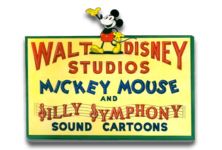
Buddy remembers, "My Dad lifted me up to sit on his shoulders and then he pointed to a large sign perched on top of one of the buildings.  There on the sign was Mickey Mouse, happily waving down to my father and me as we stood looking up from the sidewalk.  It was silly, but we both happily waved back."  Buddy and his father were standing in front of the Walt Disney Studios, located at 2719 Hyperion Avenue in the Silver Lake area of Los Angeles.


2719 Hyperion.  It is a simple address that has evolved into a near-iconic term for Disney historians, journalists and enthusiasts.  And we would like to as modestly as possible think that we have contributed to that evolution over the course of the last four years of 2719 Hyperion.com.  The history of the Hyperion Avenue studios is generally well-documented; in fact, two well-known Disney historians are each currently writing books that focus on that very subject.  So in discussing 2719 Hyperion, we thought we would approach it more in a geographical context.  This is because the area immediately surrounding the Hyperion Avenue location is nearly as rich in Disney history as the studio itself.  These neighborhoods  encompass an area of approximately two square miles just east of Hollywood.


We are going to navigate this geography by means of young Buddy Robinson, who we just introduced a few moments ago.  In the interests of full disclosure, Buddy Robinson is a wholly fictional entity.  We have created Buddy as a way to lift this exploration above the level of a dry dissertation and hopefully create a more entertaining, but still informative presentation.

As we explore the area surrounding 2719 Hyperion, as a point of reference, we are going to use this 1939 street map of Los Angeles, that was produced and distributed by the Standard Oil Company of California.  The Walt Disney Studios was closely affiliated with Standard Oil during this time period.  In 1939, Disney produced a series of four-page Travel Tykes comic book premiums available at Standard Service Stations.  The studio also produced a commercial cartoon short entitled The Standard Parade that tied into this promotion.  Just to note, within the 2719 Hyperion Archives there is a series of posts that feature Travel Tykes newspaper ads that were featured in the Los Angeles Times during the spring of 1939.

We are going to follow Buddy Robinson as he spends a Saturday afternoon during the spring of 1939 traversing his neighborhood.  But before we do that, we are going to briefly jump back in time to that day in 1933 when Buddy and his father visited the Alexander Theatre in Glendale.
The Alexander Theatre is especially significant to early Disney history.  As it was located just a few miles from 2719 Hyperion Avenue, Walt Disney used the Alexander Theatre numerous times throughout the years to run preview screenings of many of his cartoon short subjects. In their book Silly Symphonies, authors Russell Merit and J.B. Kaufman document preview screenings of Disney cartoons there as early as 1931 with the shorts Egyptian Melodies and The Clock Store.  Studio veteran Jack Kinney noted, "When a picture was finished, it was usually previewed at the Alexander Theater in Glendale to get audience reaction. After the show, the boys and girls would gather in the lobby and discuss the various scenes with Walt."
But now let us return to the spring of 1939.  Buddy Robinson is leaving his house located at 4410 Clarissa Avenue in Los Feliz.  Buddy's home was located about ¾ of a mile from the Hyperion studio as the crow flies; traveling by street routes added an additional ¼ mile to the journey.  Buddy's Aunt Connie (his mother's sister) who lived with his family would frequently walk that distance on a daily basis; she was employed as an ink and paint girl at the Disney Studio.
 
Buddy travels a couple of blocks west of his home to Hillhurst Avenue where he turns south; a block later he turns west onto Franklin Avenue where he travels two more blocks to Vermont Avenue and a business district that includes stores, restaurants, and the Los Feliz Theatre.

He might stop in and pick up some candy at either the Los Feliz Mart or the Holly Mont Market; and he'll probably run into the Owl Drug Company and buy a comic book or two if he has enough money.  He checks to see what's playing at the Los Feliz Theatre and decides that the double bill of St. Louis Blues and Girl Downstairs is not to his liking. 

Shortly after they were married in 1925, Walt and Lillian Disney lived briefly in an apartment located a half block away from these shops at 4637 Melbourne Avenue.

Les Clark, one of Disney's legendary "Nine Old Men" met Walt Disney for the first time at a small restaurant near the intersection of Vermont and Kingswell.  Clark told Disney historian Don Peri, "It was a malt shop, confectionary store, and they served lunch and other meals."  He remembered, "I met Walt in the summer of 1925.  He used to come in and have lunch almost every day.  When I graduated from high school, I got in touch with him and asked him for a job."

Veteran Warner Bros. animator Friz Freleng remembered renting a room in a house on Vermont Avenue when he briefly worked for Disney in 1927.  Freleng noted that Roy Disney would pick him up and drive him to the studio every morning, but added, "But after work we had to walk home, because he didn't care when we got home, but he did care when we got to work!" 
Buddy rides his bike one block south of Melbourne Avenue and turns east onto Kingswell Avenue.  Here he will pass one of the most significant places in Disney history.
Near the corner of Vermont and Kingswell is the location where Roy Disney and Walt Disney established the Disney Brothers Studio on October 8, 1923.  The fledgling studio shared space with a real estate office at 4651 Kingswell Avenue.

The initial rent for the location was $10/month.  The studio opened for business on October 16, 1923, the day after Walt accepted New York distributor Margaret Winkler's offer to distribute the new Alice Comedies series.  Walt and Roy, and newly hired ink and paint girl Kathleen Dollard comprised the entire staff of the operation.  On January 14, 1924, the future Mrs. Walt Disney, Lillian Bounds was added to the staff as a cel painter.  Walt and Lillian's daughter, Diane Disney Miller, remembered her mother speaking of the couple's first kiss, that likely happened at Kingswell Avenue.  ". . . it was very sweet . . . she was taking dictation from him, and he leaned across the desk and kissed her.  I find that very romantic.  I don't think I've ever told anyone other than family about that, simply because no one seemed interested."


In February of 1924, the studio moved into larger quarters directly next door at 4649 Kingswell where they were able to display the Disney Brothers name on a storefront window. 

Here is a view of how this area looks today.


A copy store now occupies the location that was once briefly, the Disney Brothers Studio.

As Buddy heads further east on Kingswell, he comes to the home of Robert Disney, uncle to the Disney brothers. 
It was here, at 4406 Kingswell Avenue, where Walt first lived upon arriving in southern California in late summer of 1923.  Robert Disney had moved to Los Angeles the prior year and earned a living working in real estate.  For a brief time, Walt worked out of his uncle's garage.

It was from this location that October 16, 1923 that Walt wrote the family of Virginia Davis in Kansas City, requesting that they come to Hollywood so Virginia could star in the new series of Alice Comedies.
Walt also had printed stationary that used the 4406 Kingswell address.  He used a piece of that stationary for a subsequent letter to Mrs. Davis on October 24, 1923.


For a little over a year, Walt and Roy lived together in a rented room across the street at 4409 Kingswell, the residence of Charles and Nettie Schneider, and then later at an apartment at an unknown address.  As roommates, the two proved quite incompatible; so much so that a frustrated Roy sent for his Kansas City sweetheart, Edna Francis.  The two were married at Uncle Robert's home on April 11, 1925.
Buddy suddenly remembers that he wants to check what's playing at the Vista Theatre, so he points his bicycle south off Kingswell onto Hillhurst Avenue.  He travels the four blocks to the corner of Hillhurst and Hollywood Boulevard where the Vista is located.
He decides that the double bill of Tailspin and The Three Musketeers is to his liking and quickly exchanges a dime for a ticket and a few hours of vintage Hollywood escapism.
It is important to remember that at this time, the movie industry was a growing and pervasive presence in the Los Feliz and Silver Lake neighborhoods, and of course in Hollywood just to the west.  Data from the 1930 U.S. Census indicates that a large number of individuals then living in these areas were associated with work within the motion picture industry.


Across the street from the Vista Theatre was one of Hollywood's then well known poverty row studios.  Monogram Studios produced such B-movie fare as Boris Karloff's Mr. Wong series, The East End Kids and The Bowery Boys and was home to numerous western matinee idols such as a young John Wayne, Tex Ritter, Hoot Gibson, Buck Jones and Johnny Mack Brown.

Walt and Lillian Disney lived for a brief time very near to this location.  The couple rented an apartment at 1307 North Commonwealth Avenue sometime during the mid-1920s.  There is no trace left of the house or building they resided in and in fact the entire 1300 and 1400 blocks of North Commonwealth Avenue no longer exist.  North Commonwealth would have intersected Sunset Drive very close to where the Monogram Studios came into being in 1931.


Today, the entire area, including the original Monogram Studio building, is part of the KCET Studios complex.  KCET is the PBS affiliate for the Los Angeles area.
After watching  movies and filling up on popcorn and Coca-Cola, Buddy pedals his bicycle north on Talmadge Street and eventually passes the former Vitagraph Studios that was sold to Warner Bros. in 1925.
Built in 1912, Vitagraph was one of the earliest of the Hollywood studios and enjoyed the presence of such film pioneers as Douglas Fairbanks, Lillian Gish, Rudolph Valentino, Mary Pickford, Cecil B. DeMille and D. W. Griffith.  ABC Television acquired the property in 1949.  Disney assumed ownership of the complex when it acquired ABC in 1996.  During the time Walt was active in the Los Feliz/Silver Lake area, the studio would have been referred to as the Warner Bros. Vitagraph or the Warner Bros. Annex.  It was located just a block away from Robert Disney's home.
A few blocks north, Buddy turns right on Franklin Avenue and pedals across the Shakespeare Bridge, a well known Los Feliz landmark.
 Just after crossing the bridge, he turns left on St. George Street.  At the intersection of St. George and Lyric Avenue, he passes two small adjacent houses that were once the homes of the Disney brothers.
Walt and Lillian resided at 2495 Lyric Avenue while Roy and his wife Edna lived next door at 2491.  Both couples moved into the small homes in 1927.


The houses were built from modified prefabricated kits manufactured by the Pacific Ready Cut Homes company.  Michael Barrier noted in his book The Animated Man, construction on the two homes began in August of 1926 and was completed by the following December.  The cost of the land and the two kit houses was estimated by Roy Disney to be approximately $16,000.

In the summer of 1932, Walt and Lillian moved into their second home, a house they had built at 4053 Woking Way in the Los Feliz Hills.  Though not on Buddy's bicycle route, the house was approximately one mile from the Hyperion Avenue studios.


Walt and Lillian lived at this location until their move to Holmby Hills in the late 1940s.  This was the home where the Disney's raised daughters Diane and Sharon.  It was also well known for its swimming pool that was perched precariously on a high hillside.  Roy O. Disney once said, "He hung this swimming pool up on the corner of this darn thing.  It's a granite hill and we were taking bets to see if it would stand."


In 1939, Walt appeared in magazine advertisements for DeSota that featured photographs taken at the Woking Way estate.

Roy and Edna Disney moved out of their Lyric Avenue home in 1934 and relocated to 4365 Forman Avenue in North Hollywood, not far from where he and Walt would build the Burbank studio at the end of that decade.  Roy would ultimately live in two other homes in that same North Hollywood/Burbank area prior to his death in 1971.

Buddy rides his bike a short distance further down St. George where he passes John Marshall High School.


John Marshall High School was opened in 1930 and its tall central tower can often be seen looming in the distance in photos of the Hyperion studio.  It has long been a favorite location of Hollywood filmmakers.  Movies such as Raiders of the Lost ArkGrease and more recently, Transformers have used the school as a backdrop.

Studio veteran Jack Kinney noted in his biography that he and number of other studio employees lived in apartments on Griffith Park Boulevard just a few blocks away from John Marshall.  He also remembered that he and other members of the story department would sneak out of the studio to watch football games at the high school.  Kinney remembered, "We were too cheap to pay twenty-five cents for a ticket in the grandstands, and we soon discovered that by climbing up an ivy-covered bank we had a first-class, close-up view of the action on the field through a chain-link fence."  According to Kinney, the school's disgruntled principal ultimately turned on sprinklers to discourage the freeloading Disney employees.

Directly across from John Marshall, Buddy turns down Evans Street where after one very long extended block he arrives at Hyperion Avenue.  He turns left on Hyperion Avenue.  He quickly drops off some overdue books at the Hyperion Branch Station of the Los Angeles Public Library, located at 2619 Hyperion Avenue.
After leaving the library, he continues one block up Hyperion Avenue to where it intersects with Griffith Park Boulevard.  He has reached the location of the Walt Disney Studios.

We have arrived at 2719 Hyperion Avenue.


During the studios' earliest of years, the area surrounding 2719 Hyperion was a generally quiet, empty place.  Animation director Ben Sharpsteen remembered visiting for the first time in 1929:

"I walked through what was mainly a residential development, a section of town which had been laid out with streets and curbs, but which had very few homes at the time.  It was late March and the grass and weeds were very tall and they were growing up through the sidewalk in places.  It was not a street that was very much used at the time.  I thought this was a very strange neighborhood for a cartoon studio, but I finally came to a main intersection as directed and I found the number on a small building next to a service station on the corner.  Sure enough, the sign over the door read 'Walt Disney Studios.'"


In the decade that followed, the Hyperion studio grew, in what many observers described as an almost "organic" expansion.  Existing buildings were expanded and extended; nearby buildings were absorbed and additional facilities emerged on the opposite side of Hyperion Avenue.


The Disney Annex was added to the studio sometime around 1936. During the late 1930s, it was in this place that aspiring artists were typically given tryout periods to prove their talent and skills, working mainly as in-betweeners under the watchful and often harsh supervision of studio manager George Drake. Part of the training process also involved art classes taught by Don Graham.


In less than one year following Buddy's travels on that Saturday afternoon in May 1939, the Hyperion studio would be gone.  By early 1940, Walt Disney and his entire operation relocated to a sprawling new studio complex in Burbank.  Buddy's Aunt Connie did not follow the company to Burbank but instead was married later in 1940 and moved to Pasadena with her new husband.  Decades later, a supermarket would occupy the location, and the address, 2719 Hyperion, would cease to exist.
Buddy turns his bike around.  It is getting late and he needs to get home for dinner.  He pauses for a moment and looks up at the large sign on the top one of the studio buildings.  He fondly remembers his birthday in 1933 when his father brought him to this place.  He scans the surrounding street and confirms that he is alone except for the occasional passing cars.  He shyly lifts his hand and waves.  And from the sign that rises high above the address that is 2719 Hyperion Avenue, Mickey Mouse waves back.

Wednesday, June 17, 2015

Pixar's Route 66: The Wigwam Village Motels

Sally's Cozy Cone Motel was the place to stay in Radiator Springs.  The set piece from the Pixar animated feature Cars owes it inspiration to the now iconic Wigwam Village chain of motels that originated in the 1930s and 1940s.  There were originally seven Wigwam Villages scattered across the USA, but now only three remain. Two are located on the Mother Road--Route 66.  On our Californy or Bust road trip, we visited Wigwam Village #6 in Holbrook, Arizona. The other surviving villages are located in San Bernadino, California and Cave City, Kentucky.  All three remaining locations are listed on the National Register of Historic Places.
The Wigwam Village was the brainchild of Frank A. Redford, who built the first one in Horse Cave, Kentucky in 1933, and patented the design for the complex. Other villages emerged over the next two decades, including locations in Alabama, New Orleans and Orlando, Florida.  Redford himself built Village #7 in Rialto in the late 1940s. Arizona motel entrepreneur Chester E. Lewis secured the rights from Redford to build his own version of the unique design, and opened Village #6 in Holbrook in 1950.
Vintage postcard of Wigwam Village #6 in Holbrook Arizona
The design of the Cozy Cone office and lobby building was influenced in many ways by the Blue Swallow Motel, located on Route 66 in Tucumari, New Mexico.  The Blue Swallow is also listed on the National Register of Historic Places.

Monday, June 15, 2015

Pixar's Route 66: The U-Drop-Inn

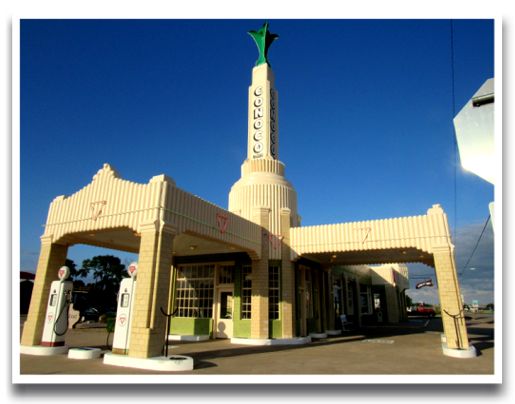
Nearly eight decades ago, the U-Drop Inn opened as an oasis of sorts on the then busy Route 66 highway in the Texas panhandle.  Located in the tiny town of Shamrock near the Oklahoma-Texas border, the U-Drop Inn opened for business on April 1, 1936 and was the only cafe within one hundred miles of Shamrock.
Original owner and operator John Nunn created the design for the establishment, literally scratching it out in the dirt of a nearby motel parking area.  Texas architect J. C. Berry drew up the plans on real paper.  Seventy years later, Pixar artists would translate the art deco-inspired design into Ramone's Body Shop in the 2006 feature film Cars.
After decades of decline, the U-Drop Inn was added to the National Register of Historic Places in 1997, and a restoration was completed in 2003.  It currently serves as a museum, visitors center, gift shop and headquarters of the local chamber of commerce.

Saturday, June 13, 2015

On the Open Road!

"Every day another new adventure, every mile another new zip code!"

Today, we hit the open road!

It's Californy er Bust--day one of our twelve day cross-country road trip, traveling from North Carolina to California and back again.  My son Jake and I will be navigating both backroads and interstates and blogging as we go.  So, to get things started here at 2719 Hyperion, we decided to celebrate one of Disney's most underrated gems, and a film that reflects our own current highway adventure.


A Goofy Movie celebrated its 20th anniversary this year.  It remains an unassuming little film that continues to be quickly dismissed by most Disney aficionados, and sadly rejected by animation scholars and movie critics (currently at 53% on Rotten Tomatoes).   But if you cast aside mainstream opinions and talk to individuals who were parents and kids back in 1995, you'll discover many who speak of the movie in glowing, and often reverential terms.  There was even a group of folks who just a few years ago, produced an elaborate live action recreation of the film's opening musical number.  Why?  Because, as was noted on their website, "we love Goofy and A Goofy Movie.  It is such a big factor in our childhood."

It certainly was an unusual concept at the time.  It came on the heels of the Disney animation renaissance, sandwiched in between The Lion King and Pocahontas, and preceded the first Toy Story and the subsequent Pixar revolution by six months.  It was a modest production, largely outsourced to satellite Disney animation studios in Paris and Australia.  The premise and many of the characters were lifted from the syndicated television show Goof Troop. That pedigree, and its Disney MovieToons brand, clearly relegated it to a status more closely associated with the company's much maligned direct-to-video product, commonly referred to as the "cheap-quels." This, despite the fact that it was jointly produced by Walt Disney Feature Animation and Walt Disney Animation France.

It is a film of many virtues.  Essentially a down-to-earth family comedy (albeit one featuring anthropomorphic dog-like characters), it showcased a parent-child generation gap that its audience seemed to immediately recognize and relate to.  Sprinkled in were well-crafted musical numbers, including two near-showstoppers: the opening "After Today" and the visually dense and high energy extravaganza "On the Open Road."
The Possum Posse--Lester, Buford, Beulah and Mortici
It also contains one of the funniest vignettes in a Disney movie.  When Goofy and Max visit Lester's Possum Park, it results in a hilarious send-up of both decaying roadside attractions and Disney's own Country Bear Jamboree.  My two sons made the high-pitched exclamation, "Who's your favorite possum?" a mantra in our household for years after the film's release.  It was a rather bold satire from a studio not typically receptive to that degree of self parody.

A Goofy Movie will never be considered top tier Disney entertainment, but it remains a fun and endearing film, largely forgotten by most, but passionately remembered and loved by many.


Road Trip Addendum
"Howdy boys, is this the way to Nashville?"

Leaving Winston-Salem, North Carolina, we pass directly through Nashville as we cross Tennessee and Arkansas.  For more details, check out our road trip diary and other road trip features on Boom-Pop!

Freeze Frame! - "It's Californ-I-A or Bust!"


Relating directly to our post today showcasing A Goofy Movie, we present this Freeze Frame! featuring two other characters who managed cameos in that film's musical number "On the Open Road."  Mickey proclaims in song our own current road trip mantra, albeit with slightly different enunciation.  

Wednesday, June 10, 2015

Revisiting Roadside Disney: Trailer Tales

Editor's Note: This week, in anticipation of our upcoming Californy er Bust cross-country road trip (departing Saturday, June 13), we will be reprinting articles from our Roadside Disney category. Enjoy!
It is an icon of roadside popular culture. A home on the road for tin can tourists. Over the years, Disney cartoon makers incorporated the American travel trailer into a number of short subjects, but perhaps never more famously than in the Technicolor classic Mickey's Trailer, released on May 6, 1938.

Mickey's Trailer was not born out of happenstance. A mere decade earlier, everyman Arthur Sherman, a modest bacteriologist, turned the then fledgling auto camping movement on its ear when he introduced a solid-walled trailer that was devoid of the more traditional canvas and tent based designs that had been popular up to that point. Jokingly dubbed the "Covered Wagon" by Sherman's children, it would launch both a successful new industry and a popular culture phenomenon. In their book Ready to Roll: A Celebration of the Classic American Travel Trailer, authors Arrol Gellner and Douglas Keister elaborated on Sherman's unique achievement:

"Sherman's Covered Wagon Company was a rare success story in the bleakest years of the Depression, and naturally, it attracted notice—both from competitors and from the American press, who were desperate for stories containing some glimmer of economic hope. For their part, Sherman's competitors—including those who had specialized in all manner of sophisticated, fold-out gadgetry—were eventually obliged to adopt the Covered Wagon's hard-walled construction."

This Depression-era trailer boom reached a peak in 1936, followed quickly by an unpredicted and near devastating decline shortly thereafter. Manufacturers dramatically over predicted growth and demand and the bubble quickly burst. This was coupled with a sudden public disenchantment with many aspects of trailer culture. Gellner and Keister noted:

"The media's giddy, rose-colored accounts were gradually supplanted by more hostile examinations of the trailering phenomenon. Trailer parks were pilloried as a new kind of American slum-on-wheels and were even accused of being a breeding ground for epidemics, while trailerites were increasingly portrayed as freeloaders helping themselves to public roads and facilities without paying taxes for their support."
When it was released in 1938, Mickey's Trailer encapsulated many of these both positive and negative associations. Via Walt's well known "Probable Impossible," the canned-ham style trailer featured in the short embodied with extreme exaggeration the trailer manufacturers much hyped claims of style, luxury and countless conveniences. Its interior featured a series of ingenious if not impossible transforming set pieces; a bunk room dramatically morphs into a bathroom (complete with sink and already filled bathtub) and then into its final incarnation as a dinette upon which Mickey serves up breakfast.

Yet the cartoon's creators, in a subtle yet still noticeable manner, poked fun at the various negative associations to trailer culture that began to emerge in the late 1930s. The short's opening reveal of the trio's city dump campsite is indicative of what Gellner and Keister described as local government fears of trailerite slums taking root on city outskirts. The perception of trailer campers as freeloaders is distinctly portrayed when Mickey, without conscience, absconds corn from a nearby farmer's field and similarly draws milk from a passing cow. The background music for that particular scene featured the song "The World Owes Me a Living."
A post-World War II boom returned the travel trailer to a more than receptive American public. The industry itself experienced a distinct split as larger residence-based mobile homes became as equally popular as their recreational-centric counterparts. The smaller travel trailers became linked with then very popular outdoor sportsmen dynamics that included camping, hunting and fishing. This pop culture phenomenon was not lost on Disney animators; they used it to great effect in the 1950 Donald Duck cartoon Trailer Horn. A canned ham-style trailer is the focal point of Chip and Dale's inspired antagonism and Donald's resulting frustration.

In the 1952 cartoon Two Weeks Vacation, Goofy falls victim to a well known highway convention--getting stuck behind a lumbering, slow-moving car and trailer combination. Mixed in the short with the Goof's other road trip pratfalls is a recurring encounter with an oversize and impassable trailer. Similar gags would be revisited quite famously a couple of years later in the classic Lucille Ball-Desi Arnaz comedy The Long, Long Trailer.

Disney Imagineers have similarly drawn inspiration from the travel trailer and have peppered Disney theme parks with numerous trailer-inspired set pieces. Trading on mid 20th century nostalgia are trailers that appear in Animal Kingdom's Dinoland, at Disney's Pop Century Resort and in Mickey's Toontown at Disneyland. Trailers were also a featured part of a character greeting area at Disney's Hollywood Studios prior to that particular location's current Pixar Studios redesign. But likely the most prominent use of travel trailers and their connection to roadside culture are the "Elfstream" designs found at Winter Summerland Miniature Golf at Walt Disney World. The theming mixes roadside campground nostalgia with retro Christmas trappings for a truly entertaining and often hilarious experience.


Media Images © Walt Disney Company

Tuesday, June 09, 2015

Revisiting Roadside Disney: Cartoon Crazy and Studios Programmatic

"At the beginning of the automobile age, in that most car crazy of places, Southern California, roadways were dotted with eye-catching beacons for travelers. Diners shaped like chili bowls, pigs, and coffee pots; hotels and theaters in Aztec and Mayan motifs; and all matter of oddly shaped buildings were part of the western architectural landscape--a trend that spread across the country."
From the book California Crazy and Beyond by Jim Heimann

Programmatic architecture, more commonly referred to as "California Crazy," was a visual mainstay along the roads and highways of southern California for much of the early half of the 20th century. It was not surprising then when Disney cartoon makers drew inspiration from programmatic design when creating the 1949 Donald Duck short All in a Nutshell.

In the cartoon, Donald Duck is the proprietor of a roadside stand called Don's Nut Butter. Shaped like a giant walnut, the stand is not just simply a background element--it is the gag that propels the story. Coveting this huge "nut," Chip and Dale set about attempting to crack its shell. When they breech an opening near the top, they discover its non-organic nature, but then decide to instead dedicate their efforts to pirating off as much of the duck's nut butter as they can possibly manage.

Don's giant walnut was inspired by numerous roadside establishments that were typically produce stands or counter service cafes. Very similar in appearance and style to the Nut Butter stand was the Jumbo Lemon, one of a chain of drink stands with locations throughout California. Other notable examples included the Chili Bowl, the Mushroom Cafe and the Tamale, all small diners that sprang up in southern California during the 1920s and 1930s.

Two years prior to All in a Nutshell, Disney animators made reference to one of the most famous examples of programmatic architecture, in the 1947 feature film Fun and Fancy Free. At the end of film, Willie the Giant is seen walking through the Hollywood landscape, searching for a "teensy-weensy little mouse." He spies the famous bowler hat architecture of the Hollywood Brown Derby Restaurant, picks it up and places it on his head. This very funny and then quite topical gag poked fun at the original Hollywood Brown Derby on Wilshire Avenue and its over the top California Crazy design.

When Disneyland opened in 1955, it could be said that it was in many ways an extension of California Crazy, taken to a much more sophisticated level of design and execution.  But the Walt Disney Company would in fact revisit programmatic architecture in the style's more historic context when, in 1989, the company recreated an idealistic golden age of Hollywood as part of the theming for Disney-MGM Studios. Included in the park's initial design were two very distinct homages to 1930s era California Crazy motifs. Both were located into the Echo Lake area of park; both were counter service food establishments (as were the vast majority of vintage-era programmatic buildings), and they both bore thematic connections to early Hollywood productions.

Dinosaur Gertie's Ice Cream of Extinction paid homage to the star of Windsor McKay's landmark animated cartoon from 1914. Dinosaurs have long been a popular subject for novelty architects and Gertie is similar in design and scale to other roadside dinosaur structures. Other creature-inspired establishments ran the gamut from dogs and chickens to pigs and fish.

Min and Bill's Dockside Diner was inspired by the 1930 film Min and Bill starring Wallace Berry and Marie Dressler. Imagineers drew on the movie's waterfront setting to create the counter service venue that takes the form of a vintage tramp steamer. Nautical design was an especially popular theme of California Crazy, distinguished typically by land-bound ships, boats and even inspired interpretations of Noah's Ark.

In an interesting, and somewhat ironic twist, Imagineers did not reproduce the original bowler hat design when they recreated the Hollywood Brown Derby Restaurant at the Studios park. Instead they based the signature eatery's design on the Hollywood Brown Derby location that was built near the intersection of Hollywood and Vine. But Imagineers did recreate the storefront facade of the Darkroom, a well known Hollywood retail store, for the park's own camera shop on Hollywood Boulevard. And it certainly could be argued that the oft-debated (and recently removed) giant Sorcerer's Hat that became an icon of the Studios is but another shining example of programmatic architecture.

One final interesting Disney-California Crazy connection to make note of: comics writer-illustrator Dave Stevens incorporated one of the more famous programmatic structures, the Bulldog Cafe, into his graphic novel The Rocketeer. Disney recreated the cafe when it adapted the work into a film in 1991, and that particular set piece resided for a number of years on the back lot at Disney-MGM Studios. The original Bulldog Cafe dated back to the 1920s and was located on West Washington Boulevard in Los Angeles. A very similar building, called the Pup Cafe, was a popular hot dog stand and served the citizens of Venice, California during the early 1930s.


Screenshots © Walt Disney Company

Monday, June 08, 2015

Revisiting Roadside Disney: Looking for a Good Night's Sleep

Editor's Note: This week, in anticipation of our upcoming Californy er Bust cross-country road trip (departing Saturday, June 13), we will be reprinting articles from our Roadside Disney category. Enjoy!
One of the themes I revisit often here at 2719 Hyperion is the traces of popular culture that can be found in Disney entertainment, especially in productions from the Studio's first three decades. The emerging dominance of automobile transportation during those decades gave birth to a roadside culture that permeated the American landscape until diminishing with the advent of Interstate highway system in the 1950s and 1960s. Disney artists and animators would often inject their work with roadside inspirations, and its easy to understand why. Based out of southern California, they existed at a focal point of roadside Americana. The mother road, the legendary Route 66, cut a path directly through Hollywood.

Overnight lodgings became necessities for weary automobile travelers. As author John Margolies notes in his book Home Away From Home: Motels in America, "The roadside hostelries that evolved were not only creative and efficient institutions, but they became part of the ethos of American mobility and popular culture. The setting of a motel room or a tourist cabin has provided moments in movies and literature."

The 1947 Donald Duck short Wide Open Spaces is the first time that a Disney character seeks out a motel for a good night's sleep. The Hold-Up Motel is no more than an old house distinguished by its clever gun motif sign, but it evokes an archetype setting made especially famous by Hollywood in countless crime noir films of that time period. Background artist Howard Dunn did a terrific job of capturing that darker, moodier style, even though the tone of the short was generally light and comical. Seedier roadside venues were clearly the inspiration for the Hold-Up Motel and those places were often distinguished as criminal hideaways or as author Margolies remarks," . . . venues of choice for those with less than honorable intentions." Even FBI Director J. Edgar Hoover attacked the tourist camp industry when he wrote an expose called "Camps of Crime" for The American Magazine  in 1940. Fortunately, the only supposed crime Donald encounters at the Hold-Up Hotel is the proprietor charging $16 for "the cot on the porch."

When Goofy took Two Weeks Vacation in 1952, his adventures were the cartoon equivalent of a Route 66 road trip in everything but highway name. At the beginning of the short, a desk bound Goof dreams of golfing, boating, hunting and fishing, but his reality instead becomes roadside escapades involving crooked mechanics, reckless trailer jockeys and the quest for a neon sign proclaiming VACANCY. These vignettes and gags were very much rooted in American roadside culture. Motor courts and tourist cabins were still in their heyday at the time of Two Weeks Vacation, and that is reflected in the backgrounds created by Art Riley.

In his search for lodging, Goofy encounters one of the common marketing mantras of the open road: LAST CHANCE. When countless miles often separated small towns and their roadside establishments, the term LAST CHANCE was frequently used when advertising or identifying restaurants, service stations and motels. To his horror, the Goof discovers he has passed the LAST CHANCE MOTEL and that the NEXT CHANCE MOTEL is still some 500 miles distant. He ultimately arrives at an unnamed motel claiming vacancy. Riley clearly drew inspiration from existing establishments. The motel's adobe architecture can be found in motor courts that dotted the American southwest. The cartoon design is an almost direct copy of vintage motels such as the El Vado Court in Albuquerque and the Adobe Motel in Santa Fe.

Goofy is trumped out of the last room at that particular establishment, but manages to subsequently secure a room at a motel-type that was once a mainstay of automobile travelers: the tourist cabin. In what is perhaps the cartoon's funniest gag, he walks through a quaint and picturesque cottage facade that could have been lifted from a mid-20th century linen postcard. But things are not what they seem, for a ramshackle shack is what lies behind the cottage door.

This is not just a simple cartoon gag; it represents a dynamic that Margolies describes in Home Away From Home:

By 1935, in another article in National Petroleum News, cabin camps were described as being of two types — the $1 cabin and the 50-cent cabin. The dollar cabins weren't all that bad: a bed with good springs, lavatory, toilet, tub or shower, chairs, lamp, and many had interior walls. There was usually a restaurant or a kitchen in a separate building, and some operations even had a swimming pool. The 50-cent cabin was much more spartan, offering little more than a bed with bathroom facilities and electricity, and a lunch-counter-type eating facility. Even so, James Agee, in his 1934 article in Fortune, could wax poetic about "the oddly excellent feel of a weak-springed mattress in a clapboard transient shack."

In the same article, Agee described in detail an even nicer two-dollar cabin: "In this one you find a small, clean room, perhaps ten by twelve. Typically its furniture is a double bed—a sign may have told you it is Simmons, with Beautyrest mattress — a table, two kitchen chairs, a small mirror, a row of hooks. In one corner a washbasin with cold running water; in another the half-opened door to a toilet. There is a bit of chintz curtaining over the screened windows, through which a breeze is blowing. ...Inside you have just what you need for a night's rest, neither more nor less. And you have it with a privacy your hotel could not furnish — for this night this house is your own."


It would appear that Goofy paid for a two-dollar cabin with attractive chintz curtaining, but ended up with the 50-cent transient shack. A closer examination reveals that the bed in the room is in fact an old door propped up with wood posts and bricks. While Art Riley is likely better remembered for his work on such feature films as Snow White and the Seven 
Dwarfs and Pinocchio, his efforts at bringing forth these then mundane scenes of 1950s America have in effect become artistic time capsules of a now bygone era.

While there are many who would likely consider animated incarnations of motel courts and tourist cabins to be no more than cartoon minutia, they are in fact a testament to artists such as Dunn and Riley whose efforts, especially those associated with short subjects, often go uncelebrated. For through their work, they preserved small pieces of history and popular culture that sadly, continue to fade from both memory and view.

Screenshots © Walt Disney Company

Friday, June 05, 2015

Pixar's Route 66

We are just one week away from the start of our epic, cross-country road trip.  For a good portion of our journey, we will be traveling along stretches of old Route 66 from Oklahoma City all the way to California.  On our companion blog Boom-Pop!, we will be Following the Joads, tracing the Route 66 journey of the Joad family, as chronicled by author John Steinbeck in his classic American novel The Grapes of Wrath.  Here at 2719 Hyperion, we will be doing some similar roadside investigating, but will instead focus on the landmarks and places that inspired many of the art designs seen in the Pixar animated feature Cars.

In the film, Lightning McQueen gets lost in the American southwest, finally surfacing in the remote little town of Radiator Springs.  He soon discovers the charms of this once thriving Route 66 community.  Pixar artists mined the Mother Road for ideas, and we will be exploring the numerous locations from which they drew their inspirations.

Our travels begin on Saturday, June 13.  We hope you'll join us as we blog our way across America and get our kicks on Pixar's Route 66!

Monday, May 25, 2015

Californy er Bust!


The immortal words of Goofy will resonate with us very soon.  2719 Hyperion writer and son will embark on an epic cross country road trip this June through the retro heart of America that will include everything from the Mother Road to Walt Disney's Missouri and more.

Twelve days.  Seventeen states.  Sixteen major cities.  Four national parks.  Route 66. Disneyland.  Hollywood.  Monument Valley.  Las Vegas.  Kansas City.  And of course. Marceline, Walt Disney's home town.

Stay tuned to 2719 Hyperion and our companion site Boom-Pop!.  We'll be on the road soon!

Sunday, April 13, 2014

Snapshot '73: Early River Life


The Walt Disney World Frontierland of 1973 does in many ways resemble a wild and largely uninhabited wilderness.  This particular snapshot showcases a view looking across the Rivers of America. Barricades can be seen in the distance, though predating any Big Thunder Mountain construction by a number of years.  Tom Sawyer Island, at the photo's right edge, was then a newly opened attraction.

Thursday, April 10, 2014

Snapshot '73: Topiary Lane


Wow, it's certainly been a while.

Life took some twists and turns over the past few years and 2719 Hyperion, out of necessity, had to move to the periphery.  Not that this is a return to full-time daily-post blogging; I'm not feeling quite that ambitious as yet.  But I have stumbled across some items of interest and I thought I would share.

First up: a good friend recently discovered some vintage Walt Disney World photographs that her father snapped in 1973.  She found it funny that the photos were by and large scenery set pieces and expository shots, devoid of posturing family members.  After catching my breath, I politely begged her to share with me whatever she could.  She graciously complied.  Hence, my return to Disney blogging and the birth of the new Snapshot '73 series of posts.


Topiary Lane still exists as a small byway just east of the Ticket and Transportation Center, but the majority of the hedge creatures that were present there in 1973 have long since migrated to other pastures.  The topiaries were early eye candy that entertained guests on their tram rides from the parking lot to the TTC.

 This Monorail-view shot provides a better location perspective.

Sunday, September 09, 2012

Windows to the Past: The Mickey Mouse Weather House


Forget about the Weather Channel and all those high-tech weather apps on your smart phones and tablets.  In 1948, people predicted the weather the good old fashioned, common sense way--they relied on cartoon characters.  "Watch for balmy days when Mickey is out--beware of rain when Donald's about."

It was as simple as this:
"There is no difficult mechanism to get out of order--nothing complicated to study.  You'll love the beloved Disney clan--Figaro the Cat, the rooster weather vane and Pluto the Pup. The Mickey Mouse Weather House is sturdy, works indoors or out, is made of brightly colored plastic all hand painted."
The Weatherman company out of Chicago sold these types of devices via mail order and advertised primarily in general interest magazines and comic books.  It appears to employ a very basic hygrometer.  For $1.49, it was likely more gimmick than science.  They must have been rather disposable.  I have never ever seen one and a quick eBay search produced no results. 

Wednesday, February 08, 2012

Lady and the Tramp Arrives on Blu-Ray


Lady and the Tramp is truly a top tier Disney classic.  Characters and story combine with very best of Disney animated technique; it is both an engaging tale and a stunning visual masterpiece.  And it has now been so deservedly migrated to a high definition home entertainment format; its Blu-ray Diamond edition arrived in stores this week.

Seeing Lady and the Tramp a number of years back in its original widescreen aspect ratio (via its first DVD release) was a revelation.  Combine that now with high definition picture and sound and it quickly becomes a Disney enthusiast's dream.  It remains to this day one of Walt Disney's most beautiful animated achievements.  

As with the other releases in the Diamond line, Disney is generous with bonus features although most have been transferred from the previous Platinum Edition.  These include the making-of featurette Lady's Pedigree, Finding Lady; The Art of the Storyboard, the 1943 storyboard version, and various excerpts from the Disneyland television program.  New to the Diamond edition is a sentimental remembrance by Diane Miller Disney entitled Remembering Dad, that focuses primarily on Walt's firehouse apartment at Disneyland.  Also new are three additional deleted scenes from very early in the development process and a deleted song entitled "I'm Free as the Breeze."

The most notable edition to the package is the Disney Second Screen feature that has been included on the previous Diamond editions of Bambi and The Lion King.  To recap once again, Second Screen is an additional interactive platform that provides supplemental content that is synchronized to the actual presentation of the film.  Two such platforms are currently available, either an Apple iPad or a laptop computer.  Second Screen comes to the iPad by way of a free application downloaded via the App Store.  For the Mac or PC, it is a Flash-based interface streamed through Disney's web site.  Second Screen provides a veritable treasure trove of archive materials including production art, photographs and studio history. 

Explore the 2719 Hyperion Archives:
What a Character! - Scamp
Windows to the Past: Lady at the Lowes Grand
Walt Disney's Surprise Package: Lady

Thursday, December 22, 2011

Exhibition Hall: Walt Disney's Christmas Carol

Every Christmas season, I still get emails about Walt Disney's Christmas Carol.

In those very early days of 2719 Hyperion, back in the latter months of 2006, I featured what I thought was an interesting, if rather obscure piece of Disney ephemera from the 1950s.  A friend, upon cleaning out the nooks and crannies of his elderly parents' home, presented me with eight torn, water-stained and near crumbling pages that had been removed from a copy of the December 1957 issue of McCalls magazine.  Contained on those pages was an illustrated holiday vignette entitled Walt Disney's Christmas Carol.  It was a perfect match for my fledgling Disney blog and on December 16, 2006, I posted the article Cedric's Christmas Carol that described what I considered a likely long forgotten piece of holiday nostalgia.

Shortly thereafter, the emails started arriving.  I heard from many fellow baby boomers who distinctly remembered this liberal retelling of the Dickens classic from their childhoods.  For many, it was a holiday tradition to read the story on Christmas Eve.  And every correspondence I received included a request for a copy of the story.

With the launch of the 2719 Hyperion Exhibition Hall, I realized I finally had an ideal forum in which to make available the complete text and illustrations of Walt Disney's Christmas Carol.  You can read the complete story in Exhibit Room 3S.  Enjoy!

Wednesday, December 14, 2011

The Rocketeer: High Flying in High Defintion

First the good news: The Rocketeer has been released in a remastered high defintion Blu-Ray.  It appears that Disney took note of the numerous pundits and bloggers who, earlier in the year, called for such an edition to commemorate the 20th Anniversary of the film's original release.  The not-so-good news: the Blu-Ray release is an embarrassing bare bones affair, devoid of all but the film itself.  It is yet another reminder of the sad state of Walt Disney Home Entertainment and its utter lack of interest in marketing to Disney enthusiasts and historians.  With The Rocketeer, they threw us a bone, and as noted, it is a very bare bone indeed.

Since there is so little to say about the new Blu-Ray release, I will reprint the content of the Retro Review I posted earlier this year as part of our own celebration of the film's 20th Anniversary:

Two decades ago, one of Disney's better live-action films met with a severe case of audience apathy. It has since languished in unfortunate obscurity despite being an exceptionally well crafted period adventure and a loving homage to vintage movie serials and 1930s era pulp heroes.

The Rocketeer deserves to fly much, much higher.

I personally found the film to be very much in the tradition of early Disney live-action movies, though in setting, eras removed from the studio's 19th century adventure stories and swashbucklers.  I am always loathe to in any way channel the ghost of Walt Disney, but I think he would have approved of  The Rocketeer, if not necessarily the slightly edgier Dave Stevens' comic books upon which the movie was based.  Much in the way that Jules Verne and Robert Louis Stevenson provided the boyhood nostalgia for Walt that he then successfully translated into motion pictures, the filmmakers behind The Rocketeer similarly tapped into the nostalgia of classic Hollywood B-movies and serials, and combined that inspiration with the new-found romance with aviation that was prevalent during the 1930s .  The result was an exciting and entertaining romp that was largely ignored by film-goers who, during that summer of 1991, were more enticed by the groundbreaking special effects of Terminator 2: Judgment Day and the comedy antics of Billy Crystal in City Slickers.

The Rocketeer was Joe Johnston's sophomore directing effort.  Johnston, a special effects veteran who had cut his teeth with George Lucas on the original Star Wars films, was fresh with success from directing Disney's own Honey I Shrunk the Kids when he was enlisted to helm The Rocketeer.  His special effects background served him well on the assignment and the film's pre-digital-era craftsmanship remains impressive to this day.  Johnston recently directed the excellent The Wolfman remake and is currently wrapping up work on the World Wat II-based Captain America: The First Avenger, set to arrive in theaters this summer.

Beyond its well-executed and fast paced storyline and capable cast, The Rocketeer is a visual cornucopia of 1930s popular culture and Hollywood archetypes.  Aviation pioneer and eccentric billionaire Howard Hughes plays a central role, while Errol Flynn is not so subtly channeled into the villainy of movie star Neville Sinclair, an undercover Nazi agent in pursuit of the jetpack that is the centerpiece of the film.  Also included in the mix is California Crazy architecture in the form of the  Bulldog Cafe; the over-the-top but rather accurate-for-the-era set design of the South Seas Club; the giant German dirigible Luxembourg; the film's climatic showdown at the Griffith Observatory; the true fate of the original and iconic Hollywoodland sign; and a brilliantly realized piece of animated Nazi propaganda showing squadrons of rocket-propelled German soldiers symbolically conquering Europe and North America.

One of the film's most notable components is the perfectly matched score by composer James Horner.  It was an Oscar-worthy effort that went almost entirely unrecognized at the time.  


Disney had intended The Rocketeer to be a trilogy of films, but the lackluster (but not entirely disastrous) box office returns quickly quashed further productions.  The film's troubled production history (screenwriters Danny Bilson and Paul DeMeo were fired and rehired several times during the movie's five years of development) and aforementioned box office did not endear it to studio execs, and it has subsequently faded from view.