Thursday, June 18, 2009

Firehouse Five Fun Facts

Special to 2719 Hyperion by Jim Korkis

In the mid-1940s, a group of Walt Disney animators, artists, writers and musicians who loved jazz and collected records would gather around a phonograph at the studio during lunch breaks and play along with the records. “Then one day the phonograph broke down right in the middle of ‘Royal Garden Blues.’ Undaunted, we kept right on playing and found to our amazement that we sounded pretty good all by ourselves!” remembered band chief Ward Kimball.

Originally, the band was called the “Huggageedy 8”. Kimball explained: “That was the sound of my old Model-T Ford. Huggageddy-huggageddy-huggageddy.” Then it was called the “San Gabriel Valley Blue Blowers.” Laughed Kimball, “San Gabriel is a little town near Pasadena where I live. So if it didn’t turn out, the boys figured they’d let them come after me! But it went okay and pretty soon we began to feel like musicians.” The final name was a result of Kimball getting a 1914 American La France fire truck that took six months to clean and fix. In addition he got some red fireman shirts, white suspenders and authentic leather fire helmets for a trip with the band down to San Diego as part of an event of the California Horseless Carriage Club in 1948.

Why were they called “Firehouse Five Plus Two”? Kimball often gave coy answers but he did tell me in an interview at the Disney Institute: “Fivehouse Five was the original name and we thought it was great but in order to let people know they were going to get a seven piece band instead of five, we’d say ‘plus two!’ “

Over the course of a little over two decades, nineteen different men were members of the Firehouse Five Plus Two band at various times:

Danny Alguire (cornet)
Ralph Ball (tuba)
George Bruns (tuba)
K.O. Eckland (piano)
Eddie Forest (drums)
Harper Goff (banjo)
Jerry Hamm (drums)
Ward Kimball (trombone)
Don Kinch (trumpet/tuba)
Johnny Lucas (trumpet)
Jim MacDonald (drums)
Clarke Mallery (clarinet)
Monte Mountjoy (drums)
Bill Newman (banjo)
Ed Penner (sax/tuba)
George Probert (sax)
Dick Roberts (banjo)
Tom Sharpsteen (clarinet)
Frank Thomas (piano)

“Walt always liked music and he was very proud of us. He couldn’t get over the fact that some of the guys who worked for him as animators and artists were all of a sudden the toast of the music world. He didn’t get mad if we took some time off once in awhile but we made it a rule not to take advantage of the situation,” remarked Kimball.

The band played for Bing Crosby at his annual Pebble Beach Golf Tournament which led to four appearances on his radio show.

Television also welcomed the firemen and they appeared on the Ed Wynn Show, the Milton Berle Show, the Make Believe Ballroom and the very first Disney television special, One Hour in Wonderland in 1950. They also appeared in two feature films, Hit Parade of 1951, a B musical from Republic and Grounds for Marriage, an MGM comedy, where Van Johnson and Kathryn Grayson go to the Firehouse Club to hear the band play “Tiger Rag”.

In 1950 the band made a series of Snader Telecriptions (fillers for TV when shows ended early). These films show the band in a firehouse setting and feature Kimball and Harper Goff. They did The Lawrence Welk Show and made a memorable appearance on Bobby Troup's Stars of Jazz show in 1958.

On opening day of Disneyland on July 17, 1955, the band appeared at the firehouse on Main Street for the ceremonies. “Walt told us to wander around the park and play wherever there was a crowd. We were the first mobile band at Disneyland,” remembered Kimball in a 1984 interview.

In 1956 the band appeared on the original Mickey Mouse Club where the band joined the Mouseketeers for “I Want To Be a Fireman” and “Tiger Rag” with Mousketeer Cubby O'Brien sitting in on drums.

An animated version of the band appeared in the 1953 Goofy short How To Dance.

“Firehouse Five Plus Two At Disneyland”, recorded on July 27 and 28 of 1962 was recorded at the Golden Horseshoe in Frontierland, a regular venue for the band in the summertime. Besides the music are samples of Kimball’s announcements like: “We're going to take a 15 minute break. So you have time to go on all the Rides!” The band also took part in many of the Dixieland at Disneyland festivals, sharing the bill with the likes of greats like Louis Armstrong.

Although the band’s last official gig was an auto show at the Anaheim Convention Center in 1971, few people realize that the band did get together nine years later to make one more final appearance in the 1980 Tournament of Roses Parade where they had performed thirty years before as the first jazz band ever to be in the parade.

Friday, May 15, 2009

Johnny, Billy and Mickey . . . and the Beanstalk

It was an unexpected but welcome moment of happy serendipity. A vintage children's record adapted from the Mickey and the Beanstalk segment of the film Fun and Fancy Free.

Let me explain . . .

Over the course of the last decade or so, my musical tastes have drifted significantly back in time. More specifically, I've become enamored with pre-rock era popular music, most especially that which filled the airwaves during the 1940s and 1950s. Bing Crosby, Rosemary Clooney, the Andrews Sisters, Louie Armstrong and Ella Fitzgerald are just among many of the era's standout recording artists who have become staples on my iPod playlists.

Bing and Rosie are especially endearing to me. I grew up on annual holiday viewings of White Christmas, the 1954 film in which the two initiated their romantic musical chemistry. It would become a partnership that would extend to recordings, concert tours and even a daily CBS radio show, throughout the late 1950s and early 1960s. Though history and popular culture will forever best associate the duo with White Christmas, the pair's crowning achievement, at least in my opinion, was their 1958 collaborative LP Fancy Meeting You Here.

I discovered Fancy Meeting You Here while browsing the Pop Standards category in a music store shortly after it was re-released in 2001. It was a revelation; a pop-jazz concept album that thematically traveled around the world, with Bing and Rosie vocalizing such songs as "On a Slow Boat to China," "It Happened in Monterey" and "Brazil." I have since discovered numerous other artists and music of that era, but Fancy Meeting You Here has become my personal favorite.

In my search for similar endeavors, I was introduced to the talents and musical productions of Billy May. One of the premiere individuals of the big band-era and beyond, May was a musician, composer and bandleader, but more relevant to this discussion, was the arranger for Bing and Rosie on Fancy Meeting You Here. He produced similar LPs featuring celebrity pairings. In 1960 he took Crosby and Louie Armstrong to New Orleans on the record Bing & Satchmo. My most recent Billy May discovery involved the 1961 teaming of Bobby Darin and Johnny Mercer on the LP Two of a Kind.

Taking all this into account, you will then understand why I was positively joyful when I performed my weekly visit to the wonderful web site Kiddie Records Weekly. As the site's introductory page explains:

"Kiddie Records Weekly began in 2005 as a one year project devoted to the golden age of children's records. This period spanned from the mid forties through the early fifties and produced a wealth of all-time classics. Many of these recordings were extravagant Hollywood productions on major record labels and featured big time celebrities and composers. Over the years, these forgotten treasures slipped off the radar and it became our mission to give them a new lease on life by sharing them with today's generation of online listeners."

The selection this past week? Walt Disney's Mickey and the Beanstalk. But more importantly, Walt Disney's Mickey and the Beanstalk--as told by Johnny Mercer, with the original cast, and music by Billy May. Wow!

Certainly this "kiddie record" is by no means a musical masterpiece. But for me personally it was a fun moment of serendipity that I had not expected, and illustrated another connection between Walt Disney and the popular music scene during the 1940s. Similar connections abound more obviously in Disney's 1940s' package films Make Mine Music, Melody Time, Ichabod and Mr. Toad and Fun and Fancy Free, of which Beanstalk was a part. Bing Crosby and the Andrews Sisters were among the many recording artists who participated in those films. One of my other favorites, Louie Armstrong, recorded his own LP of Disney standards on Disney Songs the Satchmo Way, originally released in 1968.

If you haven't yet visited Kiddie Records Weekly, you are indeed in for a treat. Among its Disney-related offerings--The Story of Robin Hood, Tales of Uncle Remus, Pecos Bill, Saludos Amigos, Three Cabelleros, Bongo, Rob Roy, Mr. Toad, The Flying Mouse, So Dear to My Heart, Elmer Elephant, Melody, Your Trip to Disneyland, Dumbo, Cinderella and The Sorcerer's Apprentice.

Wednesday, May 13, 2009

A Conversation With Joe Ranft

This interview with Pixar legend Joe Ranft will appear in a future volume of the “Walt’s People” book series that features interviews with people who worked at Disney. Disney historian Jim Korkis has been gracious enough to give us this advance peek at one of his shorter interviews as a way of reminding readers of 2719 Hyperion to check out this fantastic book series as well as the website of the editor of the series, Didier Ghez.

Special to 2719 Hyperion by Jim Korkis

Born in Pasadena, California (but raised in Whittier, California) on March 13, 1960, Joseph Henry “Joe” Ranft was an animator, storyboard artist and voice actor who worked for Disney and Pixar.

He studied character animation at California Institute of the Arts. His student film caught the attention of Disney where he worked starting in 1980 for the next years on a variety of television projects that never got made. He received additional training from Disney Legend Eric Larson as well as getting some improvisational theater training from a local Los Angeles group called the Groundlings. He did some story work on The Lion King and Beauty and the Beast.

Ranft had known John Lasseter at California Institute of the Arts in the 1970s and ended up joining Pixar in 1992. His first work included pitching and storyboarding the Green Army Men sequence for Toy Story. He worked on story development for all the Pixar feature films including some work on Cars.

Because of his performing background, he provided voices for some of the characters in the Pixar films: Lenny the Binoculars (Toy Story), Heimlich the Caterpillar (A Bug’s Life), Wheezy the Penguin (Toy Story 2), various incidental voices (Monsters, Inc.), Jacques the Shrimp (Finding Nemo), various incidental voices (The Incredibles) and Red and a Peterbilt (Cars).

He also contributed to many other films including The Brave Little Toaster, The Nightmare Before Christmas, Monkeybone, and Tim Burton’s Corpse Bride.

On August 16,2005, Ranft was killed tragically when his car crashed through a guard rail and plunged into the Pacific Ocean in Mendocino County, California. He died during the production of Cars which he co-directed.

On April 23, 1999, Joe was out on vacation with his family to Florida and had never been to Walt Disney World when he did a presentation for Disney Feature Animation Florida. He also dropped by the Disney Institute later that day and spent some time with the Animation Team. Jim Korkis was an Animation Instructor at the Disney Institute at the time and got to spend a little time with Joe.

One of Jim’s biggest thrills was introducing himself to Joe and Joe’s face lighting up as he shouted, “You write stuff!” He was familiar with the books on animation that Jim had co-written with John Cawley and Joe was gracious enough not only to autograph Jim’s copy of a book adapting A Bug’s Life but also sketched a drawing of Hemlich the caterpillar, the character he provide the voice for in the film in Jim’s book. Wearing a Hawaiian shirt, like John Lasseter, Joe very graciously answered some of Jim’s questions as they talked casually before his presentation and it was very apparent Joe had a childlike enthusiasm for telling stories.

Jim Korkis: What are some hints you can share with us about storyboarding?

Joe Ranft: Storyboarding is really re-boarding. Your first idea is never good enough and you have to keep changing. In the two and half years we worked on A Bug’s Life we ended up with over 27,500 storyboard drawings we eventually used but tossed out tons of others.

JK: How can you tell whether you need to toss away a storyboard drawing?

JR: A good storyboard panel tells just one thing and is staged to tell just that one thing. How can you check? You put it on the board and walk away from it with your back towards it and then spin around quickly and look at it and see if it clearly tells what you want it to tell. And if you feel that you are lying to yourself, you bring someone else to look at it.

JK: What qualities make a good storyboard artist?

JR: A good storyman has to juggle so many things like acting, staging, and composition…all in one panel!

JK: How is it pitching a storyboard to John Lasseter?

JR: When you pitch, you might get John’s attention for maybe twenty minutes before he is reeling off suggestions like “let’s make that wider”, “do that from a different angle” and we are scrambling to take these quick notes on post-it notes and put it on the board.

JK: So is John pretty casual at these pitches?

JR: We have a storyboard reel with a caricature of John Lasseter wearing a purple sweatshirt instead of his Hawaiian shirt. That is the truth. For story meetings, John will wear a purple sweatshirt. And early in the morning, his hair isn’t quite combed. (laughs)

JK: You seem to use John Ratzenberg a lot.

JR: John Ratzenberg who did the voice of P.T. Flea is so wonderful that you can just send him a script and a tape and he could send you back a terrific performance. In the booth, after he did the lines as they were in the script, he’d say, “Let me give you it this way” and did some marvelous things. In the flea circus scene where he goes right to camera and says “in just fifteen seconds” was something he added and we went back and adjusted our boards. And his line where he introduces himself was his improv and he said it came from an old radio show.

JK: You’re pretty modest but you’ve done some great voice work as well like Hemlich in A Bug’s Life.

JR: I think I got Hemlich because of John Lasseter’s wife. She laughed when I did the lines but didn’t when they brought in this professional actor to do them. My son, Joe, did a kid ant voice in A Bug’s Life. Doing all these voices, I had to join the Screen Actor’s Guild.

JK: I know you sometimes do “incidental voices” as well. Did you do any on A Bug’s Life?

JR: I did some incidental voices like the flies that say “Burn him again” and “I’ve only got twenty-four hours to live and I’m not spending it here.”

JK: Do you do those voices for your kids as well?

JR: I read stories to my kids and I do the funny voices and sometimes they tell me to stop doing the voices and just read the story.

JK: Do you script the outtakes that appear at the end of the film for the voice actors?

JR: The outtakes are done on the last day of voice recording for each actor if time permitted. They were not boarded but quick sketch suggestions were done of some of them. Some of them obviously were for adults so we purposely tried to include some slapstick bits for the kids. Those are my favorites.

JK: I understand the story began in a different direction for “A Bug’s Life”.

JR: Originally, the story of A Bug’s Life was supposed to be about a red ant named “Red” who ran the circus instead of P.T. Flea but they hit a stonewall in terms of developing the story.

JK: The final story seems similar to The Magnificent Seven.

JR: We get asked if the film was influenced by The Magnificient Seven and all I can say is that all the guys at Pixar are big film buffs and I also see some elements from The Three Amigos but that story falls apart for me when they are discovered not to be gunfighters. We solved that problem by coming up with the bird device storyline after the revelation. Of course, the original inspiration was the story of The Grasshopper and the Ants.

JK: Anything you remember getting cut from the film after it was in production?

JR: On the original boards, the circus bugs were doing all sorts of things offstage that eventually got cut because the scene was so long. For instance, the spider is practicing weaving the safety web within fifteen seconds while Dim times her and it is a terrible mess. “Are you sure it was fifteen seconds?” “Let me check.” “You have to check whether it was fifteen seconds?”

The praying mantis was much harsher in ignoring his wife, Gypsy. “Haven’t you forgotten half your act?” she asks extending her hand to be kissed. He replies, “You are right” and he comes back and grabs his turban to put on his head.

In the arena, when Hemlich sees the kid flies with the candy corn and offers to help them finish it, the line on the storyboard was “Get out of here, Fatso” which was cut from the film.

JK: Joe, thanks for spending time with us today. This is great.

JR: It’s been my pleasure. Thanks.

Friday, May 08, 2009

Walt In Hollywoodland

Fifty-five years before the Disney-MGM Studios welcomed its first visitors in 1989, Walt Disney and Metro-Goldwyn-Mayer had previously come together in an interesting, but now extremely obscure moment during Hollywood’s golden age.

You see, Mickey Mouse had star billing in an MGM movie. And he shared the credits with the likes of Jimmy Durante, Laurel and Hardy, and the Three Stooges.

MGM commissioned Disney to create an animated sequence for its 1934 film Hollywood Party. Disney had animated short sequences for two Fox films in the same time period--a dream sequence in the 1934 film Servant’s Entrance, and a futuristic vignette in 1933’s My Lips Betray. What made Hollywood Party different was the use of then uber-star Mickey, and a cartoon story that was essentially a transplanted Silly Symphony. It was Disney entertainment, just not in a Disney Studio-produced movie.

As to the context of Disney producing material for other studios, author Michael Barrier noted in his book Hollywood Cartoons:

"In the early thirties, Disney ventured briefly into making animated inserts for two live-action features, Servants' Entrance and Hollywood Party, both released in 1934. He evidently saw such work as a way to ease into the making of his own features, but the inserts turned out to be more a source of irritation than of profit of any kind. Such sponsored films were inherently problematic, in Disney's scheme of things, because they were not under his control in the way that his shorts and features were. Once the feature inserts were behind him, Disney shunned most sponsored films."

Hollywood Party is a “revue” movie, a type that was popular during the 1930s. It was essentially a series of song and dance and comedy vignettes, strung together by a very, very loose, and at times non-existent plot. At the center is comedian Jimmy Durante who is hosting a lavish party with a star-studded guest list. While names like Jack Pearl, Polly Moran or June Clyde don’t ring many bells these days, the faces of Durante, Stan Laurel, Oliver Hardy, and Larry, Moe and Curly are still instantly recognizable.

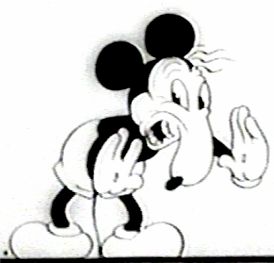
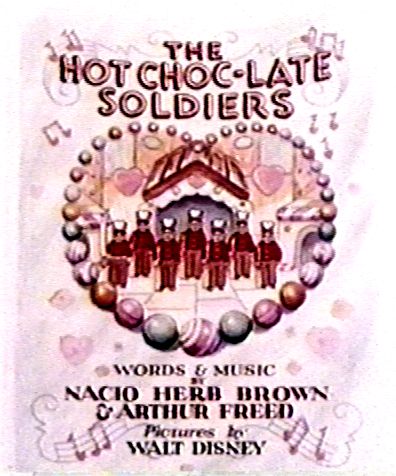
Mickey quickly takes center stage when party guests start screaming “A mouse! A mouse!” Durante quickly comes to the rescue and suddenly finds himself at odds with the famous character, who is actually in “mouse scale” with the surrounding humans. Mickey is distinctly in his feisty, early 1930s personality, taking a swing at Durante and then mocking the star’s trademark oversized nose. He wins over the surrounding party guests who demand more entertainment from the little guy. Mickey then introduces a sequence very much akin to a Silly Symphony. The movie shifts from black and white to brilliant Technicolor to present The Hot Choc-Late Soldiers.

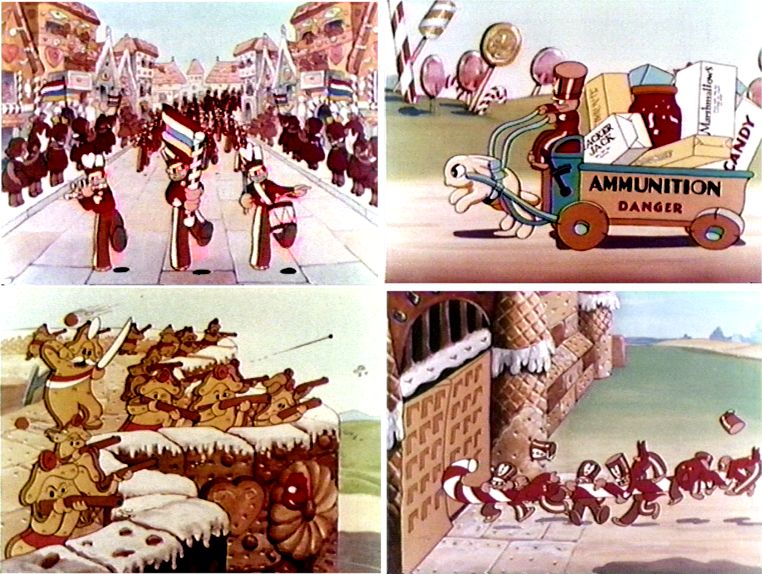
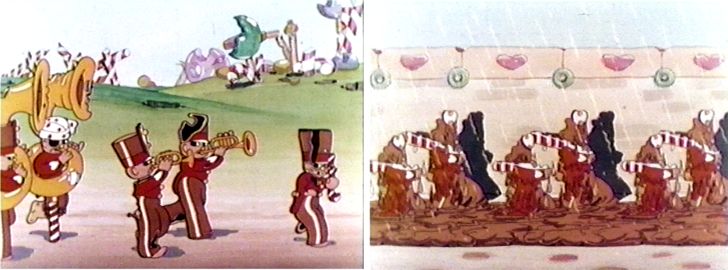
The Hot Choc-Late Soldiers is a bit bizarre in its story of candy-themed characters marching off and ultimately fighting a war. The action involves a Trojan War-themed combat with the Gingerbread Men of Pastryland. It is especially wacky when the injured soldiers return home, with battlefield injuries dressed in candy stylings (a missing leg is replaced with a candy cane stump for instance).


It is not far removed from the studio’s own Silly Symphony Cookie Carnival produced in 1935. But while Cookie Carnival had the typical Disney happy ending, Soldiers ends on a note of humorous morbidity when the sun comes out and melts the celebrating victors.


Walt would quickly cease in producing material for other studios, and focus instead on his own plans for feature length films. And likely because the endeavors were owned by Fox and MGM, who had little interest in preserving Disney content, they have all but faded into obscurity. Hollywood Party had a brief VHS release in 1992.

The sequence from Servant's Entrance miraculously surfaced last year courtesy of Didier Ghez, who writes the always informative and wonderful Disney History blog. Didier secured a copy and has generously made it available via YouTube and his site. The animation features kitchen utensils, led by a Humpty Dumpty-style egg character in a musical vignette that quite deftly for its time mixed live action and animation.

According to the IMDB, only an incomplete print of My Lips Betray survives in the UCLA Film and Television Archives.

Tuesday, April 28, 2009

Freeze Frame! - Blasting Off with Donna Reed


As we have discussed here at 2719 Hyperion a number of times, Walt Disney's various forays into futurism during the late 1950s tend to be little remembered here in the 21st century. But they did in fact have a dramatic impact on the popular culture of the post-war baby boomer era.

Case in point: the Werner Von Braun-inspired lunar rocket, featured in the Disneyland series episode "Man in Space," made a cameo appearance in a 1958 episode of television show The Donna Reed Show. The popular program chronicled the life of the Stone family, parents Donna and Alex and children Mary and Jeff, portrayed respectively by Reed, Carl Betz, Shelley Fabares and Paul Peterson. In the episode entitled "The Football Uniform," Jeff decides to donate his recently acquired rocket to the annual charity auction. He tells his parents, " . . . it wasn't as much fun as I figured it would be. Besides, all the kids are playing football." His father's response: "Well, there went two bucks into outer space!"

An interesting footnote: Peterson was a Mouseketeer, albeit briefly in 1955. Various misbehaviors, including punching a casting director in the stomach, led to his early dismissal.

Explore the 2719 Hyperion Archives:

Man in Space: March 9, 1955

Monday, April 27, 2009

The Third Wonder of the World


Has it really been twenty years?

This teaser ad appeared in a number of high circulation weekly magazines released in early April of 1989.

Friday, April 24, 2009

The Violent Mayhem of Hockey Homicide

In our current era of too-frequent overbearing political correctness, the 1945 Goofy cartoon Hockey Homicide stands as a shining example of a creative process not held hostage by studio executives overly concerned with pleasing soccer-mom demographics. The genius of this short is rooted in its parody of the sport’s reputation for excessive violence and the subsequent frenzy that that violence inspires in the game’s spectators. Rather than ignore or disavow this darker side of competition, it embraces it and celebrates it with an irreverent and sardonic glee. In the fifty-plus years since its release, Hockey Homicide has lost neither its humor nor its relevance. It is a hyper-paced, hilarious eight minutes of unbridled mayhem that also casts a satirical eye to sports fandom’s often unquenchable thirst for blood and brawling.

The cartoon is very much in the spirit of the classic quip of “attending a boxing match only to have a hockey game break out.” Beating and pummeling are the strategies of play with occasional hockey maneuvers peppered throughout. The short’s most memorable and now classic gag is the ongoing rivalry between star players Ice Box Bertino and Fearless Ferguson. When the two begin brawling even prior to the opening faceoff, it sets off a cycle of fighting and penalty suffering that extends almost the length of the cartoon. It is highlighted by the announcer’s oft repeated “Here come Bertino and Ferguson out of the penalty box . . . and there go Bertino and Ferguson back into the penalty box.”

The frenzy of the game builds and builds until it spills into the stands and ignites the spectators. The crowd storms the ice and chaos ensues, leading to an eye-popping montage of violence that incorporates scenes not only from other Goofy sports cartoons but from the studio’s features Victory Through Air Power and Pinocchio as well.

A couple of particularly funny gags: the two rival fans featured throughout the short are seated appropriately in Section 8; and when the ice is cleaned between periods, among the debris shoveled up are cowboy boots and spurs, cups and saucers, a bottle of Heinz 57, boxing gloves, an umbrella, a hair brush, a croquet mallet and even an extended hand clutching a cigar.

Especially notable in Hockey Homicide are the references by name to Disney employees. The aforementioned Bertino and Ferguson refer to animators Al Bertino and Norm Ferguson, while referee “Clean Game” Kinney pays homage to the short’s director Jack Kinney (and possibly also to storyman Dick Kinney). When a scorecard is examined early in the short, the teams’ rosters are a veritable who’s who of the Disney Studio in 1945. It’s a great screenshot, worthy of Freeze Frame status, and it is very likely the most extensive “in-joke” ever incorporated into a piece of Disney animation.

Hockey Homicide stands as one of the best Goofy cartoons produced and also easily qualifies as one of the studio’s funniest. Goofy in name, but certainly more sophisticated in content and humor, the short takes a not-so-subtle shot-on-goal at a professional sport and the antics of its passionate fans.

Sunday, April 19, 2009

The Mickey Mouse Theater of the Air

Special to 2719 Hyperion by Jim Korkis

Old time radio shows are a delight, but just like shows on television today, some were great and not to be missed, some were mediocre, and others just did not capture the potential of their concept. Unfortunately, the Disney Studios attempt at a radio show fell into the last category.

In the 1930s, radio was king and people would often change their entire lives around so that they could hear the latest episode of their favorite show. Many popular comic strip and animated characters had already made the transition to the airwaves and there were shows like “Betty Boop Fables” and “Popeye the Sailor” that entertained young audiences. Advertisers desperately wanted to sponsor a show with the Walt Disney characters and both Lever Brothers (makers of Lifebuoy among other products) and Lucky Strike cigarettes had almost convinced Walt Disney to take a chance. However, it was Pepsodent toothpaste and their commitment to a weekly budget of $10,000 to $12,000 that finally brought the Disney characters to the air in more than just occasional guest appearances on other programs.

“The Mickey Mouse Theater of the Air” premiered on radio on January 2, 1938 in the NBC Sunday afternoon slot previously reserved for the antics of “Amos and Andy”. That show changed sponsors from Peposdent to Campbell Soup as well as time slots, and Pepsodent desperately wanted something as popular as those famous comedians to take up the slack.

During the half hour show, Mickey and the gang would travel through time and space thanks to the Magic Mirror from Snow White and the Seven Dwarfs to have adventures with everyone from Robin Hood to Cinderella to Old MacDonald. The half hour was also filled by music not just from the Felix Mills Orchestra but from Donald Duck’s Webfoot Sextet, that like the later Spike Jones Band, played a variety of odd instruments from cowbells to bottles to an auto horn for comic effect.

Here is the list of all twenty episodes of “The Mickey Mouse Theater of the Air”:

January 2, 1938: Robin Hood
January 9, 1938: Snow White Day
January 16, 1938: Donald Duck’s Band
January 23, 1938: The River Boat
January 30, 1938: Ali Baba
February 6, 1938: South of the Border
February 13, 1938: Mother Goose and Old King Cole
February 20, 1938: The Gypsy Band
February 27, 1938: Cinderella
March 6, 1938: King Neptune
March 13, 1938: The Pied Piper
March 20, 1938: Sleeping Beauty
March 27, 1938: Ancient China (with a guest appearance by Snow White!)
April 3, 1938: Mother Goose and the Old Woman in a Shoe
April 10, 1938: Long John Silver
April 17, 1938: King Arthur
April 24, 1938: Who Killed Cock Robin?
May 1, 1938: Cowboy Show
May 8, 1938: William Tell
May 15, 1938: Old MacDonald

You can listen to seven of these shows at this link.

Walt himself was busy with the promotion of the just released Snow White and the Seven Dwarfs and in fact, supposedly only agreed to letting his characters on the air so that it could help promote that animated feature. The reason Walt hadn’t explored radio earlier was that he felt that his characters would not translate well to the medium, that audiences needed to see as well as hear the animated stars.. Unfortunately, Walt was only able to supply the voice of Mickey Mouse for the first three episodes. From the fourth show on, the voice of Mickey was comedian Joe Twerp (yes, that was his real name) whose comedy relied on being an excitable, stuttering person who confused words. He had been considered for the role of Doc, a similar personality, from Snow White, but Roy Atwell was chosen to supply that voice instead.

In fact, Walt got so busy that he couldn’t attend some of the recordings and that when the script called for Walt himself to make an appearance, he was sometimes impersonated by the announcer for the show, John Hiestand!

Minnie Mouse was performed by Thelma Boardman who would later supply Minnie’s voice in the some of the Disney cartoons of the 1940s. Pinto Colvig had left the Disney Studio by the time the show started so the role of Goofy was performed by Stuart Buchanan, who was the official “casting director” at the Disney Studios and had supplied the voice of the huntsman in Snow White. Donald Duck, of course, was voiced by the one and only Clarence Nash and Clara Cluck was Florence Gill. Both of them had performed the same roles in the Disney cartoons.

There were other voices on the show as well supplied by popular performers including Billy Bletcher (the voice of Pete in the cartoons who popped up as Old King Cole in the show), Hans Conreid (still many years from voicing Captain Hook who did a comical turn as the Pied Piper), Bea Benaderet (portraying Miriam the Mermaid in the kingdom of King Neptune), Cliff Arquette (“Charley Weaver” who voiced Old MacDonald), Walter Tetley, and many others including Mel Blanc. In fact, Blanc was a regular on the show but never voiced any of the Disney characters. He did do a character in several shows that got so excited that he couldn’t stop hiccuping whenever he talked. Perhaps this performance inspired Walt to use Blanc as Gideon the cat in the upcoming production of Pinocchio. The famous story that Blanc told over the years was that he recorded a voice for the cat but Walt cut everything but a hiccup from the final performance.

The show was not memorable and suffered from the fact that Walt could not give it his full attention so it quietly disappeared after only twenty episodes but it is still an interesting footnote in Disney history. Thankfully, the estate of the musical director of the “Mickey Mouse Theater of the Air,” Felix Mills, donated all his original transcription discs of the show to the Pacific Pioneer Broadcasters in California.

Wednesday, April 15, 2009

Revisiting the Disneyland Art Corner - Part Two

Editor's Note: Continuing our two-part series exploring animation art originally sold at the Disneyland Art Studio with guest contributor Rob Richards.

Special to 2719 Hyperion by Rob Richards

Continuing, here's an additional variety of Art Corner cels, as released with their original Art Corner backgrounds, then restored with digitally recreated key master backgrounds.

This original Mary Poppins cel was rather unremarkable by itself. But paired with a carefully digitized background adding the other musicians, it becomes a dazzler! As is often the case, the original paint adhered to the colored art board background. This particular cel (with ever-so careful prodding) was lifted without damage and all original paint intact!


This was a strange setup--the immediately recognizable penguins from Mary Poppins, a cel of Merlin’s carpetbag from The Sword in the Stone, and a background from 101 Dalmatians! The penguins, paired with a key frame digital background including Mary and Bert makes for a stunning Mary Poppins setup.


Coyotes Bent-Tail and Bent-Tail Jr. starred in theatrical shorts as well as TV specials. This Art Corner setup made its way to Australia and back to Southern CA. It shows two typical paint problems, cracking and bleeding (where the paint actually expands outside the ink lines, perhaps from cel shrinkage due to age). After a much-needed restoration, and a key digitized background from one of their few cartoons, it’s a fine setup of these genuinely rare characters.


The Chip and Dale setup features Captain Chip from Chips Ahoy (1956). The Dale cel has yet to be identified. Restored and placed on a Chips Ahoy digital master background it becomes a terrific piece.


The Donald and Pete setup is another unlikely pairing. Pete playing the trombone (from the "Donald's Award" TV show interstitials, which introduced the theatrical short Trombone Trouble) and Donald Duck from Donald in Mathmagicland. Restored, separated and with key backgrounds, each becomes a terrific piece. (Pete's new hand-painted background was created from looking at the original black and white footage, and re-imagining it in color!)


Imagine a Mickey Mouse cel for a dollar!!! This Art Corner Mickey played the piano for the Christmas TV special “From All of Us to All of You.” The new, custom hand-painted background beautifully showcases the original 1959 cel. A vast improvement over the original plain yellow art board!


Similarly, Mad Madam Mim transitions from a plain color background to a key digitized background from The Sword in the Stone.


The Jungle Book remains an all-time Disney classic. Two cels here, Shere Khan and “Flunky Monkey” needed and received restoration. With their added digital laser print key master backgrounds, they find themselves back in the jungle once again.


Prince Phillip and Princess Aurora are miniatures in this Sleeping Beauty cel. With figures just over an inch tall, the delicate hand inking is quite amazing to see. The full cel was heavily trimmed, but the tiny cel is still very spectacular when placed on the recreated key master background.

This is a tiny sample of the animation treasures that sold at the Disneyland Art Corner. Now, don’t you wish you had a time machine?


Visit Rob Richards at his website and also at his terrific blog Animation Backgrounds!


Animation art from the collection of Rob Richards.

Tuesday, April 14, 2009

Revisiting the Disneyland Art Corner - Part One

Editor's Note: Our previous article on the Disneyland Art Corner has proven to be one of our most popular endeavors here at 2719 Hyperion. Noted musician and Disneyana collector Rob Richards was instrumental in providing resources and information for that post. We are now very happy to welcome Rob as a contributor to 2719 Hyperion as he shares with us in a two-part series, more insight into the Disneyland Art Corner, along with some wonderful animation art from his own personal collection.


Special to 2719 Hyperion by Rob Richards

The artwork released at Disneyland’s Art Corner comprises a significant percentage of all available, collectible original Disney production cels. The studio considered these cels essentially worthless, just a necessary step in producing animated films. They were sold as souvenirs at Disneyland instead being thrown into the garbage. . . and sold cheaply at that. Some Art Corner cels were priced at seventy-five cents! Usually the price was a dollar for a single character. Multiple character setups went for as much as five dollars.

The artwork was thrown together quickly, haphazardly trimmed and stapled. Sometimes they were layered with another cel from the same production, but often not. On rare occasion the setups included an original painted production background. What a prize that would be! Most often the cels received a color print background (a reprint of Disney background art) or simply a colored piece of art board. The setups were usually uninspired. The preparation of these setups was undoubtedly a do-it-as-quickly-as-possible assembly line.

Whatever the circumstances, an incredible volume of significant art found its way to the Art Corner. Now, some fifty years later, that same art is still moving through galleries and private collections. Now the prices range from hundreds to thousands of dollars!

The examples here include all the Art Corner artifacts . . . in some you can actually see the staple used to assemble the setups!

Here, a variety of combinations typical of the Art Corner artwork.

Occasionally, the Art Corner created a really wonderful setup almost by accident. The Maificent shown is such a setup. It is trimmed, and paired with a non-key Sleeping Beauty print background. Marc Davis’ powerful character is beautifully represented by this single dramatic cel.


Another setup that works is Donald’s nephews in the backyard. The print background and trombone player are from unknown production(s). The party hat nephew is from “At Home With Donald Duck,” a TV production that paired new interstitial material with vintage theatrical shorts. The overall setup is pleasant and very satisfactory. (The ducks' white paint had cracked, and this was one instance where the paint was re-wetted by the restorer, enabling restoration with all original paint! This is not always possible.)


Unusual, eccentric pairings are never a surprise. One very bizarre combination is Tinkerbell (post-Peter Pan) paired with a Huey/Dewey/Louie, on a Sleeping Beauty background! Very strange. But, with cel layers separated and Tink put on the appropriate background of the Disneyland Castle, the art takes on a whole new feeling.


There are a great many setups that paired Donald Duck from the industrial/educational film Steel and America (1965) with penguins from Mary Poppins (1964). These turn up with some regularity on eBay. Here are several examples, followed by the separated cel setups with digitally recreated key master backgrounds.

_______________________________________________

__________________________________________________

______________________________________________________


Each collector is different. To many, the complete setup with a key background is essential to the presentation. In order to make this happen, the cel layers of the Art corner cels are separated. The character's key production background is digitally recreated and sized, laserprinted, then combined with the cels to recreate one magical moment (and one frame of film) from a classic Disney film.

Restoration is also part of the equation. The cels were never meant to last. In the early days, they were washed off and re-used!

When cels age, paint undergoes a variety of indignities: flaking, cracking, peeling, bleeding and glassing. Additionally, water damage is also sometimes seen. These problems can be repaired to perfection by professional cel restorers. There are many good ones. Never trust a company’s public relations alone. Always ask for references before you entrust your art to anyone.

Many Art Corner cels have survived intact. Others have fared badly. One theory is that certain binding agents which may or may not have been used in a certain batch of paint could cause problems. It’s as good a theory as any.

Take for example this Goofy from "The Adventure Story," a TV production which aired in 1957. The missing character is Goofy's son. They're together up in the attic reading a history of the Goof family. This cel was in the worst condition possible, a victim of aggressive water damage. After restoration, it reveals a great pose of Goofy. One day, a digital background with Goofy's son will complete the setup.


Return to 2719 Hyperion tomorrow as we continue Revisiting the Disneyland Art Corner with Rob Richards.


Animation art from the collection of Rob Richards.