Showing posts with label Vintage Headlines. Show all posts

Monday, June 06, 2011

Vintage Headlines: Keep Running. We're Brothers


The remarkable thing about his performance is not only that it is funny to hick and sophisticate alike. It is amazing that he can make each show seem as if he were auditioning.

Bob Thomas, June 21, 1963

INCIDENTALLY, a funny fellow by the name of Wally Boag ought to take his place one day soon up there with such comic greats as Bob Hope, George Gobel and Jack Benny. Young Wally, a sly ad-libber, absolutely kills the people with his balloon tricks and dancing during the performances daily In Disneyland's Pepsi-Cola Golden Horseshoe Theater.

Syndicated columnist Tedd Thomey, December 10, 1955

WALLY BOAG, the comedian who costars with Betty Taylor and Donald Novis in the Golden Horseshoe frontier show, has been featuring a unique balloon act since the early '40s. Wally always ends his show by giving a youngster in the audience the dog or elephant careicature he has created from the balloons. "After the war," Wally says, "I played for 54 weeks in a musical revue in London. "During my act, I'd call a 12-year-old girl out of the audience—always the same girl—and give her the balloons. I'd ask her if she entertained and  she would say 'Yes, I sing and off she would go into her numbers. "It was 10 years before I saw that girl  again, but I still was doing the balloon act, so I handed her a balloon. It was back stage in New York and Julie Andrews was starring in "My Fair Lady.' "

Syndicated Columnist Vera Williams, September 18, 1958

Wally Boag, who has worked four years in the park's Golden Horseshoe Frontier saloon, made this comment: "He's one of the greatest laughers I've ever played to." The king literally doubled up with laughter at Boag's gag about the two rabbits being chased by a pack of wolves.  One rabbit says: "Shall we keep running or stop and outnumber them? The other rabbit replied: "Keep running. We're brothers."

AP report of Belgium King Baudouin's visit to Disneyland in 1959

Thursday, May 26, 2011

Vintage Headlines: Disneyland Summer Reading


Here's a fun slice of 1950s pop culture with a Disney spin.

Kids have been nagged about summer reading for decades; in 1956, the librarians of Kern County, California came  up with a clever twist to encourage their young patrons to crack open the books--a Disneyland-themed summer reading program.  The details were provided in this newspaper article from June 14th of that year:
Disneyland has been chosen as the theme for Kern County Free Library summer reading clubs according to Miss Irene Branham, supervisor of work with children.  All elementary school children in the county are eligible to participate in the summer reading program. Registration for the clubs will take place in county branches during June. Children interested in joining a club are urged to sign up now.

By way of books, children joining the Disneyland clubs will visit Disneyland's Adventureland, Tomorrowland, Fantasyland and Frontierland. Each child will have a Disneyland map and booklet in which to record his make-believe visits to each land. Reading certificates will be presented to children reaching the goal of 10 books read during the summer.  Disneyland maps and posters donated to the library by Disneyland Inc. will decorate the 35 county branches sponsoring summer reading clubs. Miss Branham emphasizes that this is a pleasure reading program with the double objective of  encouraging leisure time reading and providing the librarian with an opportunity to give reading guidance to young patrons.  The library's vacation loan, allowing children to borrow eight books for a period of six weeks, will enable children to continue reading for the club during the family vacation.  Children and their parents may get further information about the summer reading program by visiting any branch of the Kern County Free Library.

Wednesday, May 18, 2011

Vintage Headlines: More and Better Shows


Spring of 1955 was a busy time for Walt Disney.  The Disneyland television show was nearing the completion of its first season, the opening of Disneyland the park was just a few months away and The Mickey Mouse Club would premiere on ABC the following September.  Newspaper columnist Bob Thomas provided a look at the state of Disney productions in this article from March 15, 1955:
The 51 acres of  the Walt Disney Studios probably contain more ideas than any similar place in the world.  The place bristles with new plans and ambitious projects. Leading the thinkers is a 53-year old dreamer named Walter Elias Disney. One of the major reasons for his fabulous success: he has never outgrown the boyish notion that even the wildest dreams can come true. Vast millions of TV viewers know Walt as the proprietor of Disneyland, an hour show that has brought new dimensions of entertainment and enlightenment to home screens. The public's response has been immense. The ABC network show sprang into the list of the 10 most seen programs.  Some 15,000 letters reach the Disney Studios weekly. The producer has even bigger plans for next  season. The first year's product of 20 shows ended last week. Fifteen programs will be repeated. Ten of these will be played again during the summer.

On Sept. 7, Disneyland will start a new season of 26 shows. Because of the amazing success of the Davey Crockett trilogy, Walt will have two frontierland subjects. One is "Johnny Tremaine," the story of a boy who lived during the American revolution and witnessed Paul Revere's Ride, the Boston Tea Party and the Battle of Lexington. The other is called "Children of the Covered Wagon." Based on fact, it will show a pioneer caravan over the Oregon Trail. "I want to get Fess Parker (who played Crockett) out of buckskin," Walt said. "He'll play  a doctor who goes along with the wagon train. Buddy Ebsen (Crockett's sidekick) will be in it too." Among the other Disneyland subjects: rocket around the world; the Goofy success story; "Robin Hood" (two parts); "Legend of Sleepy Hollow." plus the life of Washington Irving; history of the animated cartoon; American folk lore; a day in the life of Donald Duck.

Disney's latest enthusiasm is an hour-long, five-a-week children's show for ABC, the Mickey Mouse Club.  Starting this fall, it may well revolutionize the kiddie market. It Howdy Doody looks worried these days, you'll know why. "The show will be emceed by Mickey himself," Disney said. "Our people-and-places photographers all over the world will send film showing what children in other lands are doing. As soon as we get accredited, I expect to sec the Mickey Mouse newsreel right with the others filming the President at the White House."  Disney plans to show kids how to draw, how to keep clean, how to drive safely. "It seems to  me that most shows play down to the children," he observed. "I plan to play to the 12-year-olds; the younger ones will want to reach up to that age. I don't think teenagers will have their intelligence insulted, and I believe we'll have a lot of adults watching."

The pre-TV functions of the Disney lot are going in high gear too. In the mill are cartoon features like "Lady and the Tramp," "Sleeping Beauty" and a widescreen release of "Fantasia." His nature photographers are filming elsewhere; the next feature will be "The African Lion." Disney is also planning such live-action films as "King Arthur," "The Great Locomotive Chase" and "Colorado Expedition." Then there is Disneyland, the11-million-dollar, 160-acre wonderland near Santa Ana, Calif.  Opening, this July, it will be the closest thing to a world's fair that America has seen in the postwar era.
Some annotations to the article:

Johnny Tremaine emerged as a feature film (sans the "e") instead of television episodes, as did Children of the Covered Wagon, the title of which changed to Westward Ho! The Wagons.  King Arthur of course became the animated The Sword in the Stone.  Colorado Expedition was eventually released to theaters as Ten Who Dared.

Friday, May 06, 2011

Vintage Headlines: But the Commercials!


"But the commercials!  They're enough to drive you nuts."

So said well known newspaper columnist and future Walt Disney biographer Bob Thomas in an article published on December 3, 1955.  Thomas was discussing the tremendous success of the The Mickey Mouse Club television show that had debuted just a few months earlier, but was at the same time lamenting the glut of commercials that accompanied the program.  Here in the 21st century, the average television viewer can expect anywhere from 20-30 commercials during a typical hour's worth of network television.

How much was too much back in 1955?  Let's see:

"Not only are there three in every 15 minutes.  The station sneaks in three more every fifteen minutes at the station break."

Outrageous!

Among the media, Thomas was one of Disney's more passionate cheerleaders and it was unusual for him to be so critical.  Indeed, he quickly qualified the rant by adding, "The Disney people are just as upset as the public.  Walt apparently didn't foresee the excesses of the network; he vows that next year he'll have some control over such matters."

Before launching into his anti-commercials diatribe, Thomas did speak to the phenomenon that The Mickey Mouse Club had become in just a very short time:
"Mickey never had it so good.  His outsize ears are popping up on the heads of kids all over the land:  they're buying the mouse hats (29 to 98 cents) at the rate of 24,000 a day.  (Whatever happened to coonskins?)  Two hundred other pieces of merchandise connected with the club are being sold, and more are added daily."

"The mouse has captured the daytime rating honors, snowing under his major opponents, veterans Howdy Doody and Pinky Lee.  A recent survey gave the club a 76 per cent advantage over the opposition in the East."

Wednesday, April 20, 2011

Vintage Headlines: Mickey's 1951 Comeback


Did you know that Mickey Mouse made a big comeback in 1951?  This Associated Press newspaper article from March 4, 1951 provides the details.
Mickey Mouse, all-time international movie favorite, is hitting the comeback trail. He's getting his tail back, too. After ten lean years, the fabulous rodent, who in some 125 films has played scholar, great lover, cowboy, explorer or medieval knight with equal aplomb, is set for a new series of starring roles.
"We never really dropped Mickey," says Walt Disney, who created the tiny dynamo 22 years ago and made a fortune off him. "We just kind of drifted away from him."
The toast of the world 15 years ago, Mickey began taking a back seat to other members of the Disney cartoon family in 1938. That was the year Walt made his first feature-length fantasy, Snow White. That year also marked the emergence of Donald Duck as a rival.  Disney's crew, which once turned out 15 Mickey Mouse starrers a year, cut back to three or four. Donald, Pluto and Goofy who broke in with Mickey, became famous in their own films.  Dumbo, Bambl and the Three Caballeros stepped into the limelight in elaborate feature pictures.
Disney says Mickey was de-emphasized, not because his popularity waned but because he's tricky to handle.  "Only my top men are good enough to work with Mickey." Disney says, (he's always done Mickey's voice himself). "Because he's a nice, sympathetic character, not a natural comedian like Donald. It takes a lot of ingenuity to write Mickey." During the war the little fellow became a complete casualty; Disney was  devoting 85 per cent of his production to special armed forces projects. Mickey has made only four or five films since.
With his comeback in four cartoons this year, many of the younger generation will be meeting Mickey for the first time, and they'll be seeing him with a tail. Maybe you've forgotten that Mickey has been tailless for more than a decade. When Walt first drew him he was a skinny little tyke. His only clothes were a pair of shorts and shoes and he had a tail. But for one reason or another, Walt can't remember exactly why, they lopped his tail off. Why tack it on again? "We came to realize." Walt says, "that he's not as cute without it. It's an expressive thing. I remember he used to twirl it when he was nervous or angry. It carries him through action smoothly, gives him balance and grace."
There have been other changes through the years. As he aged, Mickey graduated to long pants. They gave him a shirt. Once spidery, his limbs thickened and his body assumed a pear shape. His eyes, formerly dots, were given lids. In the new series he'll have eyebrows.
Mickey wasn't Disney's first love. The first was a cat. The second was a rabbit named Oswald. But Walt wasn't quite satisfied. He wanted to make improvements and when the company he worked for said no, he launched his own business. The first two mouse cartoons didn't make much of a splash.  The industry was being turned topsy-turvy by a new element--sound. Walt took his third Mickey to New York and had it synchronized for sound. They premiered Steamboat Willie at the old Colony Theater in New York in 1928 and the mouse was famous.
There never was a more versatile fellow than Mickey. He's been a tailor, a steam shovel operator, fire chief, cop, musician, magician, inventor, football hero, polo player, farmer, whaler, tourist, hula dancer, scientist and gas station attendant. He's been around the world—to Argentina. Alaska, Africa, the Alps. Arabia. Brazil, even to Gulliver's mythical Lilliput. Once he got going there was no stopping him.  His piping voice was translated into ten foreign languages. He had fan clubs in 50 countries. His likeness was given a choice spot in Mme. Tussuad's waxworks in London.  He got into the Encyclopedia Britannica and got Disney into Who's Who. He won Disney an Academy Award and countless other accolades. And his face appeared on armed forces insignia and on hundreds of commercial products.
The entire article is sadly ironic.  Only two Mickey Mouse cartoons were released in 1951--R'coon Dawg and Plutopia.  And Plutopia was essentially a Pluto cartoon that for some reason was instead branded to Mickey. The image presented with the article features a scene from Pluto's Party, which was released in 1952, along with Pluto's Christmas Tree.  Some comeback--Mickey is essentially playing second string to his own dog in all these cartoons.  The Simple Things, released in 1953, would prove to be the last traditional Mickey Mouse cartoon of animation's golden age.  Mickey's illustrious comeback of 1951 lasted a mere five cartoons.

But Mickey's comeback would be sustained in other ways.  Theme parks and television were just around the corner . . .

Thursday, March 24, 2011

Vintage Headlines: Fred Waring in Wonderland


This month marks the 60th anniversary of an early television era Disney milestone.  On March 18, 1951, a significant portion of the popular Fred Waring Show was devoted to showcasing the music from Alice in Wonderland and featured cast members Kathryn Beaumont and Sterling Holloway.  Walt was featured in a brief prerecorded segment about the movie itself while Mary Blair designed the special stage sets used on the program.  The actual release of Alice in Wonderland was still months away.  Walt had already promoted Alice the previous Christmas Day with the special One Hour in Wonderland, his first foray in television production.


Peg Simpson, a television reporter at the time, noted:
Fred and his Pennsylvanians will introduce the music of Walt Disney's new, all-cartoon motion picture, "Alice in Wonderland." Although the story will not be told, the music will be presented with settings costumes that interpret the true "wonderland" flavor. Twelve-year-old Kathy Beaumont who acted the part of Alice for the animation of the film, will join the Pennsylvanians in the interpretations. Sterling Holloway, Disney's Cheshire Cat, will also be there. But, with the exception of little Kathy and Holloway, all parts will be taken by the Waring staffers.  Six of the songs from the film will be launched with the aid of all the Pennsylvanians.  Mary Blair, Disney set designer, has adapted the sets to television and the whole show's sure to be a gay, charming event. "I can think of no one in this cockeyed world better equipped to introduce the music from "Alice in Wonderland" than Fred Waring and Pennsylvanians," says Walt Disney. We agree fully.
Columnist John Crosby observed:
Among the more serious firsts to be committed recently was that of Walt Disney in plugging his forthcoming movie, "Alice in Wonderland," on Fred Waring's Sunday night television show.  Actually, this is the second  time Mr. Disney has used television to promote his new picture. He did it once before on a special Christmas show during which a good many of the better scenes from his early movies and one scene from "Alice in Wonderland" were shown Disney is the first major producer to use television this way.  In general, the movie people have shied away from TV as a competitor even though it's possibilities as a promotional medium are pretty obvious. Personally, I think Disney has done a shrewd job of exploitation. The two fragments of "Alice in Wonderland" I have seen have whetted my appetite for more, for the whole picture, in fact.

Fred Waring was no stranger to Disney.  He and his Pennsylvanians had performed the Trees segment in the 1948 package film Melody Time.

  
Excerpts from this particular episode of The Fred Waring Show are included on both the Masterpiece and 60th Anniversary Alice in Wonderland DVD sets.
Thursday, February 24, 2011

Vintage Headlines: Disney on Parade

Relating to yesterday's Window to the Past that features a publicity photograph from the 1973 edition of Disney on Parade, we present this Vintage Headline.  During the early summer of that year, the touring company for that elaborate stage production was appearing in venues located in western states.  Critic Robert McDougal, provided this very enthusiastic and rather detailed review of the show that was performed in Provo, Utah on May 30, 1973:
From the moment Mary Poppins came swooping out of the wings flying high above the crowd to he last moment when crowds of eager children rushed out to surround Mickey Mouse, the opening night of "Disney On Parade" Wednesday held a packed house spellbound.

The show is celebrating the 50th anniversary of the founding of the Walt Disney empire which consists of cartoon and feature film production in addition to books, records and entertainment centers.

An apt description of the presentation is flawless, but a description of the spectacle is spectacular. Costume design, lighting, choreography and execution of the spectacle were all without fault.

The show depends on a mixed media approach for its effect and on lavish costume and spectacular sound and props. A large screen is used to project animated settings and backgrounds, then at the appropriate time, the character comes alive on stage and continues the plot.

Early in the show, the story of Pinocchio on Pleasure Island uses the device to good effect. The famous puppet with his conscience (Jiminy Cricket) plunges through a series of adventures until he rescues his father from a whale in a dynamic film presentation of the whale's antics and ferocious attempts to harm the heroes.

Clever costume changes, and a series of remote controlled hoists which flew characters in and out of the production were worthy of note.

An interesting trip to the bottom of the lagoon near the island of Naboombu involved the entire cast dressed as sea creatures for a 1920-ish mini musical revue complete with villains, beautiful girls and a hero. The staging was good and the costuming extremely imaginative and engaging. The story was perhaps a little too deep for the younger members of the audience whose attention seemed to wander, but only an occasional adult moved as a child prevailed on a parent to make a trip out for drinks and other necessaries.

The children were on the edge of their seats literally throughout the rest of the performance.

A hit with the children was a skit where two cars compete for the attention of Goofey. The scene ends in a high wire chase as Bug Herbie tries to force his attentions on the lovable hound in confrontation about 30 feet above the stage.

Most of the sound and music for the production came from a finely tuned Disney sound system, but is interestingly spiced with live music and sound effects which lend realism to the overall effect of the film, the actors and the music.

Act two was a Mary Poppins spectacular with a fleet of dancing chimney sweeps, and London's former social fabric in engaging and dancing. Mary enters and leaves by the aerial hoist system and appears to fly with the aid of her umbrella.

If your child has not seen one of the annual Disney productions, he should. If he has seen one before, the chances are that he has already persuaded you to go again this year.
McDougal was clearly not well versed in Disneyana.  He failed to identify the lagoon scene as being from Bednobs and Broomsticks, which had debuted in theaters just two years earlier.  The "Goofey" misspelling is not a typo on my part, it appeared that way in the article and apparently slipped past McDougal's editor as well.

An uncredited article in the Oxnard Press Courier provided additional details (likely in the form of a re-edited press release):
For the first time in any arena show "Disney On Parade " characters 'fly' suspended from a revolutionary $250,000 computerized monorail track high in the arena. Mary Poppins , fish from the "Bedknobs and Broomsticks" production, and bears from "Bear Band Jamboree" appear to actually fly through the air at speeds up to eight miles per hour.

Production numbers open with a brief film segment on a large screen in the storybook castle which completely fills one end of the world's largest portable stage, and then the cast brings the capsule versions of the stories to life. The famous wooden puppet returns in "The Further Adventures of Pinocchio" for a visit to the carnival setting of Pleasure Island where bad boys turn magically into donkeys right on stage.

For the "Bedknobs and Broomsticks" production the stage is transformed underwater to The Briny Ballroom for a 1920's mini musical revue with the entire cast appearing as sea creatures. In the "Used Car Lot" production, Goofy and Donald Duck can't pick between a vintage Model T and Herbie the Love Bug. Both comedy cars appear to come to life. Herbie makes theatrical history as the first car to drive across the high wire chasing a frightened Goofy.

But wait!  Believe it or not, there was apparently a second production of Disney on Parade, touring simultaneously (at least during June of 1973) with the one described above.  This review from the Tucson Daily Citizen on June 20, 1973 detailed an entirely different show:
The show opens with the traditional welcome by the familiars such as Mickey Mouse, Tigger and Goofy. Then there is an amusing birthday party for Winnie the Pooh, who makes herself sick eating honey"and has the most fascinating nightmare. Donald Duck, in long hair and Liberace-sequined dress-tails plays the piano like it has never been played before.
Goofy has a go-round with the Love Bugs — Hermie and Gloria and Junior, who violate all the traffic laws. The Love Bugs were the favorite of the young people with me. But I liked the Aristocats, a big production number of swinging Paris life seen through the eyes of cats and kittens. This year Snow White gave way to Sleeping Beauty. This is another full scale production piece which features a pas de deux danced by the Sleeping Beauty and her prince. The three good fairies are plump and protective and the wicked witch is quite frighteningly venomous. Another new and quite delightful number has Donald Duck going south of the border to fiesta with his two caballero pals, Panchito and Jose Carioca. The young people with me liked this one next best to the. Love Bug: I liked it next best to the Aristocats.
The program closed with a fresh rendering of "It's a Small World" and the kids all crowded close to" the 'stage to say hello to their favorites.
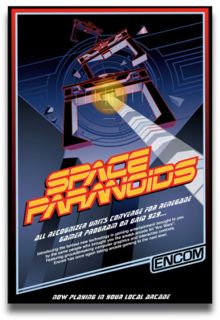
A very notable component of this production was its costuming.  Most prominent was the gown worn by the actress portraying Princess Aurora from Sleeping Beauty.  Valued at $7500, it contained more than 800 tiny lights and countless sequins.


It appears that the latter production was in fact the 1972 edition of Disney on Parade and the show's third incarnation.  The production featuring Mary Poppins was the fourth version of Disney on Parade and began touring in 1973.  The different productions would actually tour well beyond the calendar years they were initially identified with. 

Wednesday, January 12, 2011

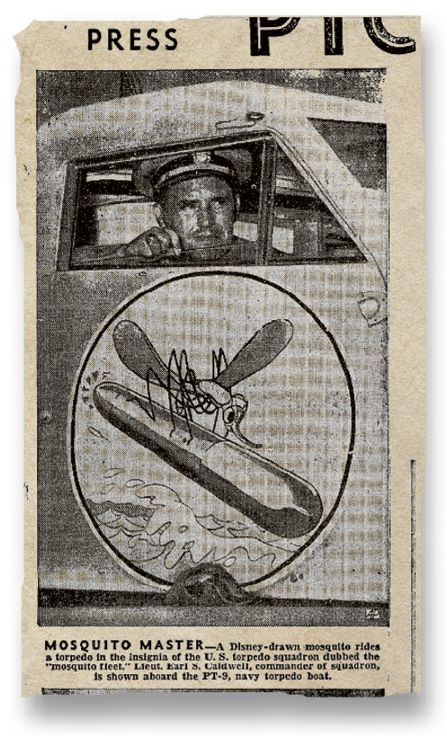
Vintage Headlines: Mosquito Master

Relating to today's Window to the Past post is this corresponding Vintage Headline from June 24, 1940.  This Associated Press photograph features Lieutenant Earl S. Caldwell, the Mosquito Fleet commander who was identified in the Library of Congress archived image.  Both photos appear to have been taken at the same press junket on June 19, 1940.

The full text of the photo's caption:
MOSQUITO MASTER--A Disney-drawn mosquito rides a torpedo in the Insignia of the U.S. torpedo squadron dubbed the "mosquito fleet." Lieut. Earl S. Caldwell, commander of squadron, is shown aboard the PT-9, navy torpedo boat.
Walt Disney himself was featured in a subsequent AP photograph published seven months later in February of 1941, that also showcased the Mosquito Fleet Insignia.
That particular photograph ran with headline, "Disney Plays Part in National Defense" and was published with the following caption:
Along with practically every other industry in the country Walt Disney is playing his part in national defense. Prompted by requests for insignias by all branches of Uncle Sam's service, Disney artists are now working on defense orders for Army, Navy and Air Corps insignia. Above Disney, left, shows Lieutenant Claude Pevey the design recently made for the Navy's torpedo boats (inset), known as the "mosquito fleet."

Thursday, December 30, 2010

Vintage Headlines: But Maybe I'm Dumb?

Here's an interesting slice of irrational newspaper punditry from the mid-1950s.  If you thought media-rooted extremism was unique to the 21st century, think again.  This newspaper column from late December of 1955 clearly reinforces the old adage that the more things change, the more they stay the same.

Richmond Barbour held the position of director of guidance for the San Diego city schools and wrote a newspaper column entitled Parent's Corner throughout the 1950s.  Though generally sound and rational in his observations and advice, his column on December 30, 1955 took a somewhat wacky turn.  He specifically targeted Walt Disney and the filmmakers of the then just recently released True-Life Adventure, The African Lion.  Here's what he had to say:
Heigh-ho folks. Let's welcome some new experts on children's discipline. They come from an unlikely place, the Disney Studio in Hollywood. What are their qualifications?

It seems they spent  three years watching lions in Africa. That's right. Three years watching lions. The connection between our children's discipline and African lions is obscure to me. But maybe I'm dumb?

Please don't think I am kidding. I've just taken time to read newspaper publicity for that recent Disney lion picture. A reporter quotes the lion-watchers as saying the law in lion families is obey or die. So lion mamas slap their cubs around. Maybe the lions have read modern psychology too. The reporter says that they never are harshly brutal in their punishment. Just knock the little ones across the landscape. Haymaker love taps.

What's the result? Hold on to your hats. There is no juvenile delinquency among the lions in that part of Africa! Isn't that marvelous? The lion-watchers seem to think so. They are quoted as saying that a headstrong lion would be a terrible nuisance to the rest of the lion family. No doubt. No doubt.

If this publicity was intentionally humorous, I'd enjoy it. But it isn't! It is serious. Wallop your kids. Knock 'em spinning. But don't be harshly brutal about it. Punishment is the rule of nature.

Did this publicity appear in your papers? I hope not. Your human instincts regarding the rearing of the human young are sounder than the instincts of lady lions prowling the African veldt.  I agree that Walt Disney has geniuses on his payroll. I'll admit that the lion-watchers are the best animal photographers in the business. But child guidance advice from Walt's lions is too much.

Please, Mr. Disney!
Barbour provides no specific quotations or citations from the publicity material he is referring to.  It was most likely press kit articles that featured veteran wildlife photographers Alfred and Elma Milotte.  Barbour was clearly playing hard and loose with subject and context and then jumps to the bizarre conclusion that Disney is advocating child abuse via his otherwise generally celebrated nature documentary.

Distilling child psychology and disciplinary philosophies from Hollywood press material?

Please Mr. Barbour! 

Thursday, December 23, 2010

Vintage Headlines: Santa Claus and Walt Disney on the Same Day


Walt Disney's second venture into television was the holiday special The Walt Disney Christmas Show which was broadcast at 3PM on Christmas Day 1951.  It followed by one year Disney's first television program, One Hour in Wonderland that had debuted on Christmas 1950.

Newspaper columnist Bob Foster provided this preview of the show on December 18, 1951:
Television is only a few years old, but already a number of traditions have been founded which make it a bit more enjoyable around Christmas time. One of the most delightful traditions to be set up is the annual appearance of Walt Disney before the television cameras. Because Christmas is basically children's holiday, this year, as last, Walt leaves his studio and produces for television on the "Walt Disney Christmas Show."  And what a show he has lined up for this year. Disney will devote more time to his cartoon characters. There will be the Uncle Remus Tar Baby sequence from "Song of the South." a scene from "Snow White and the Seven Dwarfs" and "Bambi," plus previews from Disney's next big feature, "Peter Pan," now in production, Mickey Mouse, Donald Duck, Pluto, Goofy and others will, of course, contribute their comedy cavorting. Live talent will include Bobby Driscoll, Kathryn Beaumont, Hans Conried, Bill Thompson, Don Barclay, all of whom have taken part in Disney films. The show, according to advance notices, will open in the convalescent ward of a children's hospital on Christmas morning, with Dr. Miller, played by Don Barclay, entering as Santa Claus. This should be a wonderful afternoon for the kiddies as well as adults, especially for Christmas. Ann and Lyn, our two little "Indians." are already talking about the Disney show and look to Christmas with great expectations. Why not? What more could you want, Santa Claus and Walt Disney on the same day.
Television reporter James Abbe provided this brief review of the show on December 26, 1951:
The Walt Disney Christmas Show on TV yesterday was still entrancing even when the color of the movie production had been lost.  Anything so well done originally as Disney's Bambi, Snow White and the Seven Dwarfs, Uncle Remus, can still get under the skin of young and old alike.  One solid hour of Disney classics went out over 57 stations of the CBS-TV network with Walt Disney himself acting as emcee before a gathering of enthusiastic children.
The program's sponsor, Johnson and Johnson provided $250,000 to produce the special, a figure unprecedented in the medium's then short history.  CBS, embarrassed by not running the 1950 show, quickly lined up the 57 stations that sealed the broadcast agreement with Johnson and Johnson.


The special is notable in that it included an appearance by Bobby Driscoll dressed as Peter Pan, the character he would voice in the 1953 animated feature.

The show itself is generally inaccessible, but curiously it was included on the UK version of the Peter Pan Platinum edition DVD, but not on the comparable US edition.

Thursday, December 09, 2010

Vintage Headlines: Ask Dora


Let's turn our time travel dial back seventy-one years for today's Vintage Headline.  On this date in 1939, the Walt Disney Studios, located at 2719 Hyperion Avenue, made the front page of the Los Angeles Times, thanks to the antics of a gentleman named J. Ridford Worth.  This is his very short and distinctly enigmatic story:

Eluding a deputy Sheriff who had questioned him concerning his possession of a gun, J. Ridford Worth, 39, of 818 N. Angelino Ave., Burbank, yesterday shot himself in the chest in the foyer of Walt Disney Studios, according to police.

At Georgia Street Receiving Hospital, where he refused to make a statement, Worth was reported as not in critical condition.

Deputy Sherriff G. H. Weinner said he questioned Worth at the north end of Silver Lake, where the latter was examining a revolver.  Worth jumped into an automobile and sped to the studios at 2719 Hyperion Ave., where his assertedly estranged wife Dora is employed as a secretary.

There, according to Detectives C. M. Pitts and W. L. Chase, who investigated, he shot himself.  Asked why he had done it, he assertedly declared, "Ask Dora."

Worth, according to police, is an unemployed salesman.  Mrs. Worth resides at 508 S. Wilton Place, officers said.

Thursday, December 02, 2010

Vintage Headlines: Ardent Youth Barred


Introducing our newest series here at 2719 Hyperion: Vintage Headlines.  Similar to our popular Windows to the Past series that showcases Disney-related archival photographs, Vintage Headlines will explore and uncover newspaper articles from the past that reveal heretofore largely forgotten Disney history.

It was fifty years ago this week that a young man named Gary Drapala had quite an adventure just outside the Disney Studios in Burbank, California.  This story has it all: a pink stuffed poodle, a self-inflicted injury and even an arm wrestling policeman.  Read on:

BURBANK. Calif. (AP) -With a pink poodle, a pocket-knife and his own red blood, Gary Drapala tried to storm the gates of the Walt Disney Studio to see actress Annette Funicello. Gary, 16, ended up arm-wrestling a policeman, and then telling this teen-age tale of unrequited love.
He left his home in the Greenpoint section of Brooklyn, N.Y. with a borrowed $100 and a burning desire to see Annette, onetime Mouseketeer on TV. "But I couldn't get past the gate," he said. "So I made a plan."

"I cut myself a little in a washroom of a service station near the studio. Then I went over to see the guard and ask him to give the poodle (a stuffed poodle he'd bought for $5) to Annette.

"I was going to double over, moaning. The guard would see the blood, and I wouldn't leave untilI saw Annette."

Gary gave himself a superficial 6-inch abdominal slash and faced the guard's suspicions glance Wednesday.

"But I lost my nerve." he said.  "I just gave the poodle to him and walked off to the hospital."  But at St. Joseph Hospital, across the street from Disney's, Gary's imagination started working again. Attendants called police when Gary informed them he'd been attacked by a knife-wielding stranger. Then at the police station, Gary became strangely silent. He finally agreed to tell all, though, if one of the officers could defeat him in Indian wrestling.

Juvenile Officer M.O. Daily's ham-sized hand reached across the interrogation table. There was a brief straining of muscles. Then Gary, his knuckles mashed against the mahogany, was talking like the proverbial magpie.

Police asked him what he'd planned to do if the guard had summoned Annette to view his slightly bleeding body, as planned. "I thought I'd fall on the floor and keep muttering her name over and over, "Annette, Annette, Annette. . ."

Then what?

"I suppose I'd have gotten up, given her the poodle, and left. All I wanted was to see her."

The studio said Annette was busy preparing for a personal appearance tour—in New York, of all places—and wouldn't have time to see Gary.

The article was written by Dial Torgerson, a reporter for the Associated Press.