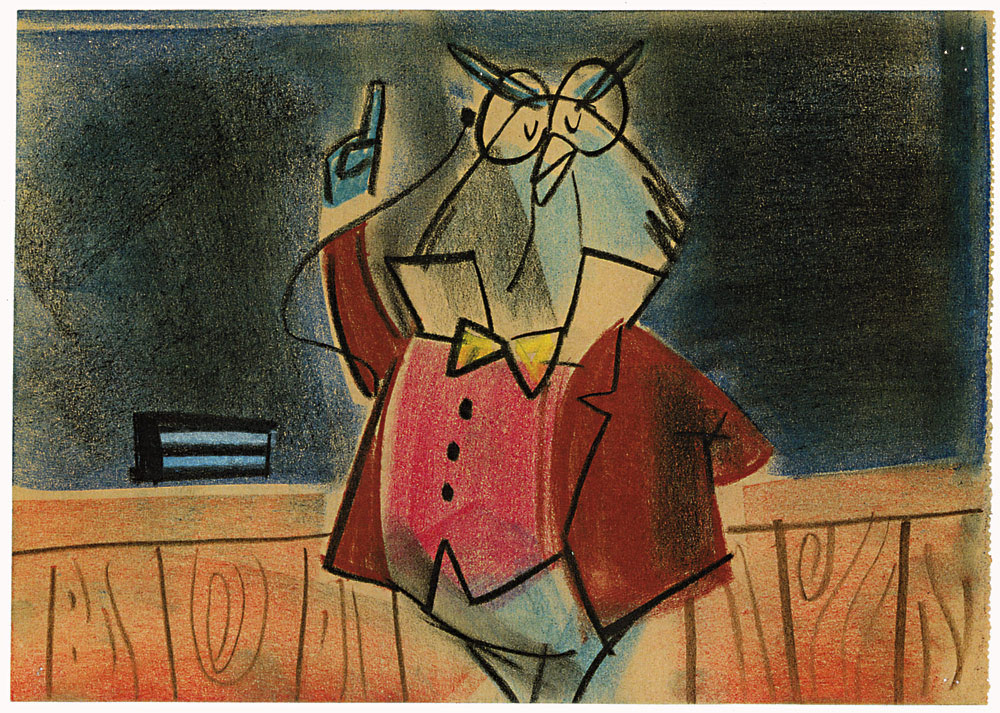
 Cartoon Brew's Amid Amidi has posted some great production artwork from Disney's Toot Whistle Plunk and Boom on his Cartoon Modern blog. Great website (Brew), great blog, amazing book. Take a look if you haven't already.
Sunday, January 07, 2007
Toot Whistle Plunk and Boom on Cartoon Modern
Cartoon Brew's Amid Amidi has posted some great production artwork from Disney's Toot Whistle Plunk and Boom on his Cartoon Modern blog. Great website (Brew), great blog, amazing book. Take a look if you haven't already.


What a Character! - Willie the Whale
 A series of posters highlight the queue area of Mickey’s PhilharMagic at the Magic Kingdom in Walt Disney World. Tying in to the music hall theme of the attraction, the posters take well-know Disney characters and feature them in faux promotional pieces for musical acts. The Three Little Pigs and Big Bad Wolf become the Wolf Gang Trio. Hercules’ villain Hades sings Torch Songs. Aladdin’s Genie sings the blues. The Little Mermaid and her sisters form Ariel’s Coral Group. And the Three Caballeros host the Festival de las Mariachas. But perhaps the most appropriate of the posters, befitting the attraction’s concert hall setting and use of “opera glasses,” would be the one that promotes I, Pagliacci, and features one of Disney’s more enormous stars, Willie the Whale.
Enormous in physical size, if not in star stature.
Willie the Whale made his one and only appearance (not counting House of Mouse cameos) in Disney’s 1946 animated feature Make Mine Music. He was the star of the film’s final segment, The Whale Who Wanted to Sing at the Met.
 The “package” films of the mid to late-1940s, Make Mine Music, Melody Time, Fun and Fancy Free, and The Adventures of Ichabod and Mr. Toad, are in many ways the forgotten children of Disney animated features. Many of the sequences contained in these films have faded from notice, while others have gained some degree of notoriety by being released individually, or by being incorporated into other programming. Such is the case with The Whale Who Wanted to Sing at the Met.
Make Mine Music has generally received mixed reviews over the years, by both mainstream critics and Disney historians alike. But one point of agreement among them all seems to be praise for the story of Willie the Whale. In his book The Disney Films, Leonard Maltin sums up the general consensus when he states, “It is pleasing that Make Mine Music ends on such a delightful note, for ‘The Whale Who Wanted to Sing at the Met’ is surely one of the film’s highlights, and tends to overshadow the film’s very definite weak sequences.”
 Make Mine Music identifies itself as a “Music Fantasy in Ten Parts.” Part Ten is Willie’s tale, and arrives under the heading of Opera Pathetique, the meaning of which becomes clear by the story’s end. Newspapers report of a mystery voice at sea, that is ultimately attributed to our hero Willie. Academics scoff, and one in particular, opera impresario Professor Tetti-Tatti, believes that Willie has swallowed an actual opera singer. He sets off to harpoon Willie, and rescue what he hopes will be his next great discovery.
Learning that Tetti-Tatti is searching for him, Willie prepares for an audition, not understanding the professor’s true intentions. He dreams of fame, and it is there where we see him performing various operas, most notably Pagliacci, as manifested in the PhilharMagic lobby poster. The final confrontation with Tetti-Tatti does not end in the usual Disney manner; suffice to say that Willie ultimately ends up performing to a sold-out “heavenly” audience.
The Whale Who Wanted to Sing at the Met is distinctly one of Disney’s standout achievements during the late 1940s, right down to its bittersweet ending. Most remarkable is the voice work of Nelson Eddy. As John Grant notes in his Encyclopedia of Walt Disney’s Animated Characters, Eddy is responsible for every word spoken or sung in the entire sequence, including a multi-track rendition involving a 400-member choir. There is also an inside joke involving Eddy--when Willie first appears in the short, he is singing “Shortnin’ Bread,” one of the singer’s popular hits.
 The short has some great details, especially the use of newspapers and media as narrative elements. Look close at one of the newspapers and you’ll see a smaller headline that reads, “OWNS SINGING SEAL CLAIMS ESKIMO.” The cover of Look Magazine is hilarious--Willie in the Princess role from Aida, which is not one the performances featured in the fantasy sequence.
The Whale Who Wanted to Sing at the Met can be seen on the DVD of Make Mine Music. One caution: the movie has been edited. While the Willie sequence is intact, the first part, The Martins and the Coys, fell victim to the PC knife when the film was released back in 2000.
Friday, January 05, 2007
Jack Hannah's Adventures in Four Color
 Disney Legend Jack Hannah is easily one of the veterans of the Disney Studio I admire most. He truly defined Donald Duck in the character's later animated years, and was key in the development of a wide variety of supporting characters, most notably mischievous chipmunks Chip ‘n Dale, and Brownstown Park residents Humphrey Bear and Ranger J. Audubon Woodlore, who all went on to become stars themselves. Today marks the 94th anniversary of Jack’s birth in 1913. In a post from last October, I commented on my two favorite Hannah shorts, Toy Tinkers and No Hunting.
Hannah’s contributions to Disney comics are not quite as well known as his film and television credits, but are notable nonetheless. His most famous effort in four color was his collaboration with Carl Barks on the artwork for the landmark 1942 Donald Duck Finds Pirate Gold. While Pirate Gold is most commonly identified with Barks, he and Hannah split the assignment 50/50. The pair worked from a script by Bob Karp, that was in turn based on storyboards for Morgan’s Ghost, a shelved feature that would have starred Mickey, Donald and Goofy.
 Hannah did a handful of other comic book assignments throughout the 1940s, two of the most notable being the cereal giveaways Donald Duck Pilots a Jet Plane and Donald Duck and the Pirates, the latter essentially being a remake to some extent of Pirate Gold.
Another remake of Pirate Gold reflected an interesting coincidence involving Hannah. The comic book Woody Woodpecker #76, published by Western Comics in 1962, derived a good portion of its story content from the original Pirate Gold. At that same time, Hannah was doing work on various theatrical cartoons at the woodpecker’s home, Walter Lantz Studios.
Wednesday, January 03, 2007
In the Traditon of Sacajewia and Susan B. . . .
 . . . comes the next wave of Disney Dollars. They will be arriving at the U.S. parks and Disney Stores on January 12.
 Sorry, but I just don't see Treasurer Scrooge McDuck going along with this whole Princess thing . . .
An Early EPCOT Character Connection
While the debate about characters in Epcot rages on, let’s go back about twenty years and remember when two of Disney’s biggest stars were featured in a small and unusual way in one of Future World’s original attractions. This comic book was a giveaway for a number of years in the mid-1980s to visitors to the Exxon-sponsored Universe of Energy. I picked up a copy at the Energy Exchange in Commnicore East in either 1987 or 1988. The copyright on the cover is 1985.
Mickey is a regular scientific genius in the story, as he gives Goofy an education in energy.
He spouts lines like “The sediment continues to decompose and the hydrogen and carbon combined chemically to form hydrocarbon compounds,” and even addresses relevant political issues when saying “Sometimes we can’t depend on other countries. Since 1973, our foreign oil supply has been cut off twice!”
Here are the activity pages from the comic’s inside front and back covers. Enjoy!


 This comic book was a giveaway for a number of years in the mid-1980s to visitors to the Exxon-sponsored Universe of Energy. I picked up a copy at the Energy Exchange in Commnicore East in either 1987 or 1988. The copyright on the cover is 1985.
Mickey is a regular scientific genius in the story, as he gives Goofy an education in energy.
He spouts lines like “The sediment continues to decompose and the hydrogen and carbon combined chemically to form hydrocarbon compounds,” and even addresses relevant political issues when saying “Sometimes we can’t depend on other countries. Since 1973, our foreign oil supply has been cut off twice!”
Here are the activity pages from the comic’s inside front and back covers. Enjoy!


Tuesday, January 02, 2007
GAF Photo Tips - 1972

In 1972, during Walt Disney World’s first year of operation, GAF was the official film of the Vacation Kingdom. They also sponsored the handy information guide given to guests. The centerpiece of the guide was a four page spread of GAF Photo Tips. Here are words of shutterbug wisdom every bit as valuable in today’s digital camera age, as they were over thirty-five years ago. My favorite: Some pictures don’t need the family. (In other words--quit blocking the submarine!) Click on the images for enlarged versions.

 Long before the advent of camcorders, home movie buffs were given these pointers:
Wind motor after each scene. This way you’ll never “run out of gas” in the middle of exciting action.
Important! . . .Don’t try to film the entire Jungle Cruise, for example, on a few seconds of film. Remember that a minimum of five full seconds is normally required for any movie scene to be enjoyed and understood.
Under the heading An Important Word About Flashbulbs is some information worthy of Lou Mongello’s next Walt Disney World Trivia book:
Don’t try to illuminate subjects or anything further than 12 feet away. Large or distant objects at night must be shot with time exposure. A flash picture of Cinderella Castle would require more than 100,000 flashbulbs!
The rest of the Information Guide is a great snapshot (sorry) of Walt Disney World shortly after its opening. I’ll share some of its other highlights in an upcoming post.
The Worm Turns - January 2, 1937
 Released on this day in 1937, the Mickey Mouse short The Worm Turns is an exercise in clever cartoon action and gags, gorgeous watercolor backgrounds and brilliant Technicolor. Made in the late 1930s days of the Hyperion Avenue studio, it is a shining example of the outstanding art direction that was a hallmark of much of Disney’s output at that time.
Had Universal’s classic Frankenstein movies been made in Technicolor, the opening sequence from The Worm Turns might give you an idea of how they would have looked. Director Ben Sharpsteen and his crew are clearly paying homage to the good doctor when Mickey, in his white lab coat and red shiny rubber gloves, mixes a vibrant and excitable batch of chemicals.
 The object of Mickey’s experimenting is to concoct a bravery potion. The ingredients he mixes together are beautifully staged via two wonderful background paintings:
 The details are terrific. For example, the recipe for the Courage Builder is quite detailed, and comes from and old bound tome entitled Ancient formulae.
As the cartoon progresses, Mickey takes on more of a supporting role as he tests his courage-inducing potion on a fly, mouse, cat, and ultimately Pluto. Showdowns build one upon another, leading up to Pluto’s confrontation with a shotgun wielding dogcatcher, played to villainous extreme by Pete.
There are so many standout moments in The Worm Turns; it is truly difficult to name them all. I particularly like the bird’s eye camera shot of Mickey about to dose the mouse:
 The clever gag of the cat’s nine lives exit, and then subsequent return, to their host. It is especially funny when Life #1 emerges, and then whistles for #2-9 to follow.
 There is also Pluto’s squash and stretch encounter with a brick wall. (Check the wonderful details--the NO PARKING crosswalk and the patched flat tire on Pete’s wagon.)
 And the neighborhood backdrop to the Pete-Pluto chase is beautiful:
 The film has one interesting continuity error. Near the beginning when Mickey removes a cork from a potion bottle with his mouth, it mysteriously disappears a few frames later.
The Worm Turns is among many other notable Disney shorts from the same time period, on the DVD set Mickey Mouse In Living Color Volume One.
A quick postscript: In my research, I was unable to track down any credits beyond director Ben Sharpsteen and animator Al Eugster. If anyone knows who was responsible for this short's amazing backgrounds, please put a post in the comments section. Thanks!
Monday, January 01, 2007
Mickey Mouse, Donald Duck and . . . Hank Porter?
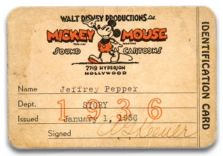
A very good friend presented me with a Christmas gift this holiday season, in what to me was an incredibly heartfelt and exceedingly generous gesture. For a period in the late 1930s, relatives of my friend collected celebrity autographs. They did this by mailing blank business cards, commonly called fan cards, to the various Hollywood studios, whose publicity departments would acquire the requested signatures, then return them, usually in a SASE.
As close as my friend can estimate, sometime in 1938 her aunt and uncle mailed a request for Walt Disney’s autograph to 2719 Hyperion Avenue. Not long after, the previously blank card came back to them. Here’s what they received:
 And it is this wonderful piece of Disneyana that she passed on to me.
What made this gift especially great was that I immediately knew there had to be a story behind it. Why? Because even though it was quite possible that Mickey and Donald both signed the card, it was fairly clear that Walt didn’t pen his name. Walt’s signature, while evolving somewhat over the years, was always very distinct and elaborate. This particular printed version had some of that flair, but most definitely came from another’s hand. My curiosity was immediately aroused; how did the studio handle these requests back then, and would it be possible to determine just who put ink (and marker) to the card?
To help answer these questions, I enlisted the aid of Jeff Kurtti who was quickly able to provide some answers. Jeff gave me the following information from Phil Sears Collectibles web site:
At least a dozen Disney Studio staff members signed Walt Disney's name to comics, fan items, promotional material, etc., over the years. The most common proxy signatures are by Hank Porter in the 1930's & 1940's, and Bob Moore beginning in the 1950's. Keep in mind that Walt NEVER drew a single Walt Disney newspaper comic or comic book, but every one of those was "signed" with a Walt Disney signature- by the artist, of course. Fortunately, Walt's own writing has distinct characteristics that distinguish it from these copies. Even so, autograph "experts" have written books in which they mis-identify Walt's autograph and those of his artists.
Jeff then gave me his assessment:
My guess is that your fan card is a Hank Porter, from the late 1930s.
Both David Lesjak and Didier Ghez have profiled Porter on their blogs, providing the following information:
Porter was a really interesting guy, and a wonderful artist. Porter was a staff artist of the Publicity Art Department from 1936 to 1950. He is the artist of the Sunday pages with the movie characters 'Snow White and the Seven Dwarfs' and 'Pinocchio'. 'Snow White and the Seven Dwarfs' appeared in the Sunday pages of the American newspapers from 12 December 1937 to 24 April 1938. Note that the actual movie wasn't released until 27 December, so the comic began its run prior to the film's release. His 'Pinocchio' Sunday ran from December 1939 to April 1940. The adaptations were written by Merrill De Maris and inked by Bob Grant. Porter also did several covers and illustrations for Mickey Mouse Magazine and Dell's Walt Disney's Comics and Stories. Walt also had Porter head up the World War II insignia unit, where in addition to supervising (and in many cases drawing) the more that a thousand insignia created by Disney, he also did a ton of other specialty drawing focused on the war effort.
Porter loved to play the piano and being left-handed, was quite an accomplished player. His favorite piano arrangement was Rhapsody in Blue. At one point in time Porter was invited to become a member of The Firehouse Five Plus Two, a Dixieland jazz band, which consisted of fellow Disney artists Danny Alguire, Harper Goff, Ward Kimball, Clarke Mallery, Monte Mountjoy, Ed Penner and Frank Thomas. Other Disney artists who also played with the band included George Probert, George Bruns, Ralph Ball and Dick Roberts. The band recorded some 13 albums beginning in 1955 and ending in 1970. For some unknown reason, Porter declined the offer to join the band.
 I had previously read about Porter in the book Disney Dons Dogtags, that spoke to his work on the studio’s insignia unit, but was not familiar with the other information about him that Jeff provided. It was a real delight to learn about one of the studio’s very talented, but largely uncelebrated artists. I did some additional digging and found that Porter was, along with Tom Wood, responsible for the artwork from the Walt Disney pages featured in Good Housekeeping from 1934-1944. Their work there has recently been collected in a wonderful book, Walt Disney’s Mickey and the Gang, published by Gemstone Publishing.
Thanks to Jeff Kurtti for taking time to help with this.
And very special thanks to my friend Betsy for her generous gift. She gave me something that came directly from 2719 Hyperion Avenue, and that means a lot to me for very obvious reasons.
As close as my friend can estimate, sometime in 1938 her aunt and uncle mailed a request for Walt Disney’s autograph to 2719 Hyperion Avenue. Not long after, the previously blank card came back to them. Here’s what they received:
 And it is this wonderful piece of Disneyana that she passed on to me.
What made this gift especially great was that I immediately knew there had to be a story behind it. Why? Because even though it was quite possible that Mickey and Donald both signed the card, it was fairly clear that Walt didn’t pen his name. Walt’s signature, while evolving somewhat over the years, was always very distinct and elaborate. This particular printed version had some of that flair, but most definitely came from another’s hand. My curiosity was immediately aroused; how did the studio handle these requests back then, and would it be possible to determine just who put ink (and marker) to the card?
To help answer these questions, I enlisted the aid of Jeff Kurtti who was quickly able to provide some answers. Jeff gave me the following information from Phil Sears Collectibles web site:
At least a dozen Disney Studio staff members signed Walt Disney's name to comics, fan items, promotional material, etc., over the years. The most common proxy signatures are by Hank Porter in the 1930's & 1940's, and Bob Moore beginning in the 1950's. Keep in mind that Walt NEVER drew a single Walt Disney newspaper comic or comic book, but every one of those was "signed" with a Walt Disney signature- by the artist, of course. Fortunately, Walt's own writing has distinct characteristics that distinguish it from these copies. Even so, autograph "experts" have written books in which they mis-identify Walt's autograph and those of his artists.
Jeff then gave me his assessment:
My guess is that your fan card is a Hank Porter, from the late 1930s.
Both David Lesjak and Didier Ghez have profiled Porter on their blogs, providing the following information:
Porter was a really interesting guy, and a wonderful artist. Porter was a staff artist of the Publicity Art Department from 1936 to 1950. He is the artist of the Sunday pages with the movie characters 'Snow White and the Seven Dwarfs' and 'Pinocchio'. 'Snow White and the Seven Dwarfs' appeared in the Sunday pages of the American newspapers from 12 December 1937 to 24 April 1938. Note that the actual movie wasn't released until 27 December, so the comic began its run prior to the film's release. His 'Pinocchio' Sunday ran from December 1939 to April 1940. The adaptations were written by Merrill De Maris and inked by Bob Grant. Porter also did several covers and illustrations for Mickey Mouse Magazine and Dell's Walt Disney's Comics and Stories. Walt also had Porter head up the World War II insignia unit, where in addition to supervising (and in many cases drawing) the more that a thousand insignia created by Disney, he also did a ton of other specialty drawing focused on the war effort.
Porter loved to play the piano and being left-handed, was quite an accomplished player. His favorite piano arrangement was Rhapsody in Blue. At one point in time Porter was invited to become a member of The Firehouse Five Plus Two, a Dixieland jazz band, which consisted of fellow Disney artists Danny Alguire, Harper Goff, Ward Kimball, Clarke Mallery, Monte Mountjoy, Ed Penner and Frank Thomas. Other Disney artists who also played with the band included George Probert, George Bruns, Ralph Ball and Dick Roberts. The band recorded some 13 albums beginning in 1955 and ending in 1970. For some unknown reason, Porter declined the offer to join the band.
 I had previously read about Porter in the book Disney Dons Dogtags, that spoke to his work on the studio’s insignia unit, but was not familiar with the other information about him that Jeff provided. It was a real delight to learn about one of the studio’s very talented, but largely uncelebrated artists. I did some additional digging and found that Porter was, along with Tom Wood, responsible for the artwork from the Walt Disney pages featured in Good Housekeeping from 1934-1944. Their work there has recently been collected in a wonderful book, Walt Disney’s Mickey and the Gang, published by Gemstone Publishing.
Thanks to Jeff Kurtti for taking time to help with this.
And very special thanks to my friend Betsy for her generous gift. She gave me something that came directly from 2719 Hyperion Avenue, and that means a lot to me for very obvious reasons.
Saturday, December 30, 2006
Snapshot! - Coral Caves Beach
 The queue area for The Seas With Nemo and Friends at Epcot is one of the real highlights of the attraction. The center sign identifies the area as Coral Caves Beach. Most of the key characters and settings from Finding Nemo are represented in some way on the surrounding signs.
Friday, December 29, 2006
Freeze Frame Followup: Fiddlesticks
My recent post about Mickey’s blink-and-you’ll-miss-him cameo in the Fleischer cartoon Bimbo’s Initiation, served to bring attention to Fiddlesticks, Ub Iwerk’s first solo effort after leaving the Disney Studio back in 1930 (thanks to Peter on our comments page, who directed us to where the short is posted on YouTube).
 Some time back, Image Entertainment released two volumes of the early Iwerks cartoons. The 58 shorts included are in pristine condition, taken from original negatives. Fiddlesticks is on the first volume, and they make mention of the “Mickey appearance” in the liner notes. I own both these volumes and they are a definite must-have. They are also currently a steal on Amazon at a mere $9.99 each.
Leonard Maltin had this to say about the Mickey clone in Fiddlesticks in his animation history bible Of Mice and Magic:
Flip doesn't speak in FIDDLESTICKS, his first film; he dances on stage for the other forest animals and provides piano accompaniment for a mouse who plays the violin. This mouse bears a definite resemblance to Mickey, particularly with his white shorts and gloves, but the face is less rounded, and the addition of whiskers obscures any direct plagiarism.
I agree with Leonard that it’s the shorts and gloves that bring to mind Mickey. The mouse itself seems to be more directly related to the “stock mice” that appeared in Disney’s silent efforts, most noticeably the Alice comedies.
An interesting side note about Fiddlesticks--it employed a two-color Technicolor process two years ahead of Disney's first color effort.
 Some time back, Image Entertainment released two volumes of the early Iwerks cartoons. The 58 shorts included are in pristine condition, taken from original negatives. Fiddlesticks is on the first volume, and they make mention of the “Mickey appearance” in the liner notes. I own both these volumes and they are a definite must-have. They are also currently a steal on Amazon at a mere $9.99 each.
Leonard Maltin had this to say about the Mickey clone in Fiddlesticks in his animation history bible Of Mice and Magic:
Flip doesn't speak in FIDDLESTICKS, his first film; he dances on stage for the other forest animals and provides piano accompaniment for a mouse who plays the violin. This mouse bears a definite resemblance to Mickey, particularly with his white shorts and gloves, but the face is less rounded, and the addition of whiskers obscures any direct plagiarism.
I agree with Leonard that it’s the shorts and gloves that bring to mind Mickey. The mouse itself seems to be more directly related to the “stock mice” that appeared in Disney’s silent efforts, most noticeably the Alice comedies.
An interesting side note about Fiddlesticks--it employed a two-color Technicolor process two years ahead of Disney's first color effort.
. . . with Walt Disney's magic touch
So as to not neglect the 1964-65 New York World’s Fair, here is some interesting material that especially features General Electric Progessland and its centerpiece attraction, the Carousel of Progress. These ads come from a Guide to the Fair that was a supplement to an issue of the then popular Look Magazine. (Click images for larger versions.)

 Here are the descriptions the same Guide provided for the Fair’s Disney-designed attractions:

 Here are the descriptions the same Guide provided for the Fair’s Disney-designed attractions:
GENERAL ELECTRIC, B12. From lightning flash to nuclear fusion —man's search for energy. You revolve around a six-section cir cular stage and see Disney's Carousel of Progress. Audio-animatronic "people" tell story of electricity's contribution to your living. Time Tube carries you to Corridor of Mirrors and viewing terrace to see lightning storm, flames shooting from sun. Look for: First public demonstration of nuclear fusion in giant domed theater; continuous shows.
PEPSI-COLA, B32. You cruise the world in a water-jet boat. Pepsi salutes UNICEF in Disney's It's a Small World. Audio-animatronic figures in native costumes sing and prance. Look for: Special UNICEF pavilion and garden Tower of Four Winds.
ILLINOIS, S9. Enjoy Great Moments With Mr. Lincoln. Disney's 10-minute presentation features audio-animatronic Lincoln figure that gestures, talks. Look for: Library of famous Lincoln manuscripts and portraits.
FORD, TI. From the caveman of yesterday to the city dweller oftomorrow. You ride in a Ford convertible through time on Disney's Magic Skyway. See and hear prehistoric animals move around, battle; cavemen create fire, invent wheel. Then, 30 feet above City of Tomorrow, on highway in the sky, you are surrounded by strange spacecraft, see glass buildings. Look for: Futur istic Ford cars—Allegro, Cougar II, Mustang II.
Some More Words of Thanks . . .
Some words of thanks to send out today--
Jenny Lerew mentioned 2719 Hyperion on her wonderful blog The Blackwing Diaries, and said some very nice things about us. Thanks, Jenny!
Chris Foxx also mentioned us on her blog Passport to Dreams Old and New. Chris sent a very nice email that was much appreciated.
John Frost over at the Disney Blog has always been very supportive, and he took it one step further by naming 2719 Hyperion one of top ten Disney blogs of 2006. We can only hope to continue to live up to the honor. Thanks so much John!
Jenny Lerew mentioned 2719 Hyperion on her wonderful blog The Blackwing Diaries, and said some very nice things about us. Thanks, Jenny!
Chris Foxx also mentioned us on her blog Passport to Dreams Old and New. Chris sent a very nice email that was much appreciated.
John Frost over at the Disney Blog has always been very supportive, and he took it one step further by naming 2719 Hyperion one of top ten Disney blogs of 2006. We can only hope to continue to live up to the honor. Thanks so much John!
Thursday, December 28, 2006
Mickey and Donald in Buckskin
 While I had out my copy of Mickey Mouse in Frontierland for yesterday's Li'l Davy post, I thought I'd do a scan of the issue's really terrific back cover. Some really great artwork was done for the back covers of the Disney Dell Giants, and I really enjoyed this one in particular. It was at the height of the Davy Crockett craze, and no doubt countless adults across America could relate to Mickey's and Donald's exasperation.
Wednesday, December 27, 2006
What a Character! - Li'l Davy
While the television show Muppet Babies is largely credited for inspiring the reverse-aging of popular cartoon brands that seemed to dominate children’s programming for much of the 1980s and early 1990s, it was not the first franchise to have its characters drink from the fountain of youth. As far back as 1956, Archie Comics spawned Little Archie, featuring pint-sized versions of its teenage cast. But Disney trumped even Archie in this matter when it debuted a character in 1955, who was a youthful version of the Disneyland television program’s then most popular star.
 Li’l Davy, however, did not survive long beyond the craze that inspired him.
Davy Crockett-mania swept the nation back in the mid-1950s. Disney premiered the adventures of the frontier hero on its ABC television program in December of 1954, and soon after, just about every child in America was sporting a coonskin cap and carrying a toy replica of Crockett’s famous “old Betsy” rifle.
Comic strip creators Bill Walsh and Floyd Gottfredson jumped on the Crockett bandwagon on June 27, 1955 when they introduced the character of Li’l Davy in that day’s Mickey Mouse newspaper comic. Davy went on to make just over twenty more appearances in Mickey’s daily strip through February of the following year. Joining Davy throughout the run was a buckskinned Jiminy Cricket, who had been appropriately renamed Jiminy Crockett.
 Li’l Davy jumped over into regular comic books in spring of 1956 when he appeared in the Dell Giant Mickey Mouse in Frontierland. He costarred with Little Hiawatha, the popular character from the 1937 Silly Symphony, who had been a staple of Disney comics since the late 1930s. In the story, Davy helps Hiawatha and his sister Sunflower rid their village of a troublesome moose, thanks to Davy’s bravado-inspired pratfalls and strangely enough, some ragweed pollen. The story features some terrific art by Disney Studio vet and longtime comic book talent Al Hubbard.
Li’l Davy was featured in seven more Dell Disney comics before disappearing completely from Amercian comics following his appearance in the Dell Giant Daisy Duck and Uncle Scrooge Showboat in 1961. He costarred in those issues with the likes of Mickey, Goofy, Pete and the aforementioned Hiawatha cast. According to the online Disney comics index INDUCKS, he later appeared overseas in an Italian Mickey Mouse comic in 1964, then oddly, much later in a Brazilian comic in 1981, and then again in an Italian publication in 1990.
Purposely cute and full of bluster, Li’l Davy was an entertaining, albeit short-lived member of Disney’s character canon. Though unknown to most folks today, he is still a fun reminder of 1950s era fads and the subsequent popular culture they created.
 Li’l Davy, however, did not survive long beyond the craze that inspired him.
Davy Crockett-mania swept the nation back in the mid-1950s. Disney premiered the adventures of the frontier hero on its ABC television program in December of 1954, and soon after, just about every child in America was sporting a coonskin cap and carrying a toy replica of Crockett’s famous “old Betsy” rifle.
Comic strip creators Bill Walsh and Floyd Gottfredson jumped on the Crockett bandwagon on June 27, 1955 when they introduced the character of Li’l Davy in that day’s Mickey Mouse newspaper comic. Davy went on to make just over twenty more appearances in Mickey’s daily strip through February of the following year. Joining Davy throughout the run was a buckskinned Jiminy Cricket, who had been appropriately renamed Jiminy Crockett.
 Li’l Davy jumped over into regular comic books in spring of 1956 when he appeared in the Dell Giant Mickey Mouse in Frontierland. He costarred with Little Hiawatha, the popular character from the 1937 Silly Symphony, who had been a staple of Disney comics since the late 1930s. In the story, Davy helps Hiawatha and his sister Sunflower rid their village of a troublesome moose, thanks to Davy’s bravado-inspired pratfalls and strangely enough, some ragweed pollen. The story features some terrific art by Disney Studio vet and longtime comic book talent Al Hubbard.
Li’l Davy was featured in seven more Dell Disney comics before disappearing completely from Amercian comics following his appearance in the Dell Giant Daisy Duck and Uncle Scrooge Showboat in 1961. He costarred in those issues with the likes of Mickey, Goofy, Pete and the aforementioned Hiawatha cast. According to the online Disney comics index INDUCKS, he later appeared overseas in an Italian Mickey Mouse comic in 1964, then oddly, much later in a Brazilian comic in 1981, and then again in an Italian publication in 1990.
Purposely cute and full of bluster, Li’l Davy was an entertaining, albeit short-lived member of Disney’s character canon. Though unknown to most folks today, he is still a fun reminder of 1950s era fads and the subsequent popular culture they created.
Tuesday, December 26, 2006
Freeze Frame: Bimbo's Initiation
 Bimbo’s Initiation, released in 1931, is considered by numerous animation historians to be among the best shorts produced by the Fleischer Studio. It ranked 37 in Jerry Beck’s 1994 book The 50 Greatest Cartoons as Selected by 1,000 Animation Professionals. Beck provided this synopsis of the cartoon’s story:
It's a strange cartoon. Bimbo falls down a man hole—smack into a surreal fraternity of characters with melted candles on their heads and two-by fours behind their backs. "Wanna be a member?" they ask again and again, and each time Bimbo says no and suffers for it. Bimbo finally meets Betty Boop, who performs an erotic dance and asks him the usual question. Not surprisingly, Bimbo finally says yes.
By now you are probably scrolling up to see if this is still 2719 Hyperion, the blog that addresses Disney entertainment. Yes, it’s still us. So, what exactly are we doing talking about a Fleischer cartoon?
Well, in the opening seconds of Bimbo’s Initiation, the title character inadvertently falls into a manhole as Mr. Beck describes above.
 After the manhole cover closes back over, an extremely fast-moving character mischievously secures it with a comically oversize lock. Just who is this mysterious prankster? Take a look:
 Yes, it seems that while Mickey was outshining the competition at the box office in the early 1930s, he still found time to sneak into at least one non-Disney produced cartoon and cause trouble. A clever, and for the most part unnoticed gag on the part of Dave Fleischer and his crew.
EPCOT 1939 - Part Eight: A Slightly Smaller Universe of Energy
We're a few weeks overdue, so what do you say we jump in our time machine and venture back to that particular World’s Fair we’ve come to call EPCOT 1939.
The universe of energy was a much smaller entity in 1939. While automobile manufacturers were represented in three major pavilions and dominated the 1939 New York World's Fair transportation zone, oil companies were consolidated to the Petroleum Industry Exhibition and relegated to one building in the Production and Distribution Zone.
 Sponsored by eighteen different companies, the Petroleum Exhibit was a generally modest endeavor compared to many of the Fair’s other attractions. The official Guide Book of the New York World’s Fair reflected the exhibit’s lack of flair with the following fairly brief and uninspired description:
Plainly land marked by a towering oil derrick in actual operation, the Building (Voorhees. Walker. Foley & Smith, architects; Gilbert Rohde, designer) fronts on the Avenue of Pioneers. Shaped like an equilateral triangle, the structure rests on four huge oil tanks, its metal walls rising in flaring tiers. Four large murals by William T. Schwarz decorate the inner walls of the Great Hall of Industry, each depicting respectively one phase in the story of Petroleum — Production, Transportation. Research and Refining. Here on a mam moth stage a motion picture in technicolor, its actors three-dimensional puppets, portrays the importance of petroleum in man's daily life. The Petroleum Garden on the roof is featured by an animated map on which miniature oil derricks depict the growth of oil production since 1860. A model of an oil refinery demonstrates the most up-to-date refining methods. Sponsored by fourteen major oil companies, the Exhibit shows how the industry has made possible and contributed to the advance of civilization during the past 80 years.
 The subject of energy was pretty much as dry then as it was at EPCOT Center in 1982, and a certain amount of window dressing was required for both to create interesting and entertaining presentations. At EPCOT, animatronic dinosaurs, sprawling theater cars and snappy songs generally countered the Universe of Energy pavilion’s mostly low key films and Exxon sponsored public relations. Lacking the sophistication and flare of late 20th century technology, the Petroleum Exhibit had to settle for a motion picture called Pete Roleum and his Cousins. And what an incredibly weird bunch of characters they were.
Animated oil droplets tell the story of petroleum production in a disjointed and often extremely strange series of vignettes, ending with a chorus line musical number that is both bizarre and more or less incomprehensible. This is partly due to the fact that a person at the exhibit interacted with the film's narrator, and those scripted lines are absent from the film.
 What makes Pete Roleum somewhat notable is that the stop-motion puppetry was created by silent filmmaker Charles Bowers. Bowers, largely unknown today, was a pioneer in stop-motion special effects photography during the mid to late 1920s. He was famous at the time for two reel features that incorporated his innovative special effects with the typical slapstick antics that hallmarked the comedies of the day. He faded from the movie business in 1930, only to resurface nearly a decade later, assisting director Joseph Losey in the making of Pete Roleum. Bowers also provided the film’s narration.
It was an odd way of promoting the virtues of energy production back in 1939. But then, here it is the 21st century, and Epcot’s presentation of energy innovations is communicated via the combination of a sitcom star, a kids’ TV program host, and a popular game show. Maybe Pete Roleum and his Cousins weren’t all that strange after all.
The universe of energy was a much smaller entity in 1939. While automobile manufacturers were represented in three major pavilions and dominated the 1939 New York World's Fair transportation zone, oil companies were consolidated to the Petroleum Industry Exhibition and relegated to one building in the Production and Distribution Zone.
 Sponsored by eighteen different companies, the Petroleum Exhibit was a generally modest endeavor compared to many of the Fair’s other attractions. The official Guide Book of the New York World’s Fair reflected the exhibit’s lack of flair with the following fairly brief and uninspired description:
Plainly land marked by a towering oil derrick in actual operation, the Building (Voorhees. Walker. Foley & Smith, architects; Gilbert Rohde, designer) fronts on the Avenue of Pioneers. Shaped like an equilateral triangle, the structure rests on four huge oil tanks, its metal walls rising in flaring tiers. Four large murals by William T. Schwarz decorate the inner walls of the Great Hall of Industry, each depicting respectively one phase in the story of Petroleum — Production, Transportation. Research and Refining. Here on a mam moth stage a motion picture in technicolor, its actors three-dimensional puppets, portrays the importance of petroleum in man's daily life. The Petroleum Garden on the roof is featured by an animated map on which miniature oil derricks depict the growth of oil production since 1860. A model of an oil refinery demonstrates the most up-to-date refining methods. Sponsored by fourteen major oil companies, the Exhibit shows how the industry has made possible and contributed to the advance of civilization during the past 80 years.
 The subject of energy was pretty much as dry then as it was at EPCOT Center in 1982, and a certain amount of window dressing was required for both to create interesting and entertaining presentations. At EPCOT, animatronic dinosaurs, sprawling theater cars and snappy songs generally countered the Universe of Energy pavilion’s mostly low key films and Exxon sponsored public relations. Lacking the sophistication and flare of late 20th century technology, the Petroleum Exhibit had to settle for a motion picture called Pete Roleum and his Cousins. And what an incredibly weird bunch of characters they were.
Animated oil droplets tell the story of petroleum production in a disjointed and often extremely strange series of vignettes, ending with a chorus line musical number that is both bizarre and more or less incomprehensible. This is partly due to the fact that a person at the exhibit interacted with the film's narrator, and those scripted lines are absent from the film.
 What makes Pete Roleum somewhat notable is that the stop-motion puppetry was created by silent filmmaker Charles Bowers. Bowers, largely unknown today, was a pioneer in stop-motion special effects photography during the mid to late 1920s. He was famous at the time for two reel features that incorporated his innovative special effects with the typical slapstick antics that hallmarked the comedies of the day. He faded from the movie business in 1930, only to resurface nearly a decade later, assisting director Joseph Losey in the making of Pete Roleum. Bowers also provided the film’s narration.
It was an odd way of promoting the virtues of energy production back in 1939. But then, here it is the 21st century, and Epcot’s presentation of energy innovations is communicated via the combination of a sitcom star, a kids’ TV program host, and a popular game show. Maybe Pete Roleum and his Cousins weren’t all that strange after all.
"He's Aimed and Ready for Action!"
 Both the interior and exterior queue areas for It's Tough to Be a Bug! at Disney's Animal Kingdom have some great posters. The interior posters are parodies of Broadway shows and are pretty difficult to photograph due to crowds and low lighting. The posters outside are easier to manage, and are a bit more stylized with their tree bark textures. The Termite-ator uses his own acid to identify himself. Note that the quote is from "Tim Burr" of the "Hollow Wood Reporter."
Sunday, December 24, 2006
The Disney Studios Christmas Cards: 1968
 Our series of Christmas cards from the Walt Disney Studios wraps up with this simple message from 1968. A very special thank you to all the readers of 2719 Hyperion for making us a part of your online Disney experience. May you all have a joyous and happy holiday season!
Saturday, December 23, 2006
The Disney Studios Christmas Cards: 1973
 The characters from the animated feature Robin Hood are featured on the Studio Christmas card from 1973. I especially like the wanted poster on the tree with Robin wearing a Santa hat.
Mother Goose Goes Hollywood - December 23, 1938
 Classic Disney animation enthusiasts received an early Christmas present this year with the release last week of More Silly Symphonies in the Disney Treasures DVD series. Especially pleasing was the inclusion of a complete and uncut Mother Goose Goes Hollywood, which was released on this day in 1938.
Close to half of this Silly Symphony has remained in the Disney vault for years, due to the extreme caricatures presented of African American entertainers Cab Calloway, Fats Waller and the long controversial Stepin Fetchit. Leonard Maltin is there with the standard Treasures’ introduction provided for shorts with potential content problems. He also provides an excellent audio commentary that identifies all the celebrities featured in the film. Blemishes and all, Mother Goose Goes Hollywood is a revealing window to the popular culture of the late 1930s, and many of the then popular stars of the golden age of Hollywood.
Some of the more well known stars featured in the poster are the Marx Brothers, W.C. Fields, Laurel and Hardy, Charles Laughton, Edward G. Robinson, ventriloquist dummy Charlie McCarthy and Katherinie Hepburn.